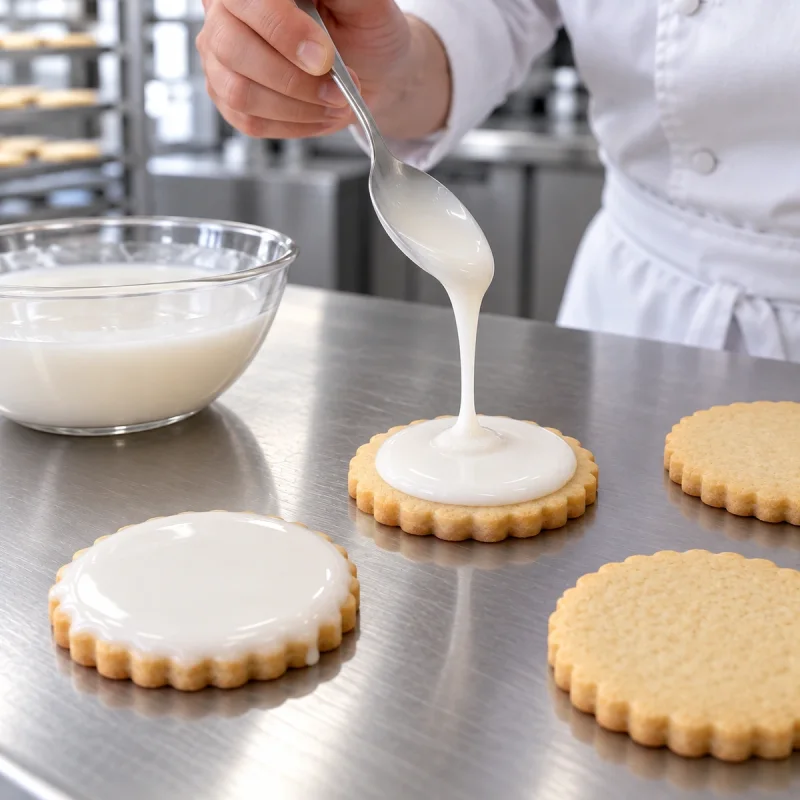
You can make cookie icing without egg whites with only powdered sugar and a small amount of water or lemon juice. A reliable starting point is 200 g very fine powdered sugar (icing sugar) and about 25 g liquid. From there, adjust the consistency in 1–2 g increments.
This is not royal icing. That distinction matters.
Royal icing gets part of its structure from egg white or an egg-white preparation such as meringue powder. A simple egg-free sugar icing sets mainly as moisture leaves the thin coating and the sugar phase becomes increasingly concentrated. It does not need prolonged whipping. It needs the right ratio.
If you want a smooth coating, clean lines, and a repeatable result, weigh the liquid as well as the sugar. With a small batch, “a spoonful or two” can be the difference between a controlled coating and a puddle around the edge of the cookie.
Basic egg-free cookie icing formula
For roughly 20–30 medium cookies, depending on their size and how thickly you apply the icing, use:
- 200 g very fine powdered sugar (icing sugar or confectioners’ sugar)
- 25 g water or lemon juice
- optional gel food coloring
Sift the powdered sugar first. Add about 20 g of the liquid and mix slowly with a spatula or spoon. Add the remaining liquid in small increments.
If the icing is still too thick, add 1 g liquid, mix, and check again. In a batch this small, a few grams can noticeably change how the icing flows.
Do not whip it with an electric mixer. This formula does not depend on building a foam. The goal is a smooth, even icing with as little trapped air as practical.
If you use lemon juice, the icing will taste noticeably sharper. Use water for a neutral flavor, or replace only part of the water with lemon juice for mild acidity.
What consistency should cookie icing have?
There is no single correct consistency. It depends on what you want the icing to do.
For coating the whole surface
The icing should be fluid enough to spread slowly across the cookie and to be guided toward the edge with a toothpick or the tip of a small spatula. It should not run over the edge by itself.
Lift a little icing and let it fall back into the bowl. The ribbon should remain visible for a few moments, then gradually blend into the surface.
For lines, dots, and simple writing
Use a slightly thicker icing. A piped line should remain in place instead of flattening immediately.
The easiest workflow is to make one thicker base first. Reserve part of it for piping, then thin the remainder gradually for coating or filling.
If the icing is too thick
The signs are straightforward:
- it is difficult to push through a small piping-bag opening;
- sharp ridges remain on the surface;
- the icing does not level on the cookie;
- spreading it pulls crumbs from the surface.
Add 1 g liquid, mix, and test again.
If the icing is too thin
You may notice that it:
- runs off the edge;
- becomes noticeably translucent;
- spreads piped lines;
- takes longer to dry;
- loses a clean decorative edge.
Correct it with sifted powdered sugar. Add a small amount at a time until the flow is controlled again.
Why does egg-free sugar icing harden?
Royal icing also relies on protein structure. In this egg-free icing, the mechanism is simpler.
Powdered sugar mixed with a small amount of water forms a highly concentrated sugar mixture. As water gradually leaves a thin coating during drying, the remaining sugar phase becomes more concentrated and the surface changes from fluid to a firm sugar layer.
Powdered sugar varies between brands in particle size and formulation, so weighing the liquid gives you a controlled starting point, but the final consistency should always be confirmed by how the icing behaves.
This is also why too much water creates problems. More water means more moisture must leave before the coating becomes firm, and an over-thinned icing produces a weaker, more translucent layer.
Cookie icing without egg whites vs royal icing
If you want a smooth white or colored coating, simple lines, dots, and basic decoration, this egg-free icing is a good fit.
If you need very firm outlines, structural details, or precision piping that must hold its shape at greater height, royal icing is usually the more appropriate technique.
| Feature | Cookie icing without egg whites | Royal icing |
|---|---|---|
| Base | powdered sugar + liquid | sugar + egg white or egg-white preparation |
| Mixing | gentle hand mixing | stable base preparation, then controlled thinning |
| Coating cookies | very suitable | very suitable |
| Simple lines | suitable | very suitable |
| Tall or structural details | limited | more suitable |
| Egg-free | yes, if all other ingredients are also egg-free | not in the traditional formula |
If egg allergy is the reason for choosing this formula, check the labels of the sugar, colors, flavorings, and any other additions, as well as cross-contact information.
Step-by-step method
1. Make sure the cookies are completely cool
Icing behaves less predictably on a warm cookie. The surface should also be flat and firm enough to decorate cleanly.
2. Sift the powdered sugar
Lumps are especially obvious in a thin icing, and they can block a small piping-bag opening.
3. Add most of the liquid, not all of it
For 200 g powdered sugar, begin with about 20 g liquid. Mix to a thick paste, then add the remainder in 1–2 g increments.
This is easier to control than trying to rescue an icing that has already been over-thinned with a large amount of extra sugar.
4. Let the icing rest briefly
A short rest gives the sugar time to hydrate evenly and allows some of the air introduced during mixing to rise toward the surface.
Stir slowly once more before using it.
5. Test one cookie first
Do not begin with the full batch.
Apply a small amount to one cookie. If it stays in a mound, it is too thick. If it runs over the edge, it is too thin. The correct coating consistency spreads in a controlled way and stops where you guide it.
6. Add color carefully
Gel colors are practical because a small amount usually changes the liquid balance less than a very fluid color.
If you use a larger amount of liquid coloring, count it as part of the total liquid and reduce the water if necessary.
How to get a smooth white surface
Four things matter most:
- very fine, sifted powdered sugar;
- an icing that is thick but still able to flow;
- a thin, even coating;
- undisturbed drying on a level surface.
After application, guide small imperfections with a toothpick or a fine professional decorating tool. If an air bubble appears, pop it while the surface is still wet.
Do not shake the cookie aggressively. That can push the icing over the edge or leave one side noticeably thicker than the other.
Drying: when are the cookies really ready?
The surface can feel dry before the icing is firm enough for stacking.
Drying depends on:
- coating thickness;
- the amount of water;
- room temperature;
- relative humidity;
- colors or other additions.
For that reason, do not treat one universal drying time as a guarantee. Before packaging, test one cookie. With a very light touch, the surface should not feel tacky or dent.
Dry the cookies in a dry room at a stable room temperature. Gentle air movement can help create a more even drying environment; avoid aggressive drying with direct high heat.
Why does the icing look translucent after drying?
The most common reason is that the icing was too thin or the applied layer was too light.
This is easy to see with white icing: the cookie color starts to show through the coating.
Use a slightly thicker icing next time. If the first coat is already completely dry, you can add a second very thin coat, although a single properly adjusted coat usually gives a cleaner result.
Why does the icing crack?
A thin simple sugar coating is naturally more brittle than royal icing. Cracks are more likely when:
- the layer is very thick;
- the cookie flexes during drying;
- the icing is applied to a warm or soft cookie;
- a dried cookie is handled roughly or stacked under pressure.
The goal is not the thickest possible white layer. It is an even layer that is thick enough to cover without becoming unnecessarily heavy.
Can I use only lemon juice?
Yes, but the flavor will be distinctly tart.
Use water for a more neutral result. For a light citrus note, replace only part of the water with lemon juice. Keep weighing the total liquid so you do not unintentionally change the basic ratio.
Can I color this icing?
Yes. A small amount of gel food coloring is the easiest option to control.
Bring the icing close to the final consistency first, then add the color. Check the consistency again after coloring, because even a small amount of extra liquid can change the flow.
Common problems and quick fixes
| Problem | Most likely cause | Fix |
|---|---|---|
| Icing runs off the edge | too much liquid | add sifted powdered sugar |
| Icing stays in a mound | too little liquid | add 1 g liquid |
| Surface dries translucent | icing too thin or coating too light | use a slightly thicker icing |
| Piped lines spread | mixture is too soft for piping | reserve a thicker portion before thinning |
| Surface stays tacky | high liquid level, heavy coating, or high humidity | use a slightly thicker batch next time and dry in a dry room |
| Visible lumps | unsifted sugar | sift the sugar before mixing |
| Many air bubbles | mixing too quickly | mix slowly and allow a short rest |
The shortest formula for a repeatable result
If you want the icing to behave the same way next time, record the actual mass of liquid you used.
Start with:
200 g powdered sugar + 25 g liquid
Then adjust in 1–2 g increments.
That is much more repeatable than relying on tablespoons, because a small volume change can have a surprisingly large effect in a small batch.
Cookie icing without egg whites works best when you ask it to do what it does well: create a smooth coating, simple decoration, and a clean sugar finish without eggs. For more structurally demanding decoration, keep the distinction clear and use royal icing instead.
Diagnostics
Common problems and solutions
The icing runs off the edge of the cookie.
Cause: The icing is too thin or the applied layer is too heavy.
Solution: Mix in a small amount of sifted powdered sugar and retest the flow on one cookie.
The icing will not level and leaves sharp ridges.
Cause: There is too little liquid, so the icing is too thick for coating.
Solution: Add 1 g water or lemon juice, mix slowly, and test again.
The icing looks translucent after drying.
Cause: The icing was too thin or the applied layer was too light.
Solution: Use a slightly thicker icing next time; add a second thin coat only after the first coat is completely dry.
The surface stays tacky or soft for a long time.
Cause: Too much liquid, an overly thick layer, or high humidity.
Solution: Leave the cookies longer in a dry room with gentle air movement; make the next batch slightly thicker.
The icing contains lumps or flows unevenly from the piping bag.
Cause: The powdered sugar was not sifted finely enough or the mixture is not homogeneous.
Solution: Mix gently; next time, sift the sugar thoroughly before adding liquid.