PEK Academy

Homemade Stock: How to Make It Clear, Rich and Flavorful

To make homemade stock, first choose the type, then simmer the ingredients gently only as long as that type needs. Skim as necessary and avoid aggressive stirring. Brown stock requires roasting first; light stock does not, while vegetable and fish stocks finish much sooner than bone stocks. Strain without pressing, cool quickly, and store at about 4°C/40°F or colder.

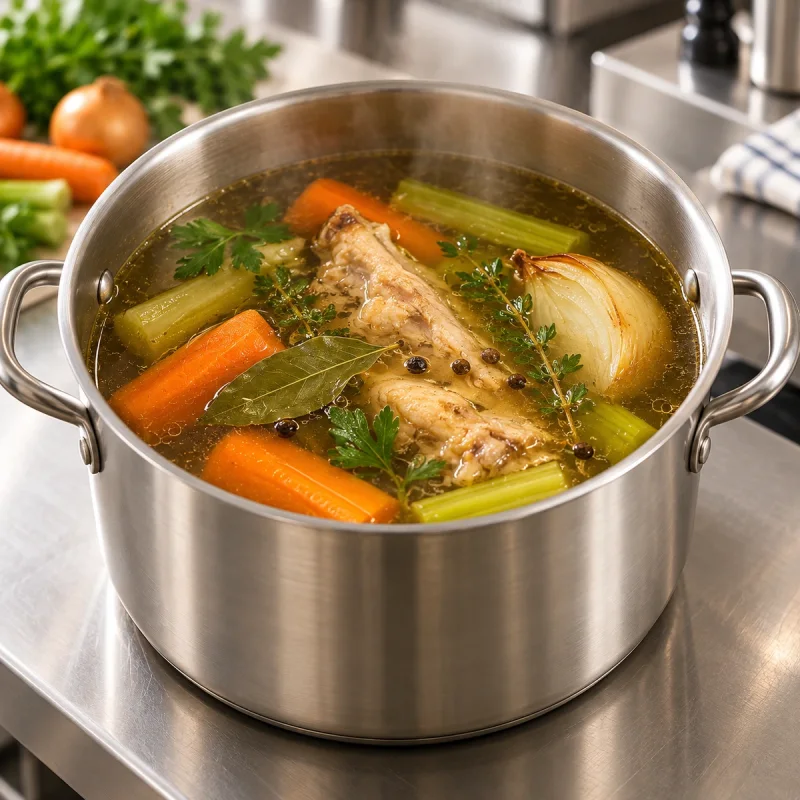
Clear homemade stock in a stainless-steel pot with vegetables and herbs in a professional kitchen

Homemade stock: how to get clear, rich flavor

Good homemade stock is not a heavily seasoned soup. It is a neutral, concentrated base that gives a dish body and depth without taking over its flavor. For a clear, versatile stock, the type of ingredients, a gentle simmer, careful skimming, and stopping at the right time matter more than simply keeping the pot on the stove for as long as possible.

For a light bone stock, start with bones or connective-tissue-rich pieces and cold water. Heat slowly, then reduce the heat to a bare simmer as the liquid approaches a boil. For brown stock, roast the bones and some of the aromatic vegetables first. Vegetable and fish stocks need much less time. When the flavor is ready, strain without pressing, cool quickly, and store cold.

Start by choosing the right type of stock

There is no single method that is best for every stock. First decide what you want the stock to do in the finished dish.

Type of stockWhat builds the flavorPractical time guideWhen to stop
Vegetableonion, carrot, celery, leek, mushrooms, herbsabout 45–60 minuteswhen the liquid is aromatic and the vegetables no longer taste fresh
Fish stock or fumetfish bones and trimmings, aromatic vegetablesabout 20–30 minuteswhen the flavor is clean and distinct; overcooking can quickly make it harsher
Light chicken or vealunroasted bones or connective-tissue-rich piecesseveral hours at a gentle simmerwhen the stock tastes full and noticeably gels after chilling
Brown bone stockwell-roasted bones and lightly browned aromatic vegetablesoften about 4–6 hourswhen flavor and color are developed without burnt or bitter notes

These are working ranges, not fixed recipe laws. Bone size, water-to-solids ratio, roasting intensity, and pot size all change the rate of extraction. With vegetable or fish stock, longer cooking is not a sign of higher quality.

Light or brown stock: the difference starts before the water

A light stock is designed for a clean, delicate flavor and lighter color. The bones are usually not roasted, and the vegetables are used without heavy browning. This is useful when the final soup or sauce should stay pale and subtle.

For a brown stock, roast the bones before simmering. Browning builds deeper roasted aromas and darker color. The aromatic vegetables can also be lightly browned, but they should never be charred. Burnt pieces do not create “more umami”; they add bitter, heavy flavors that are difficult to remove later.

The same basic rule applies to both: do not drown the ingredients in unnecessary water. Use enough to keep the bones and aromatics covered during extraction, then top up only as needed.

Mirepoix should support the stock, not dominate it

The classic aromatic base of onion, carrot, and celery is a starting point, not an absolute rule. Its job is to round out the flavor of the bones or main ingredient. Too much vegetable, or cooking it for too long, can make the stock overly sweet, vegetal, or cloudy.

Use herbs and spices with restraint. Bay leaf, thyme, parsley stems, and a few peppercorns should stay in the background. It is often best to salt stock very lightly or not at all until the final dish, especially if you plan to reduce it. A stock that tastes pleasantly salty in a large pot can become over-salted after reduction.

Why stock should only simmer gently

A rolling boil does not necessarily speed up the useful part of extraction. It churns fat and fine particles through the liquid, making the stock cloudier and the flavor less clean.

As the liquid approaches a boil, lower the heat. You want small, calm bubbles rather than constant rolling movement. During the early stage of cooking, skim foam and impurities that rise to the surface with a spoon or skimmer.

Avoid unnecessary stirring. For a clear stock, a properly adjusted pot that can be left mostly undisturbed is a better sign than constant activity.

Collagen, gelatin, and body

In bone stocks, body does not come from “boiled-out minerals.” It comes mainly from flavor compounds and gelatin formed from collagen in connective tissue. Joints, cartilage, necks, wings, and other connective-tissue-rich parts are especially useful for building body.

A well-made bone stock may look fairly fluid while hot, then softly set or gel after chilling. That is a practical sign of useful gelatin. It is not the goal for every stock: vegetable and fish stocks behave differently and should not be judged by the same standard.

Do not cook vegetable stock like bone stock

The biggest mistake with vegetable stock is assuming that several hours automatically mean more flavor. Aromatic compounds are extracted from cut vegetables much faster than gelatin is extracted from connective tissue.

For a fuller profile, briefly sauté or roast some of the vegetables before adding water. Mushrooms add pronounced umami, while tomato or a small amount of tomato paste can deepen color and flavor in a darker vegetable stock.

Use strongly flavored vegetables deliberately. Large amounts of brassicas, very bitter greens, or powerful spices can steer the stock toward one specific dish and make it less versatile.

Straining: do not press if you want a clean result

When the flavor is developed, remove the solids. For a clear stock, pass the liquid through a fine-mesh strainer. Do not force the cooked ingredients through the mesh, because that pushes fine particles back into the liquid.

If there is a lot of fat on the surface, you can skim some while the stock is hot. It is even easier after quick chilling: the fat solidifies on top and can be lifted off in a sheet. A little fat can carry flavor, so the goal is not necessarily completely “degreased water.”

The most important step after cooking is rapid cooling

A large pot of hot stock cools slowly, so do not leave it sitting on the counter for hours. Divide the stock into smaller or shallower containers, use an ice bath if needed, and get it into the refrigerator or freezer as quickly as practical.

A useful home-safety rule is to refrigerate cooked stock within about two hours, with the refrigerator at about 4°C/40°F or colder. Cooked soups and similar leftovers are generally kept for 3–4 days in the refrigerator; freeze them for longer storage.

Small portions are especially useful for freezing. A few tablespoons may be enough for sauces or deglazing, while risotto or soup needs larger containers. Label the stock type and date because frozen brown bone stock and vegetable stock can look surprisingly similar after a few weeks.

How to reheat stock safely

You do not reheat stock “to 150°C.” What matters is the temperature of the food itself, not an oven setting.

When reheating chilled stock as a leftover, heat it thoroughly. General food-safety guidance for leftovers uses about 74°C/165°F at the center; for soups and sauces, a practical approach is to bring them to a boil during reheating, then reduce the heat for further use.

If stock has been left at room temperature for several hours, boiling it hard later does not necessarily make it safe again. Some microorganisms can produce heat-stable toxins during improper storage, so timely cooling is more important than trying to “rescue” old stock with aggressive boiling.

How to recognize a well-made stock

Before putting the pot away, check the result:

  • aroma: clean and characteristic of the main ingredient, without burnt or stale notes;
  • flavor: full but not overly salty or heavily seasoned;
  • liquid: relatively clear for a light stock, darker for a brown stock without coarse cloudiness;
  • bone stock: often develops a soft gel after chilling;
  • vegetable stock: stays lighter and fresher, without a long bitter, overcooked finish.

If the flavor is too weak, it is often better to strain the stock and reduce the liquid in a controlled way than to keep cooking already-spent ingredients indefinitely.

Common problems and the right fix

ProblemLikely causeNext step
Stock is cloudyvigorous boiling, stirring, pressing solids through the strainernext time keep the simmer gentler and strain without pressing
Flavor is waterytoo much water or too little of the main ingredientreduce the strained liquid carefully
Flavor is bitterburnt ingredients or overcooked delicate vegetables/fishdo not try to fix a bitter batch by cooking longer; reduce roasting or extraction time next time
Stock becomes too salty after reductionsalting heavily before concentratingmake stock with little or no salt and season the final dish
Very fatty after chillingmany fatty parts, insufficient skimmingchill and lift off the solid fat layer
Suspicious smell after several daysstored too long or too warmdiscard it; do not taste it to test safety

One method worth remembering

For every type of stock, remember the same sequence: choose the main ingredient → decide on a light or brown profile → extract gently → skim as needed → stop at the right time → strain carefully → cool quickly → portion.

This gives you a stock that is neutral enough for soups, risotto, stews, and sauces while still providing more body and depth than water. For sauces, reduce the strained stock gradually so flavor concentration and salt stay under control.

Diagnostics

Common problems and solutions

The stock is cloudy.

Cause: The liquid boiled hard, was stirred frequently, or the cooked ingredients were pressed through the strainer.

Solution: Use the current batch where clarity is not important. Next time reduce the boil and stirring, and do not press the solids while straining.

The stock is watery and lacks body.

Cause: Too much water for the amount of main ingredients or too little extraction time.

Solution: Reduce the strained liquid in a controlled way; for bone stock, use more connective-tissue-rich parts next time.

The stock tastes bitter or overcooked.

Cause: Burnt ingredients or delicate vegetables or fish cooked for too long.

Solution: Do not try to fix a strongly bitter batch by cooking it longer. Reduce roasting intensity or extraction time next time.

The stock becomes too salty after reduction.

Cause: It was heavily salted before concentration.

Solution: If the flavor allows, dilute with unsalted stock or water; next time leave final seasoning for the finished dish.

A large pot cools very slowly after cooking.

Cause: Too much hot liquid in a deep container with limited cooling surface.

Solution: Divide into smaller or shallower containers, use an ice bath, then chill quickly.

Technical terms

Terms worth understanding

Mirepoix
The classic aromatic combination, mainly onion, carrot, and celery, used to support the flavor of stock.
Fond blanc
A classic light stock made without strongly roasting the bones first.
Fond brun
A classic brown stock in which bones and some aromatics are roasted before simmering.
Fumet
An aromatic stock, often fish-based, made with a relatively short extraction time.

Frequently asked questions

Answers to common questions

Does stock have to simmer for several hours?

No. Timing depends on the type. Vegetable stock is often ready in about an hour, fish fumet even sooner, while bone stocks need several hours. Overcooking delicate ingredients can make the flavor worse.

Why is my homemade stock cloudy?

Common causes are vigorous boiling, unnecessary stirring, and pressing cooked ingredients through the strainer. For a cleaner result, keep the liquid at a gentle simmer, skim as needed, and strain without pressing.

Do I have to roast bones before making stock?

Only if you want a brown stock with stronger roasted flavors and darker color. For light stock, the bones are usually not roasted.

When should I salt stock?

If it will be used as a versatile base or reduced later, salt very lightly or season only in the finished dish. Reduction concentrates salt as well as flavor.

How long can homemade stock stay in the refrigerator?

Under general guidance, cooked soups and similar leftovers kept at about 4°C/40°F or colder are usually stored for 3–4 days. Cool stock quickly after cooking and refrigerate it within about two hours.

Can I put hot stock in the refrigerator?

Yes, but divide a large pot into smaller or shallower containers so the liquid cools faster. An ice bath can help with larger quantities before refrigeration.