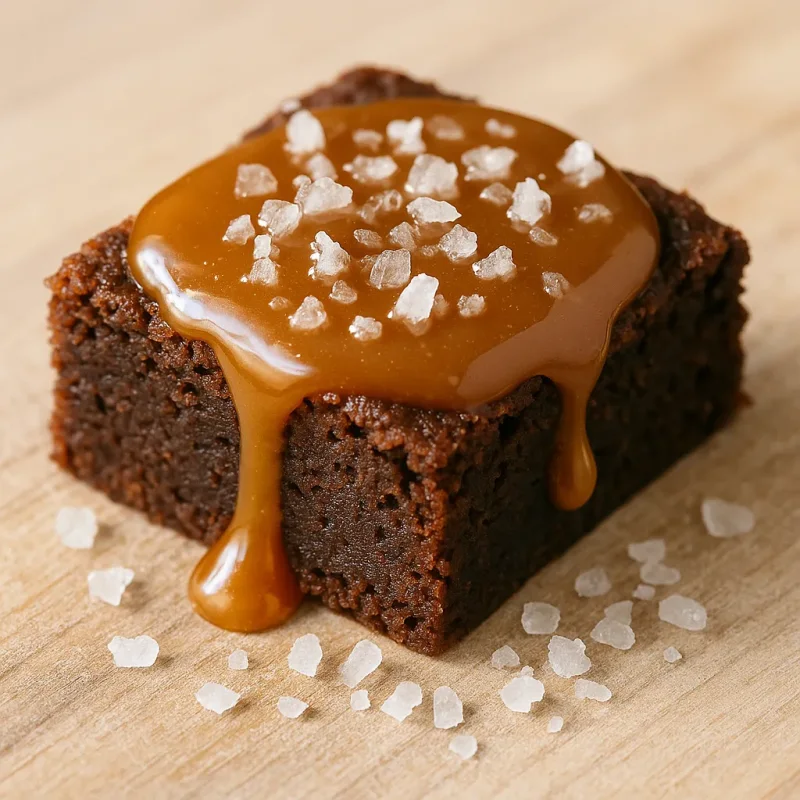
How much salt belongs in dessert?
Salt in dessert is not only about making food taste salty. In a small, accurately measured amount it can balance sweetness, reduce the dominance of some bitter sensations, and make cocoa, vanilla, butter, or caramel taste more defined.
For many sweet doughs and batters, about 0.5–1% salt relative to flour weight is a useful starting range. With 250 g flour, that is roughly 1.25–2.5 g. A tested recipe takes priority, especially when salted butter or other salty ingredients are present.
Fine salt or flaky salt
Use fine salt when you need even distribution through dough, batter, cream, ganache, or caramel. Use fleur de sel or larger flakes mainly as a finish for brief salty bursts and texture.
Why salt works with chocolate
Weigh salt in grams. A teaspoon of fine salt and a teaspoon of large flakes do not weigh the same. In chocolate desserts, sodium can suppress the perception of some bitter stimuli; the aim is a clearer cocoa profile, not a salty dessert.
Salt in caramel
In caramel, add salt gradually and account for salted butter. Never taste caramel straight from the hot pan; cool a small sample first. Add finishing flakes shortly before serving because they dissolve on moist surfaces.
Creams and fruit fillings
For creams, ganache, and fruit fillings, start lower and taste at serving temperature. A percentage based on flour is not useful when there is no flour.
Common mistakes
Common mistakes are swapping salts by volume, double-salting when salted ingredients are already present, and adding finishing flakes too early to a wet glaze.
Storage and shelf life
Normal pastry levels of salt are not a reliable preservation method. Shelf life depends on the whole formula, water activity, pH, hygiene, and storage temperature.
The PEK rule for repeatable results
PEK rule: record the salt type and weight in grams. Fine salt belongs in the mixture; flakes are a finishing tool. That makes the result repeatable.
Frequently asked questions
Answers to common questions
How much salt should I add to sweet dough or batter?
For many formulas, about 0.5–1% of flour weight is a useful starting range; with 250 g flour, about 1.25–2.5 g.
Why does salt improve chocolate flavor?
Sodium can suppress the perception of some bitter stimuli, allowing cocoa and other aromas to read more clearly.
What salt is best for salted caramel?
Fine salt for even dissolution; fleur de sel or flaky salt as a finishing texture.
Can I substitute fine salt and flaky salt in equal amounts?
Not reliably by volume. Weigh in grams because crystal size changes how much salt fits in a spoon.
When should I add salt to cookies or cake?
Disperse fine salt evenly with dry ingredients or an appropriate liquid phase; add finishing flakes after baking or near service.
Does salt make dessert last longer?
Do not rely on normal pastry levels of salt as a preservative. Shelf life depends on the complete formula and storage conditions.