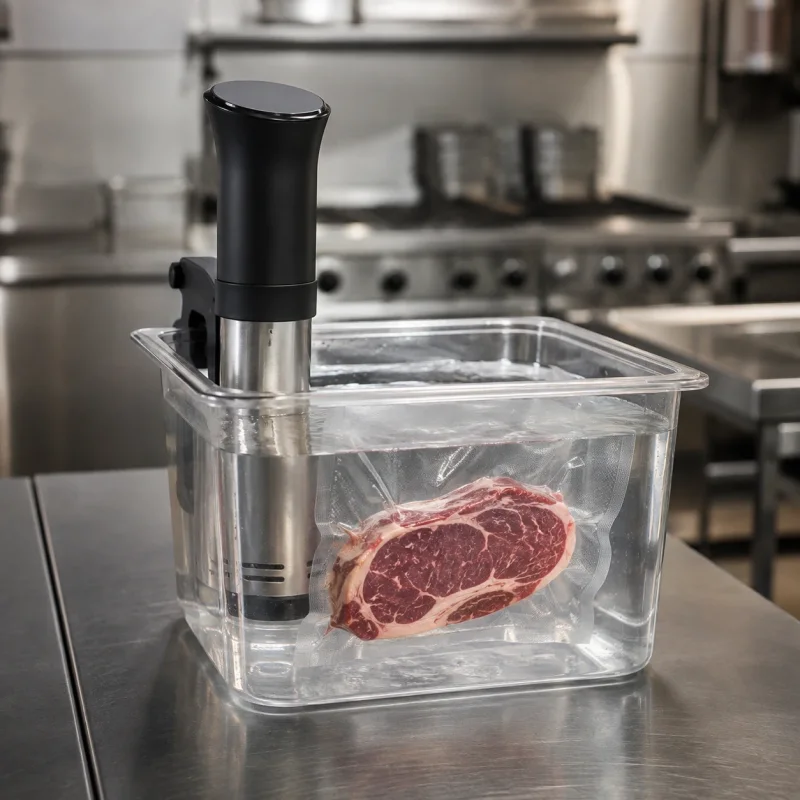
The most important idea in sous vide cooking is a simple distinction: the water-bath temperature primarily controls the final temperature and texture of the food, while food safety does not depend on a single number. Time, thickness, starting temperature, type of food and what happens after cooking all matter. A rule such as “cook chicken at one temperature for one fixed time” is therefore not a universal safety formula for every piece.
Sous vide is especially useful when you want a repeatable result with very little temperature difference between the edge and the centre. It is not a method where you can choose an arbitrarily low temperature, leave the food in the bath “long enough” and assume it is automatically safe.
What sous vide cooking is and why it cooks so evenly
Sous vide means cooking food in a sealed, heat-suitable bag immersed in a precisely controlled water bath. An immersion circulator usually heats the water and keeps it moving at the same time.
In a frying pan or a hot oven, the environment is far hotter than the desired centre temperature. The outside therefore heats faster and more aggressively. In sous vide, the bath is much closer to the intended final temperature of the food, so the whole piece approaches the target more gradually and evenly.
That greatly reduces the chance of a dry outer layer surrounding an underheated centre. It does not remove the effect of time: holding food too long can still alter texture even when the temperature never rises above the set point.
Four decisions to make before you start
A good sous vide result does not begin with “How many minutes?” It begins with four decisions.
1. What texture do you want? Target temperature affects protein setting, juiciness, tenderness and mouthfeel. With some foods, a difference of only a few degrees is noticeable.
2. How thick is the food? Thickness is often more important than total weight when heat must reach the centre. Two pieces of the same weight but different thickness may need very different heating times.
3. Are you aiming only for texture, or for a validated pasteurisation process as well? Food is not safe simply because its centre briefly reaches the chosen temperature. At lower cooking temperatures, safety depends on the combination of temperature and time for which the coldest part of the food is actually exposed to heat.
4. Will you serve it immediately or store it? If the food is not eaten straight away, rapid chilling becomes part of the process rather than an optional detail.
A basic sous vide workflow without guesswork
Fill a large enough container with water and set the circulator. Let the bath reach a stable temperature before adding food. If you are cooking several portions, leave enough space between bags for water to circulate freely around them.
Seal the food in a bag intended for food contact and suitable for the temperature you will use. A vacuum sealer is useful but not essential for every short home cook. For suitable foods, air can also be removed from a good zip-top bag by using the water-displacement method. The key requirements are a sound seal and full submersion during cooking.
Choose the time from a reliable method that accounts for the type of food, its thickness and the target temperature. For meat and fish, do not rely on a universal chart that lists only the food type while ignoring thickness.
At the end, either serve the food or move straight into a safe storage process. If meat needs a browned crust, dry the surface thoroughly and expose it to very high heat for a short time in a pan or on a grill. Sous vide gives you the even interior; the final high-heat step creates browning and roasted flavour.
Target temperature is not the same as safety time
This is where many sous vide instructions become misleading.
If the water bath is set to a particular temperature, the centre of a sufficiently thin piece will eventually approach that temperature. But microbial reduction is not instantaneous. At lower temperatures, a comparable reduction generally requires a longer hold, so sous vide safety is assessed as a time-temperature process.
That is why it is unsafe to copy a low temperature from a recipe and simply add an arbitrary amount of time. Be more conservative with poultry, ground or mechanically tenderised meat, fish and food for vulnerable people, and use validated guidance from a reliable authority. In professional kitchens, the method must also fit the operation's food-safety system and local legal requirements.
Why vacuum packaging does not make storage automatically safe
A vacuum bag reduces the amount of air around the food, but it is not sterile packaging and it does not replace adequate cooking, rapid chilling or proper refrigeration. Low-oxygen conditions can even favour certain anaerobic organisms if the product is mishandled after cooking.
If a sous vide item will not be served immediately, do not leave the sealed bag to cool slowly on the counter. Chill it rapidly in ice water and then refrigerate it at an appropriate temperature. Large or thick pieces cool more slowly, so the chilling step must be planned before the cook begins.
Vacuum packaging can improve quality and workflow, but it does not grant an unlimited safe storage life.
Choosing a target without dangerous false precision
With beef, a lower temperature may produce a pinker, juicier centre while a higher temperature gives a firmer texture. Poultry can sometimes be cooked at a lower temperature than in fast conventional cooking, but only when the time-temperature combination is validated for the actual piece. Fish may be cooked to even lower culinary target temperatures, which means “pleasant texture” and “pasteurised product” are not necessarily the same outcome.
Vegetables behave differently from meat. Plant structure generally needs higher temperatures to soften than many protein foods need for gentle cooking.
Common sous vide problems and what causes them
The bag floats
The usual cause is trapped air or gas forming in the bag. Remove as much air as practical and arrange the bag so the food stays fully surrounded by water. With several bags, use a rack or spacing that does not block circulation.
The bath is slow to reach or hold the set temperature
The container may be too large for the circulator, too much cold food may have been added at once, or water flow may be restricted. Do not start counting process time merely because the circulator is switched on; verify the actual condition of the bath first.
The meat is evenly cooked but pale and lacks a crust
That is not a failure of sous vide. It is a missing finishing step. Dry the surface very well and sear it briefly over high heat. A wet surface uses energy to evaporate water before it can brown effectively.
The texture is too soft or mushy even though the temperature was not too high
Holding time still changes structure. Sous vide prevents uncontrolled temperature rise, but it does not stop all changes that happen in tissue during hours of heating.
Water leaked into the bag
The seal failed or the bag was damaged. The process is no longer the same controlled, sealed cook that was planned. With perishable food, do not assume the result is safe simply because the food stayed in warm water.
Sous vide or conventional cooking?
Sous vide is strongest when you want a very even internal temperature, repeatability and precise control over texture. A frying pan, grill or oven develops surface browning, crust and Maillard flavour much faster.
The best result is therefore often not one method or the other, but a combination: sous vide for the centre, short intense heat for the surface.
Do you need a vacuum sealer at home?
Not always. For short cooks and foods from which air can be displaced effectively, a high-quality heat-suitable zip-top bag can be enough. A vacuum sealer is more reliable for longer cooks, larger batch work and repeatable sealing.
Liquids, marinades and very soft foods can create extra practical problems under a strong vacuum, so choose the packaging method for the food rather than assuming that “more vacuum” is always better.
How to make sous vide useful in everyday cooking
Start with one food and repeat the same process using pieces of similar thickness. Record the set and actual bath temperature, thickness, time and result. After a few repetitions, you will know which variable actually changed the texture.
Do not change temperature, time, thickness and finishing method all at once. The advantage of a precision technique is that you can alter one variable and make a meaningful comparison.
The most useful rule is simple: choose temperature for texture, and check time for safety as well. Once those two goals are separated, sous vide stops being a gadget and becomes a precise cooking tool.
Diagnostics
Common problems and solutions
The bag floats at the surface
Cause: Air remains in the bag or gases develop as the food heats.
Solution: Remove as much air as possible and keep the bag fully submerged without blocking water circulation.
The water bath takes a long time to reach or hold the set temperature
Cause: Too much cold food, insufficient circulator power, an oversized container or restricted water flow.
Solution: Reduce the load, restore free water flow and verify the actual temperature with a reliable thermometer.
The meat is evenly cooked but pale and has no crust
Cause: Sous vide does not reach the surface temperatures needed for strong browning, and a wet surface slows searing further.
Solution: Dry the meat thoroughly and sear it very briefly over high heat.
The texture is too soft or mushy even though the temperature was not too high
Cause: The food was held at target temperature too long; time changes structure even without a further rise in temperature.
Solution: Shorten the holding time next time and compare a piece of similar thickness.
Water has entered the bag
Cause: The seal failed or the bag was damaged.
Solution: Do not treat the process as a controlled closed sous vide cook any longer; with highly perishable foods, do not assume safety without reassessing the process.
Technical terms
Terms worth understanding
- Target temperature
- The temperature used mainly to set the desired final texture and degree of doneness.
- Pasteurisation
- A time-temperature process that reduces vegetative pathogens to a defined safety target; it is not the same as simply reaching a chosen temperature.
- Water displacement
- A way to remove air from a zip bag by lowering it slowly into water and sealing it just before full immersion.
Frequently asked questions
Answers to common questions
Is a vacuum sealer required for sous vide?
Not always. For shorter home cooks and suitable foods, a heat-suitable zip bag with the water-displacement method can work. The bag must stay well sealed and submerged.
Can I leave food in the sous vide bath much longer because it cannot overcook?
Not indefinitely. The centre will not rise much above the bath temperature, but longer holding still changes texture, and safety also matters at lower temperatures.
Is sous vide automatically safer than conventional cooking?
No. Its advantage is precise control, but safety depends on correct time, temperature, hygiene, packaging, thickness, chilling and storage.
Can I cook sous vide in advance and reheat later?
Yes, but the food must be rapidly chilled after cooking and stored correctly under refrigeration. A vacuum bag alone does not guarantee safe extended storage.