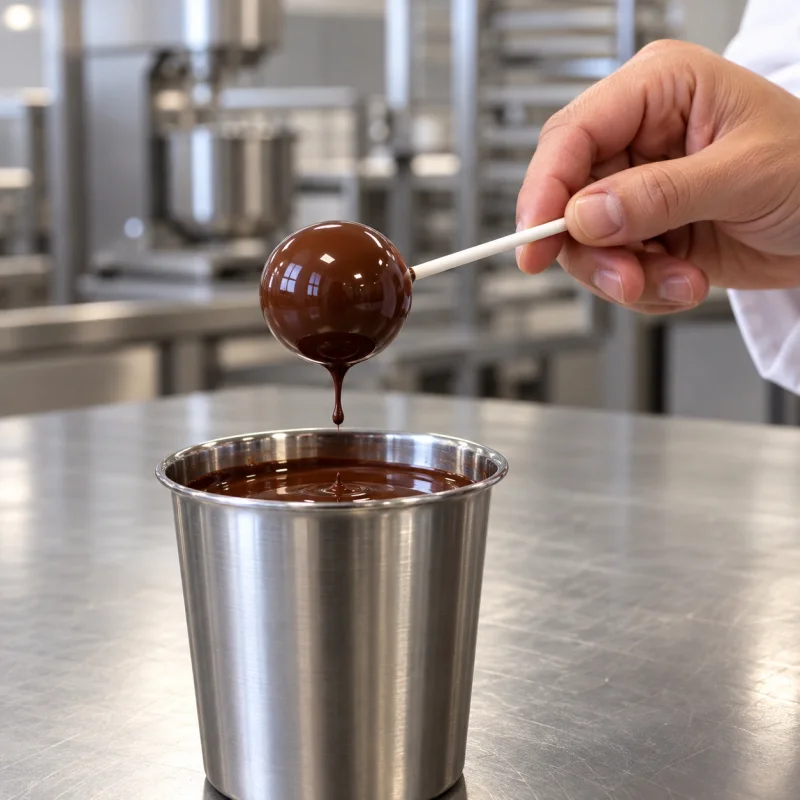
The ball looks neatly shaped and the stick is straight, but the first dip sends everything to the bottom of the bowl. When cake pops fall off the stick, adding frosting is not always the answer. Check three things: whether the mixture holds its shape, whether the coating around the stick has set, and whether the coating flows easily enough to dip without a strong tug.
Start with one test ball. If it crumbles during shaping, begin with the mixture. If the ball stays whole but the stick slips out, check the attachment. If the problem starts only during dipping, check the coating's consistency and your dipping motion. This lets you address the cause instead of changing the whole batch by guesswork.
The mixture must hold together before coating
Cake pops made from cake crumbs are more than miniature cakes. Crumble baked, cooled cake and combine it with frosting or another binder until it can be shaped. The amount depends on the cake: a moist cake does not need the same addition as a dry, crumbly one.
Do not add all the frosting at once. Mix in a small amount, combine thoroughly and shape a test ball. Watch whether it crumbles, keeps a smooth surface or begins to slump after shaping.
For a crumbly mixture, also check the size of the crumbs. More frosting will not necessarily fix large chunks of cake. Crumble the cake evenly first, then adjust the binder gradually.
If the mixture is wet, very greasy or spreads out, stop adding frosting. Chilling helps when the binder has warmed up during handling, but chilling alone cannot remove excess binder. If the mixture contains too much frosting, adding more of the same cake may help. Add it gradually and test the shape again.
Test each different mixture separately. Nutella frosting, mascarpone and buttercream do not behave identically. A ratio that works for one version should not automatically be used for another.
Give the stick a firm attachment
Dip the tip of the stick into your chosen coating and insert it towards the centre of the ball. Do not push it through the top. Wait for the coating around the attachment to set before dipping the whole ball.
These are two separate checks: a firm ball and a set attachment. A firm ball with a still-liquid attachment is not ready for dipping.
If the ball slips, try a smaller ball made from the same mixture. This helps distinguish a size problem from a mixture or attachment problem. If the smaller ball also falls apart, reducing the size alone will not repair the mixture.
Chocolate and compound coating need different handling
You can coat cake pops with chocolate or a purpose-made confectionery coating. Choose before making the batch: melting, working consistency and setting differ between products.
For a firm, properly crystallised chocolate shell, follow the tempering process appropriate to your chocolate. Couverture containing cocoa butter and compound coatings made with other fats cannot be treated as interchangeable without adjusting the method.
For compound coating, read the manufacturer's instructions first. Do not assume it needs the same temperature or addition as chocolate.
If the coating is too thick, do not force the ball through it. Check the recommended melting method and any thinning product permitted by the manufacturer. More heat is not always the solution: some coatings become thicker when overheated.
Dip the ball rather than stirring with it
Use a container deep enough to cover the ball without repeatedly turning it against the bottom. Dip the ball and lift it carefully; do not use it to stir the coating.
Remove excess coating by tapping the stick gently. Vigorous shaking adds strain to the attachment just when the fresh coating makes the ball heavier.
Let the test cake pop set before continuing. If it holds its shape, the stick stays in place and the shell does not crack, continue with a small portion of the batch. Keep the remaining balls under the conditions required by the recipe so they do not soften while you work.
Colder is not always better
The balls need to be firm enough to handle. That does not mean a frozen ball plunged into very warm coating gives the best result. A large temperature difference can contribute to cracks in the shell.
At the other extreme, a mixture that becomes too warm during handling may soften and slip. Aim for a firm ball and correctly prepared coating, rather than the coldest possible centre.
If the shell cracks only after dipping, check the temperature difference and setting conditions. Do not immediately change the cake-to-frosting ratio if the ball held its shape properly before coating.
Separate four common problems
The ball crumbles during shaping: check the crumbs and binder quantity. Coating cannot compensate for a poorly bound mixture.
The stick slips out of an intact ball: check its insertion position and whether the coating attachment has set. Assess ball size after that.
The ball falls during dipping: check the mixture's firmness, ball size and resistance from thick coating. Change one thing at a time.
The shell cracks after setting: check the temperature difference and cooling method first. A cracked shell is a different fault from falling off the stick.
Record a successful test
Note the cake, binder quantity and ball size that survived dipping. Record the coating and how you prepared it too. This record will help your next batch more than the rule “add a little more frosting”.
A firm shell does not prove that the cake pops can be stored at room temperature. Follow the ingredients and verified storage instructions of the specific recipe. Mascarpone or another perishable filling still requires appropriate storage when enclosed in a coating.
Diagnostics
Common problems and solutions
Crumbling before coating
Cause: Uneven crumbs or insufficient binder
Solution: Improve the crumbs first, then adjust the binder in small additions.
An intact ball slips off
Cause: The attachment is unset or the insertion position is unsuitable
Solution: Test the attachment before a full dip.
Falling during dipping
Cause: A soft or oversized ball, or resistant thick coating
Solution: Test a smaller size and improved coating flow separately.
Cracked shell
Cause: A large temperature difference or unsuitable setting conditions
Solution: Check ball and coating preparation before changing the mixture.
Frequently asked questions
Answers to common questions
Is a smaller ball always the solution?
No. It reduces weight but does not repair poorly bound mixture or an unset attachment. Compare a smaller ball made from the same mixture.
Can I replace mascarpone with Nutella at the same ratio?
Do not assume so. The binders differ; test shaping and dipping one ball again whenever the mixture changes.
Does a hard shell make room-temperature storage suitable?
Not by itself. Storage depends on the ingredients and verified instructions of the specific recipe.