Halloween Desserts: Decorating Ideas and Stress-Free Prep
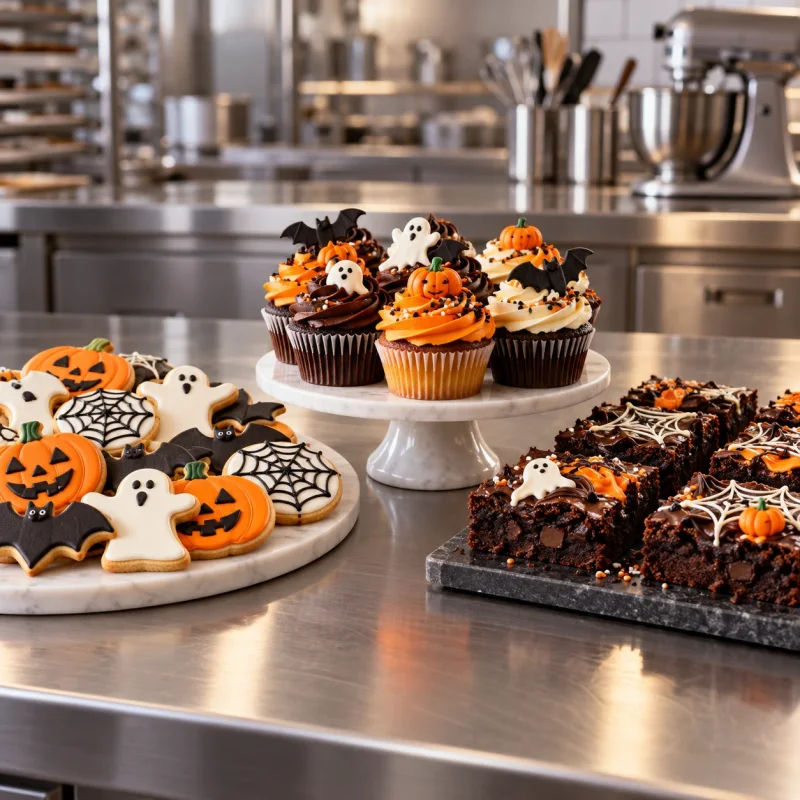
You do not need ten different recipes to build a memorable Halloween dessert table. A more reliable approach is to choose three stable formats – for example cookies, cupcakes and one larger dessert – then repeat two or three motifs across them. Spider webs, ghosts and pumpkins are enough to make the whole table feel intentional.
The goal is not maximum decoration. The goal is decoration that still looks good when guests arrive.
Choose desserts around your prep schedule
For a home party, cookies, cupcakes and a cake, brownie slab or traybake make a practical combination. Cookies can be made well ahead. Cupcakes are ideal for repeatable piping, but the frosting needs temperature control. A larger cake creates a focal point, although it takes more fridge space and needs more careful transport and slicing.
If time is tight, do not add a fourth or fifth dessert. Improve the finish on the three you already have.
Keep the colour palette tight
One dark base, one light contrast and one accent colour usually looks stronger than a rainbow of unrelated shades. Cocoa and dark chocolate give depth, white icing or pale frosting creates contrast, and orange provides an immediate Halloween cue.
For red accents, a thick raspberry or cherry sauce can work well. Avoid adding so much liquid that it loosens the frosting or glaze.
Three decorating techniques worth repeating
Spider web
Pipe thin pale concentric circles onto a still-soft dark glaze. Drag a toothpick from the centre outwards to create the web. If the lines merge into a puddle, the glaze is usually too thin or the pattern was drawn too late.
Ghosts
Ghosts work on cupcakes, meringues and chocolate decorations. A clean silhouette with two small eyes is often more effective than lots of fiddly detail.
Pumpkins
Orange frosting, icing or a simple chocolate shape is enough to suggest a pumpkin. The dessert itself does not have to be pumpkin-flavoured.
Stability matters more than the photo
A frosting that looks perfect for five minutes is not a good buffet frosting. Keep dairy-based and other perishable creams chilled until serving, following normal food-safety guidance. A useful visual check is whether piped peaks and edges stay defined.
If frosting begins to slump or look unusually glossy, cool it before adding more decoration. For ganache or a drip, let the mixture cool and thicken enough to run in controlled drops rather than racing to the cake board.
Cooling is a texture adjustment, not a way to make food safe after unsafe storage. Follow the chosen recipe’s refrigerated storage instructions and replace serving plates with fresh, chilled batches.
What to make ahead
One or two days ahead, you can usually prepare cookies, cake layers, brownies and dry chocolate decorations. On the day, add delicate creams, fruit sauces and toppings that soften quickly. Keep crisp elements separate until as late as practical so they do not absorb moisture.
This simple order removes a lot of last-minute pressure.
Build the dessert table
Start with one visually strong centrepiece, then add two lower groups. Repeat the same motifs, vary the height and leave some empty space. Food should not sit directly beside candles, heaters or other sources of warmth.
For a larger party, keep part of the dessert supply chilled and replenish the table in smaller batches.
A simple party plan
Make chocolate cookies with a white web, cupcakes with one stable orange or white frosting, and brownies or a cake as the centrepiece. Repeat the same two or three motifs across all three.
You get a coordinated table, a manageable prep schedule and desserts that have a better chance of looking right until the last guest.
Diagnostics
Common problems and solutions
Frosting loses its shape.
Cause: It may be too warm or too loosely formulated.
Solution: Chill if still safely stored; check the recipe before decorating again.
Spider-web lines spread together.
Cause: The glaze may be too thin or partly set before drawing.
Solution: Adjust the consistency and draw the web immediately.
Crisp decorations become soft.
Cause: They have absorbed moisture from cream or the surroundings.
Solution: Store separately and add shortly before serving.
Technical terms
Terms worth understanding
- Crumb coat
- A thin first layer of frosting that traps loose crumbs.
- Drip
- A controlled glaze or chocolate coating running over the cake edge.
Frequently asked questions
Answers to common questions
Which Halloween desserts are easiest to manage?
Cookies, cupcakes and one larger dessert or traybake because they can be prepared in stages.
How do I make a spider web on icing?
Pipe pale circles onto soft dark icing and drag a toothpick from the centre outwards.
What can I make the day before?
Cookies, cake layers, brownies and most dry chocolate decorations.
How do I get strong Halloween colours?
Use cocoa and dark chocolate for dark tones, orange ingredients or food colouring for orange, and thick berry sauces for red accents.
Why does frosting soften on the table?
Usually because it is too warm or the recipe is too soft. Keep it chilled until serving.
How do I make the table look coordinated?
Limit the colour palette and repeat two or three motifs across several desserts.