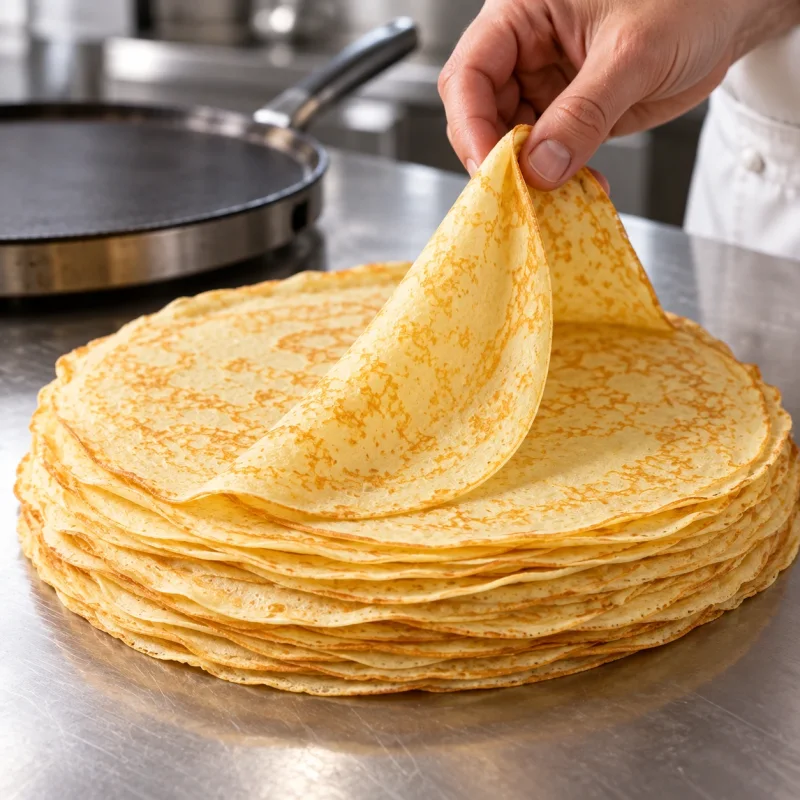
Thin crêpes for desserts: flexible, not hard
A dessert crêpe should be thin but flexible. It needs enough structure to flip, fill and roll without tearing. That comes from batter consistency, rest, pan heat and flip timing rather than a single secret ingredient.
What the batter should look like
The batter should run quickly across the tilted pan and form a thin continuous film. Heavy ridges usually mean it is too thick. A watery batter that forms a weak film may be too thin.
Use the first crêpe as a calibration test and adjust in small steps.
What resting actually changes
A 20–30 minute rest is useful with classic batter because the flour has time to absorb liquid more evenly. The batter often feels slightly thicker afterward.
Make your final consistency adjustment after the rest, not immediately after mixing.
Mix smooth, not foamy
The goal is a smooth batter without lumps. A blender is fine, but avoid whipping in lots of air right before cooking. Excess bubbles can leave a field of tiny holes.
Blend until smooth, rest, then stir briefly before cooking.
Pan heat and fat
Preheat the pan evenly. A pan that is too cool delays setting, which encourages sticking and tearing. A pan that is too hot dries the edge before the batter can spread evenly.
Use only a thin film of butter or oil.
When to flip
Flip when the top no longer looks wet, the edge begins to release, and a thin spatula can slide underneath without pulling the crêpe apart.
Flipping while the top is still wet means the structure is at its weakest.
Why crêpes tear
Check pan heat and flip timing first.
If both are correct and the crêpe still tears, then adjust the batter. Do not automatically add more egg; too much can make the crêpe eggy and tougher without fixing the real problem.
For rich dessert fillings
For mascarpone, chocolate, curd or fruit fillings, do not cook the crêpe until the edge becomes dry and brittle.
A lightly golden, flexible crêpe rolls better. Cool completely before adding chilled cream fillings.
Make-ahead and storage
Cool cooked crêpes, stack them, cover them and refrigerate. Egg-and-milk crêpes should not be kept at room temperature for days.
For longer storage, freeze with parchment between layers. Reheat only enough to restore softness; there is no need for one universal oven time.
Quick troubleshooting
| Symptom | Likely cause | Fix |
|---|---|---|
| tears during flipping | flipped too early or pan too cool | wait for a matte top and released edge |
| too thick | batter thickened after resting | add a little liquid |
| dry, cracking edge | overcooked | shorten cooking time |
| sticks | pan not evenly hot or surface worn | preheat properly and use a thin fat film |
Set the flow, let the batter rest, heat the pan evenly, and flip only after the structure has set.
Diagnostics
Common problems and solutions
The crêpe tears during flipping.
Cause: It was flipped too early or the pan is too cool.
Solution: Wait for a matte top and released edge.
The crêpe is too thick.
Cause: The batter became too thick after resting.
Solution: Add a little liquid and test again.
The edges are dry and crack.
Cause: Cooking time is too long or the pan is too hot.
Solution: Shorten the cooking time.
Frequently asked questions
Answers to common questions
How do I make very thin crêpes without tearing them?
Use fluid but not watery batter, rest it for about 20–30 minutes, and add only enough to coat the pan quickly. Flip only after the wet sheen has disappeared and the edge releases.
Why do my crêpes tear when I flip them?
Common causes are flipping too early, a pan that is too cool, or batter that is still too weak after resting. Fix the process before automatically adding more flour or eggs.
Does crêpe batter have to rest?
Not every method requires a long rest, but 20–30 minutes is useful for classic batter because it gives the flour time to hydrate more evenly.
How do I know the pan is hot enough?
A small amount of batter should set into a thin film right away without browning in seconds. If butter darkens rapidly, the pan is too hot.
How can I make crêpes ahead for dessert?
Cool them, stack them, cover them and refrigerate. Egg-containing foods should not sit at room temperature for many hours.
How do I stop crêpes becoming rubbery or dry?
Do not overcook them. For filled desserts, aim for a flexible, lightly golden crêpe instead of dry, crisp edges.