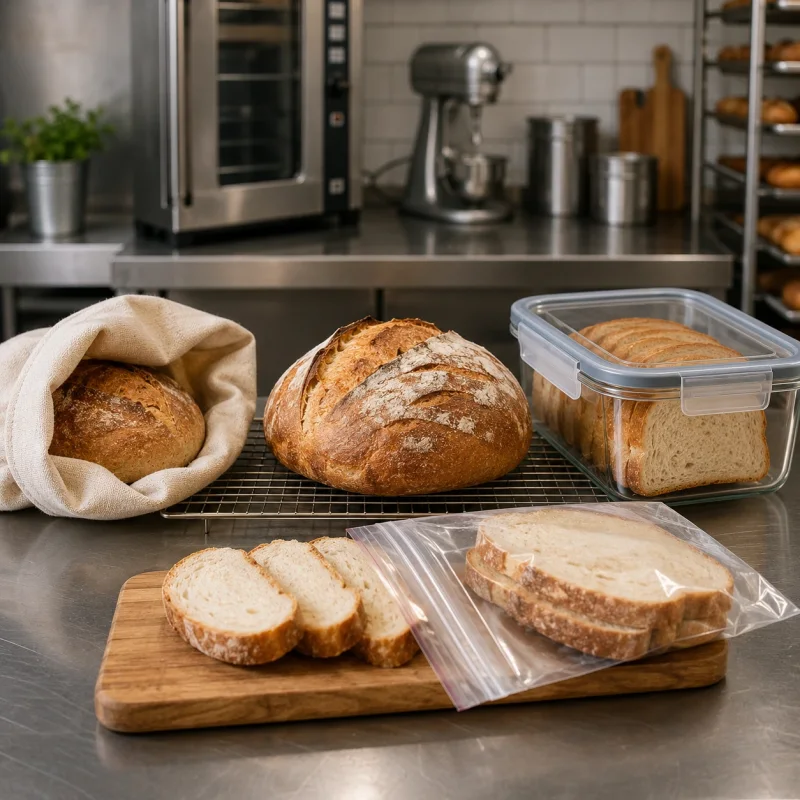
How to store bread: decide what you want to preserve first
Let freshly baked bread cool completely on a rack before wrapping it or putting it in a container. If you want a crusty loaf to keep a firm crust, use a more breathable storage method. If your priority is a soft crumb, choose a more airtight bag or container after the bread has cooled. If you will not eat the bread within a few days, freezing is usually a better quality choice than refrigeration.
There is no single storage method that is best for every loaf. The right choice depends on whether you mainly want to preserve a crisp crust, a soft crumb, or good quality for longer storage.
1. Cool bread completely before storing it
Warm bread is still releasing water vapor. Seal it too early and that moisture becomes trapped, producing condensation inside the packaging. The crust softens quickly, and warm humid conditions are also more favorable for mold growth.
A simple practical check: the loaf is ready to store when the underside no longer feels warm and no droplets form after it is enclosed.
If you also want a reliable airy crumb and crisp crust during baking, use the principles in Homemade bread: soft airy crumb and crisp crust.
2. Give crusty bread some airflow
For rustic loaves, baguettes and similar breads, keeping the crust crisp is often the main short-term goal. On the day of baking, a paper bag, a clean bread cloth, or a bread box with some airflow can work well.
The trade-off is straightforward: the crust stays drier and firmer, but the crumb loses moisture faster than it would in airtight packaging. Once a loaf is cut, protect the cut face in particular.
3. Use a tighter seal for a soft crumb
Sandwich bread, milk bread and soft rolls usually stay softer in a well-sealed bag or container, but only after they have cooled completely. Reducing air exchange slows moisture loss from the crumb.
The trade-off is a softer crust. That is not a defect when soft bread is the goal, but the same packaging quickly reduces the crispness of a rustic loaf.
Tangzhong is another technique that can improve water retention from the recipe stage, but it does not replace correct cooling and storage.
4. The refrigerator is usually not the first choice for bread quality
Bread does not stale only because it dries out. Starch structure and water distribution in the crumb also change during storage. Refrigerator temperatures above freezing can speed the firming associated with staling in many breads, so refrigeration is usually not the best default for texture.
In a very hot, humid environment where bread molds quickly, food safety and real room conditions matter more than ideal texture. For longer storage, however, timely freezing is usually the better quality strategy.
5. Freeze bread while it is still fresh
For bread you will not eat within a few days:
- cool it completely;
- slice or portion it if useful;
- protect it well from air and drying;
- freeze it while it is still fresh and pleasant to eat.
Slices are convenient because you can remove only what you need. Around three months is a practical quality guideline when bread is well protected, not a universal safety deadline. Packaging, bread style and freezer temperature stability all affect the result.
Thaw only the amount you need. Slices can often go straight into a toaster or oven.
6. Refresh older bread by judging the result, not a fixed timer
There is no universal reheating temperature and time for every loaf. A thin slice, a roll and a large loaf need different treatment.
Aim for visible and tactile results:
- a slice should become dry and lightly crisp at the edges;
- a roll should feel pleasantly firm outside and warm inside;
- a larger loaf should regain a fresher crust without drying the crumb further.
A toaster is usually simplest for slices; use a preheated oven for larger pieces and check early.
Common bread-storage mistakes
Sealing bread while it is still warm. Condensation means it was packed too soon. Cool it longer on a rack next time.
A crusty loaf turns rubbery overnight. It was stored too airtight for the desired crust. Use a more breathable method for short storage or refresh it before serving.
The crumb dries out quickly. Paper or an open cloth may allow too much airflow for soft bread. Once fully cool, move it to a sealed bag or container.
Freezing bread only after it has gone stale. Freezing preserves current quality; it does not restore quality already lost. Freeze it while it is fresh.
Cutting off visible mold and eating the rest. Bread is porous. If mold is present, discard the whole loaf.
Which storage method should you choose?
- Crisp crust for a short period: paper, a bread cloth or a ventilated bread box.
- Soft crumb and soft breads: a sealed bag or container after complete cooling.
- A cut loaf: protect the cut face and reduce unnecessary air exposure.
- More than a few days: slice, wrap well and freeze.
- Refrigerator: not the default for texture; it can be a practical compromise in unusually hot, humid conditions.
The key decision
Bread storage is not about finding one “best bag.” Decide first what you want to preserve. More airflow helps the crust, less airflow helps retain moisture in the crumb, and freezing is the strongest option when you want good quality for longer.
Diagnostics
Common problems and solutions
Droplets collect inside the bag or container.
Cause: The bread was enclosed while it was still warm.
Solution: Next time, cool it completely on a rack before sealing it.
A crusty loaf is rubbery the next day.
Cause: The packaging was too airtight for the goal of keeping a crisp crust.
Solution: Use a more breathable method for short storage or refresh the crust before serving.
The crumb dries out quickly.
Cause: The bread is exposed to too much air or a soft loaf is being stored too openly.
Solution: Once fully cool, use a better-sealed bag or container, or freeze the surplus.
Mold appears on the bread.
Cause: It was stored too long in conditions that allowed mold to grow.
Solution: Discard the whole loaf rather than cutting away only the visible mold.
Technical terms
Terms worth understanding
- Starch retrogradation
- Reorganization of starch molecules during cooling and storage that contributes to the firming of bread crumb.
Frequently asked questions
Answers to common questions
How long can bread stay at room temperature?
There is no single correct number of days for every bread. Formula, packaging, room temperature and humidity all matter; freeze surplus while it is still fresh if you will not use it soon.
Is a paper bag always best for bread?
No. It can help keep a crust drier, but it does not protect the crumb from moisture loss as well as more airtight packaging.
Is a plastic bag bad for bread?
Not by itself. It retains moisture well in fully cooled soft bread, but it softens the crust of rustic loaves and should never trap steam from warm bread.
Why does bread seem to stale faster in the refrigerator?
Staling is not just drying. Changes in starch structure and water distribution at refrigerator temperatures can speed crumb firming.
Can I freeze sliced bread?
Yes. Slices are practical because you can thaw only what you need. Cool bread completely and protect it well from air before freezing.
What should I do if bread has mold?
Discard the whole loaf. With porous foods such as bread, removing only the visible mold is not considered a safe solution.