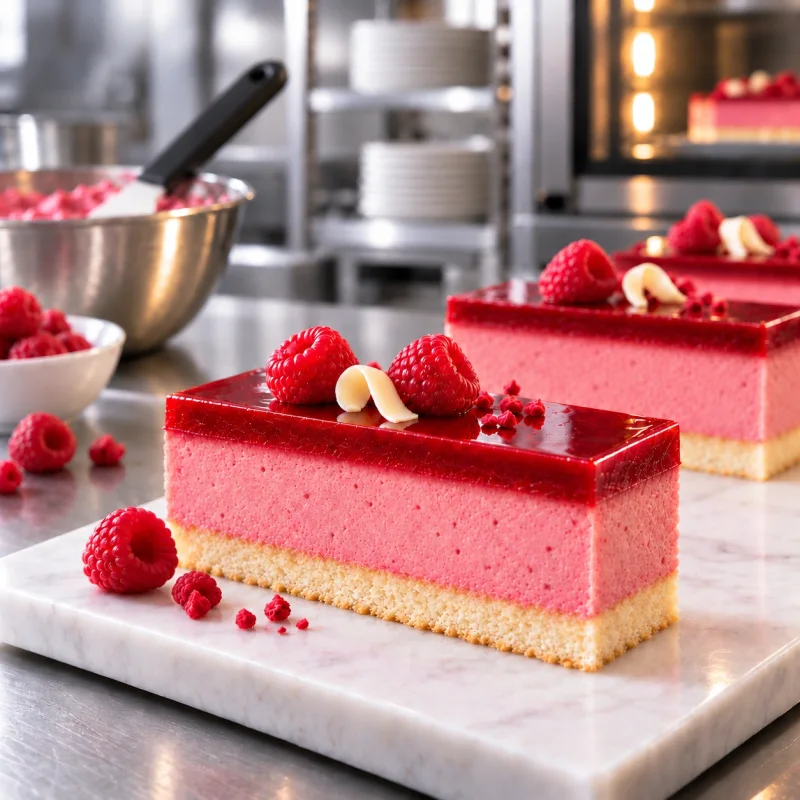
Gelatin should support a clean slice, not turn cream rubbery
Most gelatin failures become obvious only after the dessert is fully chilled
Cut into a mousse cake and the problem is easy to see: the filling spreads, liquid beads along the cut, translucent lumps remain in the cream, or the texture resists the fork like rubber. The cause is often more than the amount of gelatin. Hydration, gentle dissolving, temperature equalization, and enough chilling time all matter.
Gelatin does not set the moment it is mixed in. Its protein network develops as the dessert cools, so a fluid mousse while filling the mold is not proof that something has gone wrong. Judge the result only after the dessert has chilled completely.
Dose by weight and gelling strength
Sheet count is not a reliable unit
Gelatin sheets from different brands can vary in both weight and strength. Bloom value describes gelling strength, so four sheets from one product are not automatically equivalent to four sheets from another.
Weigh the gelatin. For softer creams and glass desserts, 0.6–0.9% of the total mass is a practical starting range when working with gelatin around 180–200 Bloom. For a mousse that needs a clean slice, 1.0–1.4% is a useful starting range. In 1,000 g of mousse, that means roughly 10–14 g gelatin.
These are starting points, not universal formulas. Sugar, fat, alcohol, acidity, and incorporated air all influence firmness. More gelatin does not automatically mean a better dessert; too much creates an elastic, rubbery bite.
Hydrate gelatin fully before dissolving it
Cold water prevents dry centers and hard granules
Unless the manufacturer specifies otherwise, sprinkle powdered gelatin evenly over five to six times its weight in cold water. For 10 g gelatin, 50–60 g water is a practical starting point. Let it bloom for 5–10 minutes. Do not dump the powder into one pile, because the outside can hydrate while dry powder remains trapped inside.
Soak gelatin sheets in plenty of very cold water for 5–10 minutes, or until fully soft and flexible. Lift them out and gently squeeze away excess water. Properly hydrated gelatin should not contain pale, dry areas.
Dissolve gently and avoid boiling
Warm bloomed gelatin only until it is completely fluid. Around 50–60°C / 122–140°F is a useful practical range for gentle dissolving. It should look clear and free of visible particles.
Do not boil it or hold it at high heat longer than necessary. Extended heat, especially in an acidic fruit base, can weaken the final gel. Use a gentle water bath or brief microwave pulses and stir slowly between each pulse.
Temperature shock causes strings and lumps
Do not pour warm gelatin straight into very cold cream
When liquid gelatin hits a refrigerator-cold mixture, it can begin setting at the contact point. Instead of dispersing smoothly, the partially set gelatin gets torn into thin elastic strings or tiny lumps.
First stir two or three tablespoons of the base mixture into the dissolved gelatin. Add a little more cream, mix until smooth, and only then blend the tempered mixture into the main bowl.
For some mousse systems, a gelatin base around 24–28°C / 75–82°F can be a useful working range before folding in whipped cream. It is not a universal target: the formula, ingredient temperatures, and state of the mixture matter.
Fresh tropical fruit can stop gelatin from setting
Fresh pineapple, kiwi, mango, papaya, and figs can contain proteolytic enzymes that break down gelatin proteins. A dessert may therefore remain soft even when the gelatin quantity and hydration are otherwise correct.
Heat-treat these fruits before combining them with gelatin — for example by cooking or blanching — or use appropriately pasteurized or canned fruit. Heat deactivates the enzymes. There is no single time-and-temperature rule that applies to every fruit and every process.
Agar is not a 1:1 substitute for gelatin. It is activated differently and produces a firmer, more brittle gel, so the formula has to be redesigned for it.
Chilling determines whether the slice stays clean
The outside of a dessert can feel firm while the center is still developing its gel network. Chill small glass desserts for at least 4 hours. For mousse cakes and thicker layers, 6–8 hours is a useful starting point; 8–12 hours often gives the cleanest slice.
Thaw frozen mousse desserts slowly in the refrigerator at roughly 2–6°C / 36–43°F. Fast room-temperature thawing can soften the outer layers while the center remains frozen and may increase moisture release around the edges.
For slicing, warm a thin knife in hot water and wipe it dry. Properly stabilized mousse holds its shape and cuts with a smooth, dry-looking edge, but still yields softly under a fork.
Quick troubleshooting
- Mousse is still loose after adequate chilling: check the actual gelatin weight and Bloom, complete dissolving, fresh enzyme-active fruit, and real chilling time.
- Strings or small lumps: the gelatin probably hit a mixture that was too cold before temperatures were equalized.
- Rubbery slice: the dose or gelling strength is too high for that formula.
- Translucent grains: hydration or dissolving was incomplete.
- Water release after thawing: review the whole formula and freeze-thaw process, not only the gelatin dose.
The most reliable rule is simple: weigh gelatin, know its Bloom strength, control each processing stage, and judge the final dose only on a fully chilled dessert.
Diagnostics
Common problems and solutions
Mousse is still liquid after adequate chilling.
Cause: Too little gelatin for its Bloom and formula, incomplete dissolving, or fresh proteolytic fruit.
The cream contains elastic strings or small lumps.
Cause: Dissolved gelatin hit a mixture that was too cold and began setting locally.
The cream holds its shape but the slice is rubbery.
Cause: The dose or gelling strength is too high for the formula.
There are hard translucent grains in the mousse.
Cause: Gelatin was not evenly hydrated or fully dissolved.
Liquid appears around the edge after thawing.
Cause: Freezing, thawing, and the full formula affect the result, not just gelatin quantity.
Technical terms
Terms worth understanding
- Bloom
- A measure of gelatin gelling strength; at comparable conditions, a higher Bloom value produces a stronger gel.
- Hydration
- Pre-wetting gelatin in cold water so water distributes evenly through the material before dissolving.
- Tempering
- Gradually equalizing the temperature of dissolved gelatin with part of the base before adding it to the colder main mixture.
- Proteolytic enzymes
- Protein-degrading enzymes that can damage the gelatin network and prevent setting in some fresh fruits.
Frequently asked questions
Answers to common questions
How much gelatin do I need for 500 g of mousse?
With gelatin around 180–200 Bloom, 5–7 g can be a useful starting point for a soft but sliceable mousse. It is not universal; consider Bloom and the whole formula.
Can I reheat gelatin if it starts to set?
Yes, very gently and only until it becomes fluid again. Avoid boiling and unnecessary prolonged heat.
Why does gelatin form strings in whipped cream?
It usually began setting when it contacted very cold cream. Temper it with part of the base before incorporation.
Can I replace gelatin sheets with powdered gelatin?
Yes, but compare weight and similar Bloom strength and follow the instructions for the specific product.
Why does gelatin fail with fresh kiwi or pineapple?
Fresh fruit can contain proteolytic enzymes that break down gelatin. Heat-treat the fruit or use an appropriate pasteurized or canned version.