How do I use agar agar instead of gelatin in desserts?
Agar agar can replace gelatin in many desserts, but it is not plant-based gelatin and it is not a 1:1 substitute. Agar is a polysaccharide from red algae; gelatin is a protein. They set differently, feel different in the mouth and respond differently to heat.
If your goal is a reliable mousse, fruit insert or clean-cut layer, the safest method is to choose a sensible starting percentage, follow the instructions for the exact agar product, dissolve it completely, and incorporate it before it begins to gel.
How much agar agar should I use?
For pure agar powder, these are useful starting ranges, not universal guarantees:
- 0.20–0.30% of the total mixture for a very soft gel,
- 0.35–0.50% for many mousses or inserts,
- 0.70–1.00% for a firmer gel.
For example, 0.4% of a 500 g mixture is 2 g of agar agar.
Do not convert gelatin blindly by weight. Product strength varies, and commercial products sold as “agar agar” may contain carriers or other hydrocolloids. The package directions therefore take priority over any general table.
For the texture of mousses and cake fillings, also see how to build stable cake creams and mousses. If you actually want the softer, elastic behavior of gelatin, read how to use gelatin in desserts without lumps or weak setting.
How to dissolve agar agar correctly
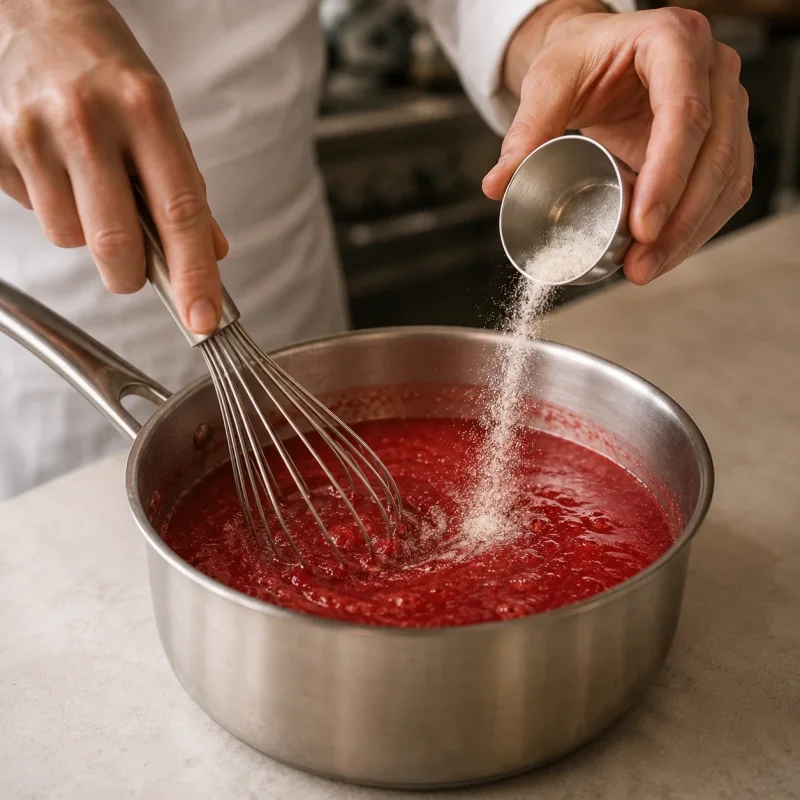
Disperse the powder evenly in a liquid that can be heated. Whisk so there are no dry pockets, then heat according to the product instructions until the agar is completely dissolved. Many agar powders require boiling or near-boiling conditions; some products specify a short simmer.
A properly dissolved base is smooth and fluid. If you can see dry specks, feel graininess, or see a thickened rim forming as it cools, the next step becomes less predictable.
Do not keep strongly acidic fruit mixtures boiling with agar longer than necessary. In a very acidic recipe, dissolve the agar first and add the acidic purée or juice later if the formula allows.
How to add agar to a mousse without lumps
The difficult part is timing. Agar can begin setting while the mixture is still much warmer than refrigerator temperature.
Do not pour a very hot agar solution directly into cold whipped cream, but do not wait until the agar base has formed a skin or threads either. A reliable approach is to mix a small portion of the cream base into the warm agar mixture first, then fold or blend that tempered mixture quickly into the remainder.
If your dairy cream is already lumpy for another reason, the separate guide to mascarpone cream without lumps is the better troubleshooting route. If whipped cream has been overworked, use the dedicated guide to fixing overwhipped cream.
Agar agar versus gelatin: the texture is different
Agar usually creates a firmer, cleaner and more brittle gel. Gelatin is generally softer, more elastic and melts readily in the mouth.
That means a technically set agar dessert can still be the wrong dessert if the desired texture is a trembling panna cotta or a very soft mousse. In those cases, gelatin or another hydrocolloid system may be a better fit.
Acidic fruit, fresh fruit enzymes and agar
Fresh pineapple, kiwi, papaya and figs contain enzymes that can break down gelatin proteins and weaken gelatin-based desserts. Agar is a polysaccharide, so those proteolytic enzymes do not attack it in the same way.
Acidity is a different issue. Strong acid combined with prolonged heating can weaken an agar system, so complete dissolution and controlled heating matter.
Can agar desserts be frozen?
Some agar gels can release water after freezing and thawing. Do not solve that automatically by adding more agar: a stronger gel can become unpleasantly brittle without fixing freeze–thaw quality.
If the dessert will be frozen, make a small test sample first and compare it with an unfrozen control.
Quick troubleshooting
The dessert is still runny: check the product label, dissolution and acidity before raising the dose.
There are firm threads or bits: the agar began setting before or during mixing. Incorporate sooner.
The slice is rubbery or brittle: the concentration is likely too high, or agar is the wrong textural choice.
The mousse collapses: the agar base was probably too hot or mixing continued too long.
Water appears after thawing: the gel network is not sufficiently freeze–thaw stable; consider a different hydrocolloid system rather than simply using more agar.
The rule worth remembering
Use agar agar as agar agar, not as “gelatin from algae.” Follow the specific product, dissolve it completely, incorporate it while fluid, and tune the amount only after the method is under control.
Diagnostics
Common problems and solutions
The cream stays runny after chilling
Cause: The agar was not completely dissolved, the product has lower gelling power, acidity or the formula weakens the gel, or the dose is too low.
Solution: Check the label and dissolution step first. Correct the process before increasing the dose, and compare only with the same product and recipe.
There are firm threads or tiny pieces in the cream
Cause: The agar base started to set before or during incorporation.
Solution: Next time incorporate it sooner. Temper it with a small portion of the cream mixture first, then combine promptly while the base is still fluid.
The slice is firm but rubbery or brittle
Cause: The dose is too high or agar is being used for a texture that should be soft and elastic.
Solution: If the gel is otherwise uniform, reduce the dose in a small, precisely measured step or choose a different gelling system for a softer result.
The mousse loses volume when the agar base is added
Cause: The agar base is too hot or the mixture is worked for too long.
Solution: Mix a small amount of the cream into the warm agar base first, then fold that mixture quickly and gently into the rest.
Water separates after freezing and thawing
Cause: Ice crystals damaged the gel network and increased syneresis.
Solution: Compare a small frozen sample with an unfrozen one. If freeze–thaw quality matters, test another hydrocolloid system or a combination rather than simply adding more agar.
Technical terms
Terms worth understanding
- gel strength
- The ability of a gelling agent to form a gel of a given firmness at a given concentration and under defined conditions.
- syneresis
- The release of liquid from a gel network during storage or after freezing and thawing.
- thermal hysteresis
- The difference between the temperature at which an agar gel forms and the substantially higher temperature at which it melts again.
Frequently asked questions
Answers to common questions
Can I reheat a mixture that has already set with agar agar?
Reheat only a plain agar base or gel that does not contain whipped cream, mascarpone, curd cheese or other heat-sensitive ingredients. Heat until the gel is completely fluid again.
Which liquid should I use to dissolve agar agar for a dairy cream?
Use a liquid portion of the recipe that can safely be heated to the temperature required by your agar product, such as milk or part of the unwhipped cream. Do not boil mascarpone or whipped cream.
Can I activate agar agar directly in an acidic fruit purée?
With very acidic purées, it is safer to dissolve the agar completely in a less acidic portion of the liquid first, then add the purée or acidic juice afterwards when the recipe allows.
Can I use agar flakes in the same amount as powder?
No. Flakes and powders differ in dissolution rate and often in effective gelling strength. Follow the ratio and method for the exact product you are using.