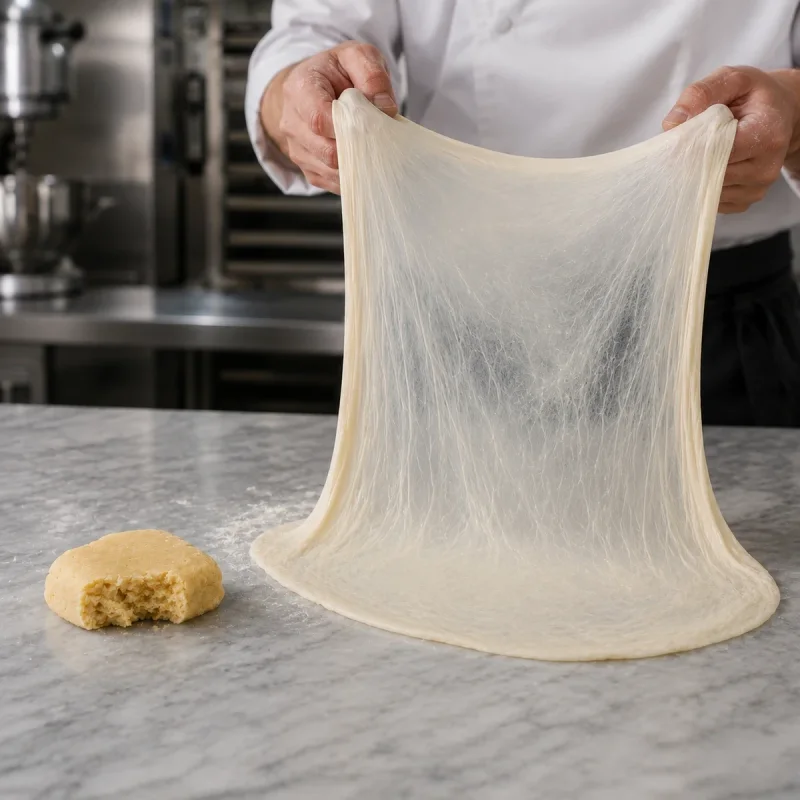
Shortcrust pastry and strudel dough need opposite gluten strategies
You can feel the difference almost as soon as you start rolling. Proper shortcrust pastry should be cold, cohesive and pliable, but it should not behave like elastic bread dough. Strudel dough has almost the opposite requirement: after kneading and resting, it needs enough strength and extensibility to stretch into a very thin, nearly translucent sheet without constantly snapping back or tearing.
The reason is gluten. In shortcrust, gluten development is deliberately limited by fat, a small amount of liquid and minimal mixing. In strudel dough, a strong gluten network is deliberately built through hydration, kneading and resting. The same mixing method cannot produce the right texture in both systems.
Overworking shortcrust makes it tougher and more prone to shrinking. Underdeveloping strudel dough leaves a weak network that tears before the sheet can become thin enough.
Ratios are starting points; dough behaviour is the final test
For a basic shortcrust-style dough, about 50–60 g fat per 100 g flour is a useful technical starting range. Add liquid gradually and stop when the crumbly mixture holds together when squeezed. The exact requirement changes with the flour, fat, eggs and sugar in the formula.
More fat generally gives a more tender, crumbly texture but reduces mechanical strength. More water makes the dough easier to bind, but it also increases the opportunity for gluten to develop. A sweet shortcrust therefore cannot be treated exactly like a savoury one.
Strudel dough begins from a different balance. About 55–60 g water per 100 g flour is a useful first orientation, usually with salt and a small amount of oil. It is not a universal hydration target. A flour with higher water absorption may need more; a weaker flour may become sticky and unstable at the same hydration.
The protein percentage printed on the flour bag is not enough to predict extensibility. The practical test is the developed dough itself: when stretched slowly, it should lengthen into a thin membrane before breaking.
How shortcrust becomes tender without losing all structure
In shortcrust pastry, fat should coat at least some of the flour before water fully hydrates the proteins. This limits the amount of gluten that can form. The baked pastry then breaks with a short, tender fracture instead of bending and springing like bread.
With a rubbing-in or sandy method, work cold fat into the flour until the mixture resembles uneven crumbs. Larger pieces of fat can create a slightly flakier, more irregular structure; more finely dispersed fat gives a more uniform, crumbly break.
Add liquid only after that. Mix just until the particles hold together when pressed. A perfectly smooth, strongly elastic shortcrust dough is usually a warning sign, not the goal.
Shape the dough into a flat disk or rectangle, cover it airtight and chill for about 30–60 minutes. A flat piece cools more evenly than a thick ball. The fat firms up again and any gluten tension has time to relax.
For rolling, the dough should be cold but not rock hard. Deep cracks around the edge often mean it is too cold; give it a few minutes at room temperature. If the surface starts to look greasy or shiny, chill it again for 10–15 minutes instead of repeatedly adding more flour.
Thickness, resting and how you line the pan control shrinkage
For many pies and tarts, around 3–4 mm is a useful pastry thickness. Thinner pastry dries quickly and may break under a heavy filling. Very thick pastry bakes more slowly and can stay pale or heavy in the middle.
Do not stretch the dough into the pan. Lay it over the pan and gently ease it into the corners by lifting the edge. If you pull it tight and press it against the sides, the stretched gluten tries to return to its original shape in the oven and the sides are more likely to slump or shrink.
Chill the lined shell for at least 20–30 minutes before baking. Blind baking is especially useful when the filling is wet, cooks more quickly than the crust, or is added after the shell is baked. Baking weights should support the sides as well as the centre.
For a 24–26 cm / 9½–10 inch shell rolled to roughly 3–4 mm, around 180°C / 350°F in a conventional oven is a sensible starting point, but actual time depends on the pan, formula and oven. After removing the weights, continue until the base no longer looks raw and greasy.
A wet filling can ruin a well-made shortcrust shell
Crispness is not controlled by the dough formula alone. If a wet or hot filling sits on raw or underbaked pastry, water migrates into the base and makes it harder for the lower layers to dry during baking.
Cool fillings before assembly and remove or bind excess free liquid where practical. Juicy fruit may benefit from a thin absorbent layer or a pre-baked shell. A hot filling placed on cold pastry can also soften the fat before the tart reaches the oven.
Strudel dough needs a developed gluten network – and then time to relax
In strudel dough, water hydrates the flour proteins and kneading links them into an elastic network. That network must be strong enough to support an extremely thin sheet yet relaxed enough not to retract as you stretch it.
Mix the ingredients into a rough dough, then knead until it becomes smooth, cohesive and clearly extensible. The number of minutes matters less than the end signal: on a slow stretch, the dough should form a thin membrane before tearing. If it remains rough and breaks after only a short stretch, the network is underdeveloped or the hydration may be too low.
After kneading, shape a smooth ball, lightly oil it and cover it. For same-day use, about one hour of resting is a useful starting point. Resting evens out moisture and reduces elastic tension, but it does not replace insufficient kneading.
If the dough has been refrigerated, let it warm gradually while covered. A dry skin is especially damaging: it cannot extend with the moist interior and becomes the first place the sheet splits.
Stretch strudel dough from the centre toward the edges
Roll the dough only enough to start thinning it. Then lift it over the backs of your hands or closed fists and stretch it gradually. Use broad pressure; fingertips concentrate force and make holes more easily.
Work from the thicker centre toward the edges. The target is a uniformly thin, almost translucent sheet. A heavy band left through the middle bakes more slowly and absorbs more moisture from the filling.
If the dough keeps shrinking back, do not fight it with more force. Cover it and give it another 10–15 minutes. Extra relaxation is often more effective than pulling harder. A small hole near an edge is manageable, but tears across the whole sheet point to dry dough, weak development, insufficient rest or inadequate hydration.
Strudel filling should be cool and low in free liquid
Very thin dough has a large surface area and very little mass, so it browns quickly but also absorbs moisture quickly. The filling should be cool before assembly. With juicy fruit, part of the released liquid can be managed with breadcrumbs, ground nuts or an appropriate amount of starch, depending on the recipe.
Lightly coat the stretched dough with fat. This reduces sticking between layers as the strudel rolls. Too much fat pools at the bottom and can produce a greasy layer instead of a crisp one.
Do not compress the strudel into a hard roll. Excessive pressure squeezes liquid out of the filling and glues the thin layers together. Place the seam underneath.
For many strudels, 190–210°C / 375–410°F in a conventional oven is a useful starting range. The end point is an evenly browned, dry exterior and a properly baked underside, not a fixed number of minutes.
Shortcrust, strudel and puff pastry are not variations of one system
Shortcrust limits gluten. Strudel dough develops gluten and is mechanically stretched very thin. Puff pastry builds separate layers of dough and plastic fat through lamination.
Strudel layers are created by stretching a sheet and rolling it around the filling. Puff-pastry layers are created by repeated folds and rolling of a laminated dough block. The terms are not interchangeable.
Shortcrust pastry vs strudel dough at a glance
| Feature | Shortcrust pastry | Strudel dough |
|---|---|---|
| Main goal | short, tender break | very thin, extensible sheet |
| Gluten development | deliberately limited | deliberately developed |
| Main handling | minimal mixing and chilling | kneading, resting and stretching |
| Ready-to-use signal | cold and pliable, not greasy | stretches thin without rapid snap-back |
| Main risk | toughness, shrinkage, soggy base | tearing, retraction, gummy layers |
| Typical uses | pies, tarts, tartlets, biscuits | strudel and other hand-stretched pastries |
Troubleshooting
| Symptom | Likely cause | What to change |
|---|---|---|
| shortcrust bakes hard and tough | too much liquid or too much mixing | add liquid gradually and stop as soon as the dough holds together |
| edges crack deeply during rolling | dough is too cold or too dry | let it temper briefly; if truly dry, add only a few drops of cold water |
| pastry shrinks in the oven | stretched into the pan or insufficiently rested | ease it into the pan without tension and chill thoroughly before baking |
| strudel dough keeps snapping back | gluten network is still tense | cover and rest for another 10–15 minutes |
| strudel tears in many places | dry surface, weak development, low hydration or too little rest | check hydration, kneading and protection from drying |
| base stays soft and wet | too much free moisture or insufficient pre-baking | cool the filling, bind excess liquid and blind bake when needed |
The most useful rule is simple: decide the mechanical job of the dough before you mix it. If it should break short and tender after baking, limit gluten. If it must stretch across a large surface into a nearly transparent sheet before baking, build the gluten network and then give it enough time to relax.
Diagnostics
Common problems and solutions
Shortcrust bakes hard and tough.
Cause: Too much liquid or too much mixing developed excessive gluten.
Solution: Add liquid gradually and stop working the dough as soon as it holds together.
The pastry edge cracks deeply during rolling.
Cause: The dough is too cold, too dry, or moisture has not distributed evenly yet.
Solution: Let it temper for 5–10 minutes; if the whole mass still crumbles, add only a few drops of cold water.
Shortcrust shrinks during baking.
Cause: The dough was stretched into the pan, overworked, or not rested enough.
Solution: Ease it into the pan without tension and chill the lined shell thoroughly before baking.
Strudel dough keeps snapping back while stretching.
Cause: The gluten network is still too tense.
Solution: Cover and rest for another 10–15 minutes before continuing.
Strudel dough tears in many places.
Cause: The network is weak, the surface has dried, or hydration is too low.
Solution: Check kneading, resting, hydration and protection from drying.
A tart or strudel base stays soft and wet.
Cause: The filling contains too much free liquid or the pastry is underbaked.
Solution: Cool the filling, reduce or bind excess liquid, and pre-bake shortcrust when appropriate.
Technical terms
Terms worth understanding
- Gluten network
- The connected protein structure in wheat dough that provides elasticity, extensibility and structural strength.
- Hydration
- The amount of water relative to flour weight; 60% means 60 g water per 100 g flour.
- Rubbing-in method
- A shortcrust technique in which fat is worked into flour first, limiting how readily water can hydrate the flour proteins.
- Blind baking
- Pre-baking an empty pastry shell, usually with weights, before adding a wet or already-cooked filling.
- Dough relaxation
- Reduction of elastic tension in the gluten network during resting, making dough easier to roll or stretch.
- Lamination
- Repeated folding and rolling of dough with separate layers of fat to create puff-pastry layers.
Frequently asked questions
Answers to common questions
Can shortcrust pastry be made a day ahead?
Yes. Keep it well covered in the refrigerator and let it warm only until pliable before rolling. Pastry that is still rock-hard is more likely to crack.
Can strudel dough rest too long?
Extra rest often improves extensibility as long as the surface is protected from drying. For longer storage, refrigerate it and let it temper while covered before stretching.
Is strudel dough the same as puff pastry?
No. Strudel dough becomes thin through hand stretching, while puff pastry gets its layers from laminating dough with separate layers of fat.