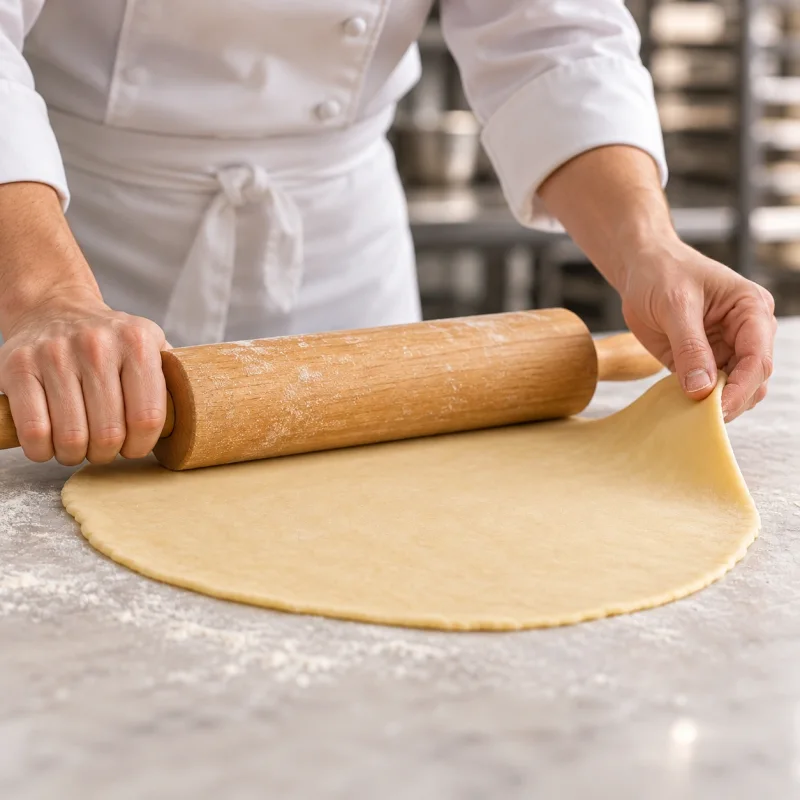
How to roll out dough without sticking, tearing, or shrinking
When dough misbehaves under the rolling pin, adding more flour is not automatically the right fix. First identify what the dough is actually doing. Local sticking, greasy softening, cracking in cold shortcrust, and elastic spring-back in wheat dough are four different states, and they need different responses.
If the dough only catches in a few spots, lift it and add a very light separating dusting of flour. If a fat-rich dough turns shiny, soft, or smears under the pin, chill it. If cold shortcrust cracks as soon as you press it, let it soften just enough to become pliable while remaining cool. If a smooth wheat dough stretches and then rapidly pulls back, cover it and let it rest so the internal tension can relax.
The key distinction is simple: flour helps with surface sticking, chilling helps overly soft fat-rich dough, and resting helps an elastic gluten network. None of these is a universal correction to the recipe itself.
The same principle applies when working with shortcrust pastry and strudel dough: preparation before rolling matters just as much as the movement of the rolling pin. Strudel dough is usually rolled only in the early stage; final thinness comes from controlled hand stretching. Some pizza doughs are also better shaped by hand if you want to preserve an airy rim.
Diagnose the symptom before choosing the fix
| What you see | What to check first | Best next step |
|---|---|---|
| Dough sticks in isolated spots but is not greasy | Does it release cleanly when lifted? | Lightly flour the surface and pin, then keep lifting the dough as you work |
| Fat-rich dough becomes shiny, soft, or greasy | Is it smearing and losing firmness? | Stop rolling and chill it flat until firm again |
| Cold shortcrust cracks at the edge on the first press | Is the slab too stiff to bend without cracking? | Let it stand briefly at room temperature and test pliability again |
| Smooth wheat dough springs back after every pass | Does it retract without crumbling or a greasy sheen? | Cover and rest the dough; do not fight it with extra force |
| Dough tears mostly at thin spots or edges | Are the edges much thinner than the centre? | Reduce pressure at the edges and even the thickness with short strokes from the centre |
This order of diagnosis prevents two common mistakes: working large amounts of extra flour into warm fat-rich dough, or trying to overpower a tense wheat dough with a harder rolling stroke.
Temperature matters most with fat-rich doughs
Shortcrust, puff pastry, and other doughs high in solid fat need to be cool enough for the fat to stay firm, yet pliable enough that the slab does not split under the rolling pin. When the dough is too cold, the edges can crack. When it is too warm, the fat softens, the surface turns shiny, and sticking increases quickly.
Do not judge readiness only by the number of minutes since the dough left the refrigerator. Press the edge or bend it slightly. Dough that is ready to roll should yield without crumbling, while your finger should not sink into a soft, greasy surface.
If the dough starts to smear while you work, do not keep adding thicker layers of flour. Place it on a flat surface, cover it, and chill until it is firm enough to release cleanly again. This matters especially with laminated doughs because softened fat and damaged layers reduce separation during baking.
Use flour as a separating layer, not a recipe correction
Dust a clean, dry work surface with only enough flour to create a thin film. Lightly dust the rolling pin as well. After a few strokes, lift the dough. If it still moves freely, you do not need more flour.
Excess flour gets pressed into the outside of the dough as you roll. Shortcrust edges can become drier and more crumbly; other doughs may develop tough, floury patches. If the dough is already dry and crumbles through the whole cross-section, extra flour makes the problem worse. Without knowing the actual recipe and ratios, it is not technically sound to prescribe either more flour or more liquid blindly.
For very soft or delicate dough, roll between two sheets of baking parchment. Peel the paper away from both sides from time to time and lay it back down. That reduces direct sticking without continuously working more dry flour into the dough.
Roll from the centre outward and keep the dough moving
Place the rolling pin near the centre and roll toward the edge. Return to the centre and repeat in another direction. Short, controlled strokes help keep the thickness more even than repeatedly pressing from one edge all the way across.
After a few strokes, lift the dough and, when the shape allows it, rotate it about a quarter turn. This is not only for making a circle. It immediately tells you whether the underside has started to stick, while changing rolling direction makes thick spots easier to detect.
Do not press harder on the edge just because you need a larger sheet. The edge thins faster than the middle and becomes the first place to tear. If you need a precise final thickness, rolling guides or spacer rings are useful as a final thickness limit; they do not solve wrong temperature, sticking, or dough tension.
If the dough springs back, give it time to rest
A smooth wheat dough that stretches under the pin and then quickly retracts is showing elastic tension. Do not keep forcing it thinner with harder passes. Cover it so the surface does not dry out, then let it rest. Continue only when the same test stroke produces noticeably less spring-back.
That gives you a useful control test: if the dough becomes easier to extend after resting, tension in the gluten network was a major part of the problem. If it also crumbles, feels dry, or breaks apart, gluten tension is not necessarily the only cause and the specific formula needs to be assessed.
With strudel dough, this distinction is particularly important. Rolling is generally only the first stage before gentle hand stretching. With pizza dough intended to have a puffy rim, vigorous rolling can press gas out of the edge, so hand shaping is often the better choice.
Repair small cracks locally instead of re-kneading
Small cracks at the edge of shortcrust can be pinched together gently and levelled with one short pass of the rolling pin. If a small piece is missing, patch it with a scrap of the same dough and press it into place without intensive kneading.
Re-kneading already rolled shortcrust warms the fat and increases mechanical work on the flour. Instead, stack scraps, press them gently into a slab, and chill before rolling again if necessary.
Long cracks through the centre call for diagnosis, not cosmetic repair. A cold, rigid slab needs more pliability; a shiny, soft slab needs chilling; markedly dry and crumbly dough needs the recipe checked. Adding flour to all three would be the wrong response.
Transfer rolled dough without stretching it
Do not lift a thin sheet by one edge. Its own weight stretches it and changes the thickness before it even reaches the tin. If needed, lightly flour the surface, drape the dough loosely around the rolling pin, and move it with both hands. Where the recipe allows, another option is to roll on parchment and transfer the dough together with the paper.
Lower the dough into the corners of the tin. Do not pull it over the rim or stretch it to gain a missing centimetre. Stretched dough can contract again during baking.
Before trimming, run one final control check: the dough should move freely on the surface, the thickness should be even, and there should be no greasy patches, pronounced dry cracks, or translucent thin spots. The last pass of the rolling pin should only level the surface—it cannot fix a problem that really needs temperature control, resting, or a change in pressure.
Diagnostics
Common problems and solutions
Dough sticks locally to the work surface but is not shiny or greasy.
Cause: Surface adhesion is too high and the separating layer is insufficient.
Solution: Lift the dough, add a very thin dusting of flour under the sticking area, and continue with short strokes.
Shortcrust or laminated dough becomes soft, shiny, and smears under the rolling pin.
Cause: The fat phase has softened too much during handling.
Solution: Stop rolling, cover the dough on a flat surface, and chill until firm again.
Cold shortcrust cracks at the edge on the first press.
Cause: The dough is too rigid or not pliable enough for its current thickness.
Solution: Let it stand briefly at room temperature and test pliability again; do not increase rolling force.
Smooth wheat dough quickly springs back to a smaller shape after rolling.
Cause: The gluten network is under elastic tension.
Solution: Cover and rest it; continue when the same test stroke produces less retraction.
Dough tears mainly at isolated thin spots or edges.
Cause: Pressure and thickness are unevenly distributed.
Solution: Roll from the centre outward, reduce pressure on thin areas, and use short final strokes to even the thickness.
Frequently asked questions
Answers to common questions
Is wood, stone, or metal the best surface for rolling dough?
The surface being flat, clean, and dry matters more than the material itself. Cooler stone or metal can help with fat-rich dough, but neither is a magic fix; condensation can actually increase sticking.
Are rolling-pin spacers useful?
Yes, when you need a repeatable final thickness. They limit how thin the dough can be rolled, but they do not fix soft fat, surface sticking, or elastic spring-back.
Why does dough still stick between two sheets of parchment?
Fat-rich dough may simply be too soft or too warm. Peel the paper from both sides and inspect the surface; if the dough is soft and shiny, chill it before continuing. Parchment reduces direct adhesion but cannot correct the dough condition.
How do I roll a more even round?
Start with an evenly shaped flat disk. Roll from the centre outward and rotate the dough as you work when the shape allows. Do not pull the edges into shape because that quickly creates thin spots.