Sourdough baking: how to diagnose dense, sour, or cracked bread
Dense crumb, strong acidity, and uncontrolled cracks do not share one cause. Read several signals together: starter activity, dough temperature, fermentation progress, loaf strength, oven spring, scoring, bake and cooling.
1. Dense or gummy crumb
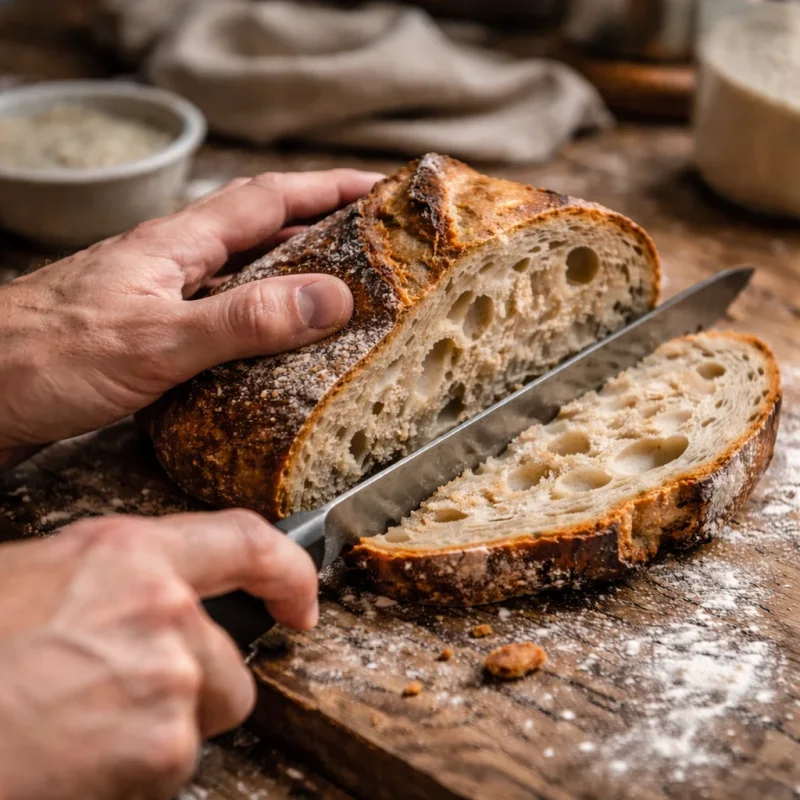
Large holes next to dense, gummy zones often point toward insufficient fermentation or a weak starter. A flat loaf with little oven spring may instead have fermented too far, although high hydration and weak gluten can look similar. A gummy crumb can also come from underbaking or slicing while the loaf is still hot.
Use bread-dough fermentation as the reference process and judge the dough, not the clock alone.
2. A sour loaf is not automatically a failed loaf
Acidity is part of sourdough's flavour profile. Starter maturity, inoculation, flour, time and temperature all change the balance. If you want a milder loaf, adjust one variable at a time rather than masking acidity with sugar.
3. Cracks in the wrong place
A score gives expanding dough a controlled weak point. If it is missing, too shallow, poorly placed, or the crust sets too early because steam is insufficient, the loaf may split elsewhere. Strong bursting together with a tight crumb can indicate underproofing; an overproofed loaf more often has little oven spring and spreads.
4. What to watch before baking
During bulk fermentation, track volume, bubbles, elasticity, surface tension and dough temperature. During final proof, check whether the loaf still holds shape while fermentation has clearly progressed. A poke test is only one clue, not a universal measurement.
5. Cold fermentation is a tool, not a reset button
Refrigeration slows fermentation and can improve scheduling and flavour control. It cannot rebuild a gluten network that has already degraded or reverse severe overfermentation. Start the cold phase when the dough is in the intended state.
Diagnostics
Common problems and solutions
Large holes appear next to dense, gummy crumb.
Cause: Insufficient fermentation or a weak starter.
Solution: Extend fermentation at the same temperature or improve starter activity.
The loaf spreads and gains almost no oven spring.
Cause: Overproofing or insufficient structural strength.
Solution: Shorten fermentation and separately check hydration and gluten development.
The loaf cracks away from the intended score.
Cause: Underproofing, unsuitable scoring, or insufficient steam.
Solution: Check proofing, score depth and direction, and the steam environment instead of assuming overproofing.
Frequently asked questions
Answers to common questions
Why is my sourdough bread dense with few holes?
Dense, sour, and cracked sourdough bread can have different causes; diagnose from several signals rather than one symptom. Distinguish fermentation, starter, baking, cooling, and scoring problems before changing the formula.
Why does sourdough bread taste too sour?
Dense, sour, and cracked sourdough bread can have different causes; diagnose from several signals rather than one symptom. Change one variable at a time and record dough temperature and fermentation time.
How can I recognize overfermented dough?
Distinguish fermentation, starter, baking, cooling, and scoring problems before changing the formula. Overproofed dough often loses oven spring and spreads.
Why does bread crack during baking?
Crack away from the score. Check proofing, score depth and direction, and the steam environment instead of assuming overproofing.
How do I know when dough is ready to bake?
Change one variable at a time and record dough temperature and fermentation time. Underproofed dough may show large irregular holes next to dense areas.
Does cold fermentation really help sourdough?
Distinguish fermentation, starter, baking, cooling, and scoring problems before changing the formula. Change one variable at a time and record dough temperature and fermentation time.