When Is a Sourdough Starter Strong Enough for a First Loaf?
A living starter is not automatically strong enough to raise bread
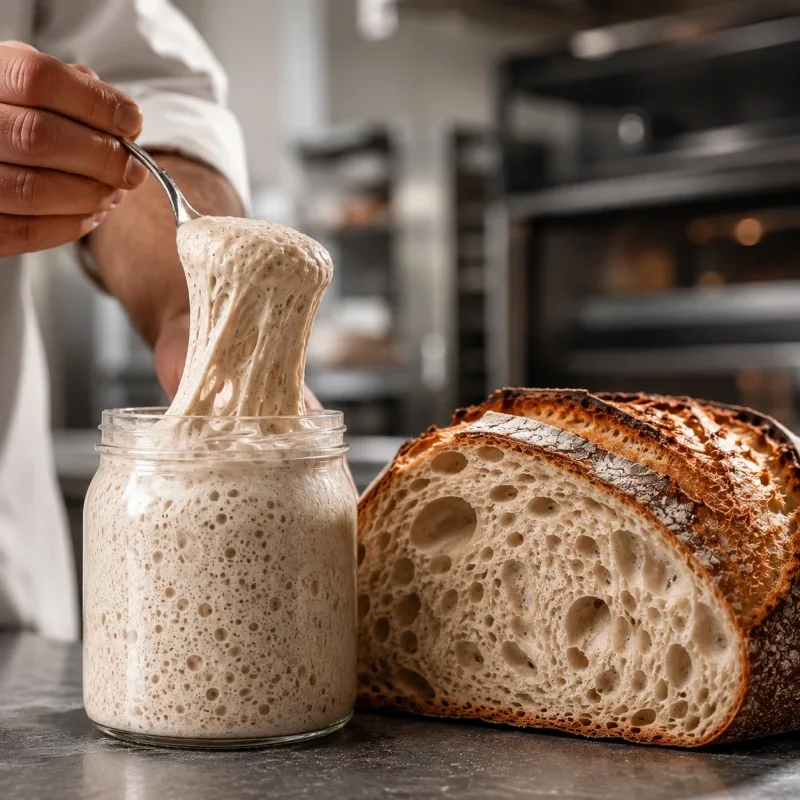
Lift a spoon from the jar and the starter stretches into a glossy, sticky strand. Bubbles line the glass, pockets of gas are visible through the paste, and the top is slightly domed and taut. This is where you need to separate two ideas: a starter can be alive without yet having enough leavening power for bread. For a first loaf, it needs to produce gas predictably enough for the dough to retain that gas through shaping and into the oven.
A useful beginner benchmark is a starter that repeatedly grows to roughly double its post-feeding volume within about 6–8 hours in a warm environment. A very active starter may be faster. The repeatable pattern matters more than a single number: look for a domed top near peak, bubbles against the jar, and a clean, pleasantly tangy aroma.
For your first loaf, do not chase a “perfect” starter. Chase repeatability.
If it surges once and barely moves at the next feed, it is not stable yet. If it collapses after only two hours, the feeding ratio may be too small or too much old, acidic starter may have been carried over. If it stays almost flat after 12 hours, it may need more warmth, fresher flour, or a few more days of regular feeding. A good first-loaf starter is not dramatic. It is predictable.
The First 7 to 10 Days Without False Alarms
An early burst of activity is not the same as a mature starter
New starters often mislead beginners. On day two or three the mixture can rise suddenly and smell intensely fermented, then appear almost quiet the following day. That does not prove baking strength. The microbial community, acidity, flour supply, and temperature are still settling into a more stable pattern.
For a simple feeding routine, you can use 30 g starter, 30 g water, and 30 g flour. Use water around 26–28°C (79–82°F) and keep the jar near 24–26°C (75–79°F). If development is slow, replace part of the white flour with whole-wheat or rye flour. Do not keep increasing the total mass every day. Retain a small portion and feed it with fresh flour and water so acidity does not build faster than leavening power.
Mold, pink discoloration, or a rotten smell means the starter should be discarded. Tangy, yogurt-like, fruity, floury, or lightly alcoholic aromas can occur during normal development. A sharp acetone-like smell usually means the starter is hungry and needs feeding.
Before making your first loaf, watch several feeds in a row. The goal is not a specific age in days but repeatable leavening performance: the starter rises on a similar schedule after feeding, reaches a clear peak, and then slowly begins to fall.
Your First Dough Tells the Truth
Too much water hides the problem in the bowl and reveals it on the bench
For a first loaf, use a formula you can control: 500 g bread flour, 330–350 g water, 100 g active sourdough starter, and 10 g salt. With many home-baking flours, 330 g water is the safer starting point. If the dough sits as a soft cohesive mass after mixing and gradually relaxes during the rest, the balance is workable. If it spreads like a thick batter, the hydration is probably too high for the flour’s strength.
Mix the flour with most of the water first and rest for 30–45 minutes. Then add the starter and salt. The dough can be sticky, but it should resist when stretched. That resistance matters: the flour is absorbing water and the gluten network is beginning to organize.
During the first two hours, perform 3 to 4 sets of stretch-and-folds about 30 minutes apart. Do not knead aggressively. Lift one side of the dough, stretch it to the point just before tearing, and fold it across the center. By the second or third set, the mass should look smoother, feel more elastic, and spread less.
If the dough tears immediately, it may need more rest. If it offers almost no resistance, the hydration may be too high or the flour too weak.
Bulk Fermentation Determines the Crumb Structure
The dough needs to rise without spending all of its strength
Bulk fermentation is the main fermentation period between mixing and shaping, and it is one of the biggest dividing lines between an airy and a dense loaf. Beginners often wait for a full doubling because that is familiar from commercial-yeast doughs. With sourdough, that can be too late. The dough needs to gain volume, gas, and strength while still retaining enough reserve for shaping and oven spring.
For this beginner wheat formula, at a dough temperature around 24–25°C (75–77°F), roughly 30–50% volume increase can be a useful starting benchmark — not a universal rule. Flour strength, whole-grain percentage, hydration, and temperature all change how much rise you see in the container. End bulk only when the rise is supported by process signs: bubbles along the sides, a slightly domed surface, a more aerated feel, and a gentle jiggle when the container is moved. The clock is only a framework. The dough decides.
A dark crust cannot rescue poor fermentation.
Shape too early and the loaf may still hold together on the outside while the crumb remains dense and damp. Wait too long and the dough becomes sticky, spreads, and loses tension. If it smells strongly acidic, looks wet, tears stickily, and starts collapsing, you are probably approaching over-fermentation. Next time, end bulk sooner or lower the dough temperature.
Shaping Should Preserve Gas, Not Squeeze Out the Crumb
Surface tension matters more than perfect geometry
When bulk is complete, turn the dough onto a lightly floured bench. Do not punch it down or deliberately press out the gas. Pre-shape it loosely and let it rest for about 20 minutes. Then final-shape: bring the edges toward the center, turn the smooth side up, and use short pulls against the bench to build surface tension.
The surface should look smooth, not torn.
If the shaped loaf spreads immediately, it either lacks surface tension or bulk fermentation has already gone too far. If the surface tears while you tighten it, there may be too much flour on the bench or you may be pulling too aggressively. The goal is not a hard ball; it is an elastic loaf that holds its shape while preserving gas inside.
For easier scheduling and cleaner scoring, use an overnight cold fermentation: cover the shaped loaf and refrigerate it at about 4–6°C (39–43°F). A cold proof can improve handling and flavor development, but it cannot repair underdeveloped dough or reverse over-fermentation.
Baking Should Confirm a Well-Fermented Dough
A hot Dutch oven helps, but it cannot replace fermentation
Preheat the oven to 250°C (482°F) with a Dutch oven, baking stone, or heavy baking surface inside. Turn the loaf onto parchment, score it with a sharp blade at roughly a 30–45° angle, and move it into the hot vessel immediately.
Bake covered for the first 20 minutes at 240–250°C (464–482°F). Uncover, reduce to 220–230°C (428–446°F), and continue for another 20–25 minutes. Steam in the covered vessel delays crust setting, giving the loaf time to expand. A fully baked lean sourdough loaf will typically reach an internal temperature around 96–98°C (205–208°F).
Do not cut it hot. The crumb continues to set as the loaf cools; slicing too early traps steam in a soft structure and can make the starch smear on the knife. Cool the loaf on a rack for at least 90 minutes.
When the Starter Is Not the Main Problem
Cold dough and weak flour can imitate a weak starter
If the dough is not rising, the starter is not always to blame. A useful target dough temperature after mixing is around 24–26°C (75–79°F). A much colder dough can look almost stalled even when fermentation is simply proceeding more slowly.
Sugar is not required for a basic bread dough to rise. Yeasts and bacteria gain access to sugars released from flour starch, so for a lean loaf, dough temperature is a far more useful control variable than adding sugar.
PEKI recommend changing only one variable at a time while learning your first sourdough loaf. Record the starter’s peak time, room and dough temperature, water quantity, bulk-fermentation duration, and how the dough feels during shaping. Then adjust one thing on the next bake: a little less water, more fermentation time, or a warmer dough. That turns every loaf into useful evidence instead of another guess.
Diagnostics
Common problems and solutions
The starter has bubbles, but the loaf stays low.
Cause: The starter is alive but its leavening power is not yet repeatable enough, or the dough was kept too cold or fermented too briefly.
Solution: First verify repeatable starter rise and dough temperature; extend fermentation only if the dough still lacks maturity signs.
The dough spreads after mixing and is hard to shape.
Cause: Hydration is too high for the flour being used or the gluten network is not developed enough.
Solution: Next time start with less water and increase it only after the flour shows enough strength.
The crumb is dense with very little aeration.
Cause: Bulk fermentation was too short, the dough was too cold, or the starter was not active enough.
Solution: Evaluate temperature, volume rise, bubbles, and dough tension together; do not fix the problem by time alone.
The dough is sticky, tears during shaping, and spreads quickly.
Cause: Fermentation may have gone too far or the dough structure may be too weak for the chosen hydration.
Solution: Next time end bulk earlier or reduce the water; also check flour strength.
Technical terms
Terms worth understanding
- Sourdough starter
- A fermented mixture of flour and water containing a community of yeasts and lactic acid bacteria that contributes to leavening and flavor development.
- Hydration
- The amount of water relative to total flour, expressed as a percentage; flour and water contributed by the starter should also be included in the calculation.
- Bulk fermentation
- The main fermentation of the entire dough mass after mixing and before dividing or shaping.
- Oven spring
- The increase in loaf volume early in baking while gases expand and the crust has not yet fully set.
Frequently asked questions
Answers to common questions
How old does a sourdough starter need to be before the first loaf?
There is no single required age in days. A more reliable criterion is that it rises on a similar schedule after several consecutive feeds and has enough leavening power for dough.
Does sourdough starter have to float in water?
No. The float test depends on hydration and trapped gas, so it is not a reliable proof of readiness. Repeatable post-feeding rise, bubble structure, and time to peak are better indicators.
Why is my first sourdough loaf dense?
Common causes are a starter that is not active enough, dough that is too cold or under-fermented, and hydration beyond the flour’s ability to build a stable structure.
How much should dough rise during bulk fermentation?
There is no universal number. For a beginner wheat formula, roughly 30–50% can be a useful starting point, but bubbles, a domed surface, aeration, and tension should confirm the decision.