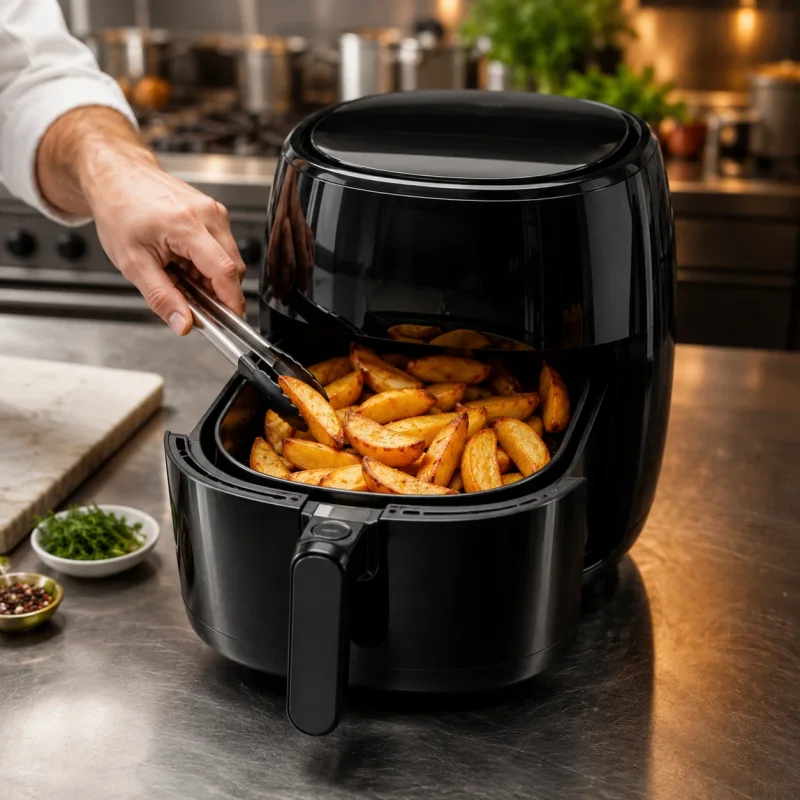
Air fryer cooking times and temperatures without guesswork
Air fryer time and temperature are starting points, not guarantees. Two appliances can behave differently at 180 °C because heater power, fan speed, basket geometry and presets vary. Always consider food thickness, basket load, starting temperature and the instructions for your model.
The repeatable sequence is simple: similar-sized pieces → room for airflow → sensible starting temperature → early check → one small adjustment at a time.
How to choose a starting setting
Before you press start, ask five questions: What are you cooking? How thick are the pieces? How full is the basket? Is the food fresh, chilled or frozen? How does your specific model behave? That is why “cook everything at 180 °C” is not a useful rule.
Practical starting settings
| Food | Amount | Starting temperature | Approximate time | What to check |
|---|---|---|---|---|
| Fresh fries | 800–1200 g | 180 °C | 18–25 min | golden surface, tender centre; shake during cooking |
| Frozen fries | 400 g | 180 °C | 12–16 min | even colour and crispness |
| Chicken wings | 6–8 pieces | 180 °C | 15–20 min | browned skin and properly cooked centre |
| Root vegetables | about 600 g | 180 °C | 16–20 min | browned edges and tender centre |
Treat these as first-batch calibration values for similar quantities. Manufacturer tables already vary by model, which is the clearest sign that no single chart can be absolute.
Change temperature or time?
If the surface is pale but the centre is nearly done, first check basket crowding and surface moisture. Only then consider a slightly hotter finish. If the surface darkens too quickly while the centre lags behind, lower the temperature and extend the time. If food is dry, start checking earlier and shorten the cook; use higher heat only briefly for colour if needed.
Basket load and airflow
An air fryer works by moving hot air quickly around the food. A dense layer blocks that path. For a large quantity, two smaller batches often beat one overcrowded basket. Shake or turn food when contact areas are staying pale or the browning is visibly uneven, not just because a timer says you must.
Do you need to preheat?
Not always. Some programs and recipes assume preheating, while other models are designed to start from cold. Follow the instructions for the specific appliance rather than a blanket “always preheat” rule.
How do you know the food is actually done?
For potatoes and vegetables, check tenderness in the centre plus colour and surface texture. Cakes and desserts need different cues; see How to Bake Cake in an Air Fryer Without Drying It Out. For meat and poultry, do not treat the timer or surface colour as a food-safety test. Use a validated recipe and, where appropriate, a clean food thermometer to check the centre.
An air fryer is not the same as a convection oven
Both move hot air, but they differ in cavity volume, distance from the heating element, air speed and control strategy. A rule such as “always subtract 20 °C and 20% of the time” is therefore only a rough heuristic, not a guarantee. For the oven side of the comparison, read Convection vs Conventional Oven for Baking: Temperature and Rack Position.
The PEK air fryer calibration method
For the first successful batch, write down only four things: the amount of food, piece size or thickness, temperature and actual time to the result you wanted. On the next batch, change one thing only. After two or three repetitions you have a useful setting for your model, basket and usual portion rather than a generic internet chart.
Common problems
Food is pale and soft
The usual causes are crowding, surface moisture or a start temperature that is too low. Reduce the load and dry the food before you reach for a higher temperature.
Outside is too dark but the centre is not ready
The temperature is too aggressive for the thickness. Lower it, cook longer and verify the centre of larger pieces.
Food is dry
Check earlier next time and shorten the cook. If the surface still needs colour, use a short hotter finish rather than extending the entire cook.
One side browns more
Make piece sizes more consistent and shake, rearrange or turn once during cooking.
The short answer
Reliable air-fryer cooking does not depend on one perfect temperature. It depends on a sensible starting profile and early checking. Respect the model, load and thickness, change one variable at a time and build settings that are proven for your own appliance.
Diagnostics
Common problems and solutions
The food is pale and soft.
Cause: The basket is overcrowded, the surface is wet or the starting temperature is too low.
Solution: Reduce the load, dry the surface and only then raise the temperature slightly near the end if needed.
The outside is too dark while the centre is still underdone.
Cause: The temperature is too high for the thickness of the food.
Solution: Lower the temperature and extend the cooking time; check the centre of larger pieces.
The food is dry.
Cause: The cooking time is too long, the temperature too high or the pieces too thin.
Solution: Check earlier next time and shorten the cooking time; use a hotter finish only briefly if the food still needs colour.
One side is browning more strongly.
Cause: Pieces are uneven, the basket is too full or airflow is not reaching all surfaces equally.
Solution: Make the pieces more uniform and shake, rearrange or turn them once during cooking.
Technical terms
Terms worth understanding
- air fryer calibration
- Repeating the same food while recording load, thickness, temperature and time until you have a dependable setting for your specific model.
- airflow
- The movement of hot air through the basket and around the food; overcrowding restricts it and changes cooking speed and evenness.
Frequently asked questions
Answers to common questions
Do I always need to preheat an air fryer?
No. It depends on the model and the recipe. Some manufacturers use preheating for certain programs; others explicitly design models to start without it. Follow the instructions for your appliance.
How often should I shake or turn food?
Small pieces of potatoes and vegetables often benefit from one shake or stir. Turn larger pieces if the underside is lagging. With a small load and strong airflow, it may not be necessary.
Can I simply convert an oven recipe to an air fryer?
Not with one universal formula. Air fryers differ in power, airflow and cavity size. Use the recipe as a starting point, check earlier and then change only one variable.
Why are my fries soft instead of crisp?
Check basket load and surface moisture first. An overcrowded basket and wet pieces trap steam. Reduce the load, dry the surface and shake during cooking when needed.
How do I know meat is safely cooked in an air fryer?
Do not judge from time or surface colour alone. Use a validated recipe and, where appropriate, a clean food thermometer to check the actual centre temperature.