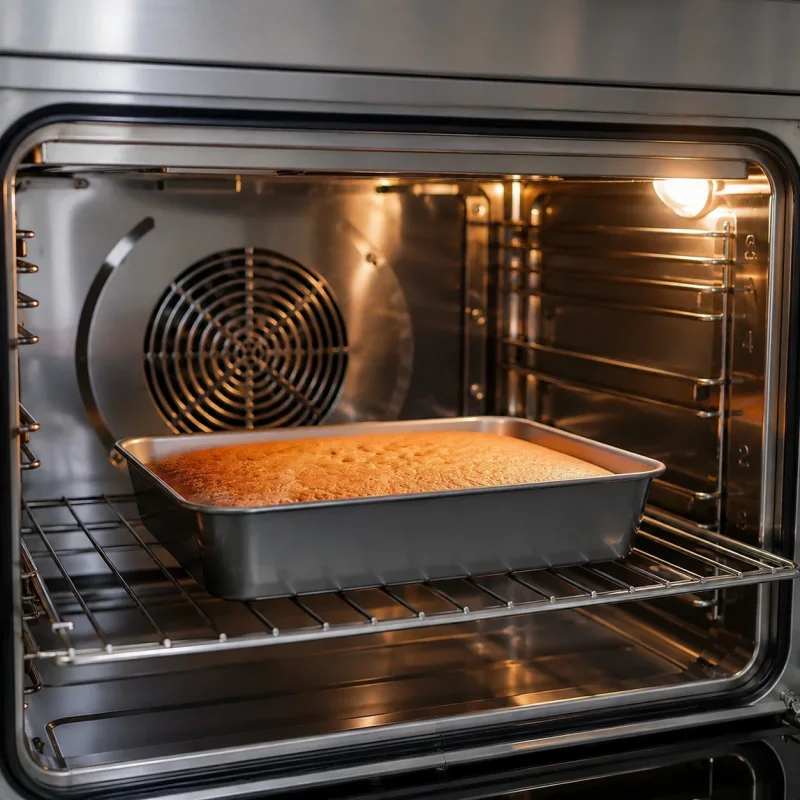
Convection is not automatically better — choose the heating mode first
Three settings drive most oven-baking results: heating mode, temperature, and rack position. In convection mode, a fan moves hot air around the oven cavity. That increases heat transfer at the food surface and helps moisture evaporate faster. It can improve browning and make multi-rack baking more practical, but it does not make convection the best setting for every cake, custard, or delicate batter.
For many baked goods on a single rack, conventional bake is a calm, predictable starting point. Still air can be useful when a delicate cake needs time to rise and set before the surface dries or browns too aggressively.
The most useful troubleshooting rule is simple: do not change convection, temperature, and rack position all at once. Change one variable, observe the result, and then decide what to adjust next.
How much should you lower the temperature for convection?
For recipes written for conventional baking, a common US starting adjustment is about 25°F lower (roughly 15°C) when switching to convection. GE, Whirlpool, and King Arthur all use this general rule. Some European manufacturers use about a 20°C reduction, so your oven manual and the specific mode still take priority.
For example, a recipe written for 350°F conventional bake might be tested at about 325°F convection. If your oven has an automatic convection-conversion feature, do not reduce the temperature a second time.
If the top is browning too quickly while the center is still behind, lowering the set temperature is usually a better first correction than simply cutting the baking time.
Which oven rack position should you use?
For many cakes and single-pan bakes, the center rack is a sensible starting point. It places the pan away from the strongest direct influence of either the top or bottom heating zone.
Rack position is not cosmetic, though. It changes the balance of heat:
- top browning too fast: try one rack lower;
- bottom too pale: try one rack lower or a mode with stronger bottom heat;
- bottom too dark: move the pan higher;
- pizza, tarts, and crisp-bottomed bakes: a lower rack plus a preheated stone or steel may work better.
Always give the recipe and your oven manufacturer's rack guidance priority over a universal “middle rack” rule.
When conventional bake can be the better choice
A still oven environment can be helpful for delicate batters that need a controlled rise and gradual setting. Whirlpool specifically notes that some cakes and other delicate pastries may benefit from conventional heat rather than more intense moving air.
That does not mean cakes cannot be baked with convection. It means the fan is a tool, not a quality upgrade that should always be switched on.
When convection really helps
Convection is especially useful when you want to:
- move heat more actively around the oven cavity;
- bake on more than one rack;
- promote stronger surface browning or crisping;
- remove surface moisture more quickly;
- bake multiple trays of cookies or small pastries more evenly.
If a trusted recipe specifically calls for conventional bake, start there. Once you know the baseline result, you can compare a convection version intentionally.
Preheating: when it matters most
Cakes, biscuits, cookies, and other relatively short bakes often depend on entering an oven that has already reached a stable target temperature. If the batter goes into a cold oven, the warm-up period becomes part of the recipe and can change lift, crust formation, and total baking time.
Some modern oven programs are explicitly designed to work without full preheating. In those cases, follow the manufacturer instructions. “Always preheat” and “never preheat” are both too broad as universal rules.
How to tell whether the center is actually baked
Surface color is not enough. A cake can look dark and finished on top while the center is still structurally weak.
For sponge cakes and similar batters, use several signals together:
- the center no longer looks liquid or visibly sloshes;
- the surface springs back after a very light touch;
- the edge may begin to pull slightly from the pan when that is normal for the recipe;
- the recipe's skewer or toothpick test shows no raw batter in the center.
Bread, cheesecake, pies, and custards need different doneness criteria. A toothpick is not a universal oven test.
Fast oven troubleshooting
Top is too dark, center is underbaked
The oven may be too hot for the product, the pan may be too high, or convection may be drying and browning the surface too quickly. Lower the temperature first. If needed, move the pan one rack lower or compare with conventional bake.
Bottom is too dark
The pan may be too low, the bakeware may absorb heat aggressively, or the selected mode may emphasize bottom heat. Move the pan higher and change nothing else on that test bake.
Bottom is pale but the top is done
Move the pan lower. For pizza, tarts, and similar products, a preheated stone or steel or a mode with stronger bottom heat can improve the base.
One side always browns more
If the same side runs darker across different foods, your oven probably has a repeatable hot zone. For stable products, rotate the pan 180 degrees later in the bake. Do not rotate delicate batters before their structure has set.
The same recipe dries out in convection
Next time, lower the convection temperature or return to the heating mode the recipe was written for. Merely shortening the time can leave the center underbaked.
PEKI recommend: build a map of your own oven
For your next few bakes, record only three things:
- heating mode;
- temperature;
- rack position.
Then change one variable at a time. After a handful of repeat bakes, you will know your oven far better than if you keep changing several settings whenever something looks wrong.
Good oven baking is not about always using the same mode. It is about understanding how air movement, temperature, and rack position affect the specific food you are baking.
Diagnostics
Common problems and solutions
Top or edges are too dark while the center is underbaked.
Cause: Temperature is too high, the pan is too high, or convection is browning and drying the surface too quickly.
Solution: Lower the temperature first; if needed, move the pan lower or compare with conventional bake.
Bottom is too dark while the top is correct.
Cause: Pan is too low, bakeware absorbs heat aggressively, or the mode emphasizes bottom heat.
Solution: Move the pan higher and check bakeware and heating mode.
Bottom is pale while the top is already done.
Cause: Too little energy reaches the base or the pan is too high.
Solution: Move the pan lower or use a suitable mode with stronger bottom heat if the recipe allows.
One side repeatedly browns more.
Cause: The oven has a repeatable hot spot.
Solution: Rotate stable bakes 180° later in the bake and document the hot zone.
The same recipe dries out in convection.
Cause: Moving air increases heat transfer and surface evaporation.
Solution: Lower the convection temperature or return to the heating mode the recipe was written for.
Cake colors early but the structure is not set.
Cause: The surface receives energy faster than the center can set.
Solution: Lower the temperature and test a lower rack before making other changes.
Technical terms
Terms worth understanding
- Convection
- An oven mode that uses a fan to move hot air and increase heat transfer at the food surface.
- Conventional bake
- A non-fan baking mode that relies primarily on upper and lower heating elements and natural air movement.
- Center rack
- A rack position near the middle of the oven cavity.
- Hot spot
- An area of the oven that repeatedly browns food more strongly.
- Preheating
- Bringing the oven to its target operating temperature before loading the food.
Frequently asked questions
Answers to common questions
Is convection always better for baking?
No. Convection increases air movement and heat transfer, but delicate cakes and batters may benefit from the still environment of conventional bake.
How much should I reduce the temperature for convection?
About 25°F (15°C) is a common US starting adjustment. Some manufacturers use about 20°C, so follow the recipe and your oven manual first.
What rack should I use for cake?
The center rack is a good starting point for a single cake unless the recipe says otherwise. If the top browns too quickly, test a lower rack or lower temperature.
Why is the top dark but the center still raw?
The surface is getting too much heat before the center sets. Lower the temperature and, if needed, move the pan lower.
Why is the bottom pale?
The pan may be too high or receiving too little bottom heat. A lower rack or more suitable heating mode can help.
Should I rotate the pan during baking?
If your oven has a repeatable hot spot, stable baked goods can be rotated 180° later in the bake. Do not rotate delicate batters before the structure has set.