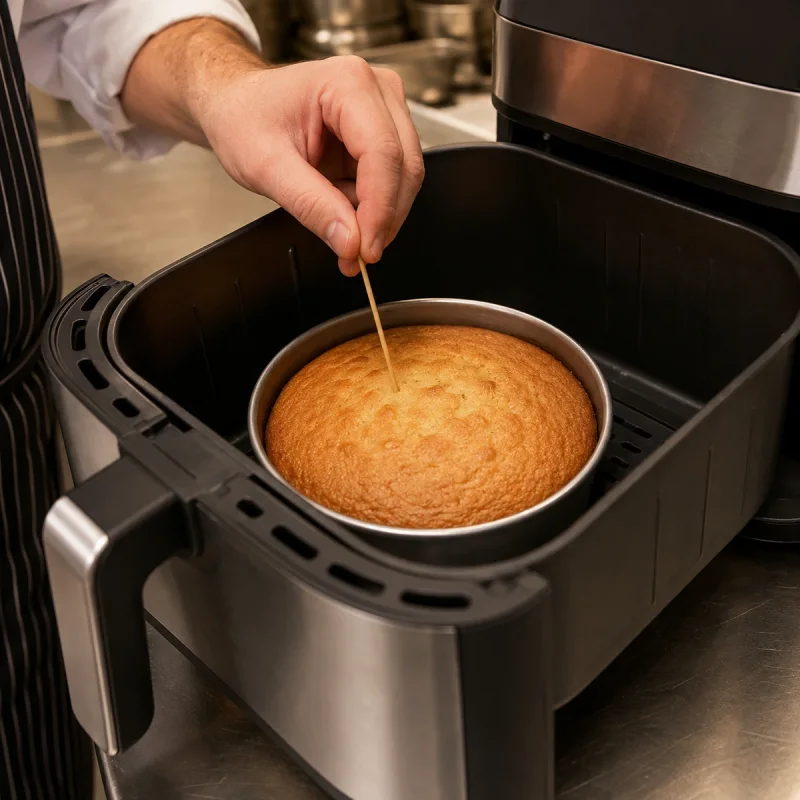
Why air fryer cake can dry out so quickly
The biggest mistake when baking cake in an air fryer is looking for one universal temperature-and-time conversion. Air fryers differ in wattage, basket size, heater position and airflow. The result also changes with the size and material of the pan, the depth of the batter and the type of bake.
If the top is browning fast while the centre is still underbaked, do not simply keep cooking at the same setting. On the next attempt, adjust the starting temperature, batter depth or pan and begin checking the centre sooner. The goal is not the darkest possible crust. It is the point at which the crumb has just set without losing more moisture than necessary.
An air fryer is therefore not a conventional oven with a single conversion factor. Moist, evenly baked cake depends on the interaction between pan size, airflow, batter depth and a reliable doneness test.
Start with the pan, airflow and batter depth
For cakes, muffins, brownies and other batters that rise, use an oven-safe pan or tin that fits inside the basket while leaving room for hot air to circulate around it. A pan that almost seals the basket changes how heat reaches the food: the top may brown aggressively while the centre warms much more slowly.
Philips specifically advises leaving space around a baking tin so air can pass around it, and its guidance for cakes, muffins and breads warns against overfilling a pan with rising batter. Bosch publishes model-specific programmes and timings for its air fryers, reinforcing the same principle: a number from one machine is not a physical constant for every air fryer.
A better workflow is to start with a recipe or manufacturer setting that is appropriate for your machine, observe what the bake actually does, then make a targeted adjustment next time.
Use the right doneness signal for the type of bake
| Bake | What tends to go wrong in an air fryer | Useful sign that it is nearly done |
|---|---|---|
| Muffins and small cakes | The top colours before the centre sets | Top is stable, centre springs back lightly, and a tester has no liquid batter |
| Small layer or loaf cakes | A deep mass of batter slows heat reaching the centre | Centre is no longer liquid or deeply sunken; edges are baked but not dry |
| Brownies | A few extra minutes can turn fudgy into dry | Centre is set to the degree required by the recipe, not hard and dried out |
| Filled puff pastry | Filling can keep the lower layers damp | Layers are lifted and baked through around and beneath the filling |
| Cookies | Small portions overbake very quickly | Edges are set while the centre remains as soft as the recipe intends |
Surface colour is not enough. In the compact cavity of an air fryer, strong top heat and fast-moving air can produce a convincing golden crust before the centre has finished baking.
What to do when the top is done but the centre is still raw
Check four variables.
- Batter depth. A deeper layer takes longer for heat to reach the centre.
- Distance from the heating element. In some basket designs, the top of the cake sits very close to the heat source.
- Airflow. An oversized pan or an overfilled basket can disrupt circulation around the bake.
- Starting setting. A conventional-oven recipe is not automatically a direct air-fryer setting.
Do not treat a dark top as proof that the middle is done. For cakes and muffins, use a skewer or another test appropriate to that recipe. For brownies and deliberately moist bakes, a completely clean skewer may not be the target; the doneness test must match the intended texture.
How to keep air fryer cake moist without changing the recipe
A dry crumb does not automatically mean the formula needs extra fruit, fat or liquid. Very often the bake simply stayed in the heat too long after the structure had already set. With small cakes and muffins, the window between properly baked and noticeably dry can be short.
When testing a new recipe, start checking earlier rather than blindly following the timing from someone else's machine. Keep multiple portions similar in size so they bake at a comparable rate. Once the centre is properly set, do not extend the bake just to force a darker colour onto the top.
It also helps to keep a simple record: air fryer model, pan size and material, amount of batter, starting programme or temperature, when you first checked it and which doneness signal told you to stop. That record is more useful than a generic rule such as “always reduce the oven temperature by 20°C” or “always cut the time by 20%”.
Parchment must not interfere with airflow
Baking parchment can be useful, but it needs to be suitable for the temperature and positioned so the fan cannot lift it towards the heating element. A loose sheet should not be left unweighted in a running air fryer.
The same underlying rule applies to silicone, metal, ceramic and glass: use cookware that is oven-safe and small enough to preserve the airflow the appliance needs. If the manufacturer specifies a maximum pan or tin size for your model, that guidance should take priority over a generic internet tip.
Preheating is not a universal requirement
Some air fryers and recipes call for preheating; others are designed to start from cold. “Always preheat your air fryer for a few minutes” is therefore too broad to be technically reliable.
For repeatable baking, the important point is consistency. If a recipe was successfully tested with preheating, repeat that start condition. If a manufacturer-designed bake programme is intended to start without preheating, do not add a preheat step simply because another model uses one.
Common air fryer cake problems and the next adjustment to make
The top is very dark but the centre is wet
Likely cause: the setting is too aggressive for the combination of your appliance, pan and batter amount, or the batter layer is too deep.
Next attempt: start more gently, use less batter or a better-fitting pan, and make sure air can still move around the pan.
The cake is evenly baked but dry
Likely cause: baking continued for too long after the crumb had already set.
Next attempt: begin checking sooner and stop as soon as the correct doneness signals for that bake are reached.
One side is much darker
Likely cause: basket geometry, pan position or airflow is producing uneven heat exposure.
Next attempt: position the pan as the appliance instructions recommend and avoid blocking vents or circulation paths with oversized liners or cookware.
The parchment lifts during cooking
Likely cause: the paper is not held down by batter or food, or the sheet is too large for the basket.
Next attempt: use only the amount of parchment you actually need and never leave a loose sheet in a strong airflow.
The PEKI approach: record the state, not just the minutes
When adapting a cake to your air fryer for the first time, record:
- the appliance model and basket size,
- the type and size of pan or tin,
- the approximate batter amount and depth,
- the starting setting,
- when the surface began to brown strongly,
- the signal you used to judge the centre,
- the texture after cooling.
That turns the next adjustment into a response to real evidence rather than a generic conversion chart. Once the result is repeatable, you have a useful setting for your recipe, your pan and your air fryer.
Air fryers can be excellent for small cakes, muffins, brownies, cookies and pastry, but the advantage does not come from one magic time or temperature. Good results come from controlled heat transfer: preserve airflow, choose the right pan, judge the centre separately from the colour of the top and stop baking as soon as the structure is ready.
Diagnostics
Common problems and solutions
The top is very dark while the centre is still wet.
Cause: The setting is too aggressive for the combination of air fryer, pan and batter amount, or the batter layer is too deep.
Solution: On the next attempt, start more gently or use less batter and check that air can move around the pan. Judge doneness at the centre as well as the surface.
The cake is evenly baked but dry.
Cause: Baking continued too long after the centre had already set.
Solution: On the next attempt, start checking sooner and stop once the correct doneness signals for that bake are reached.
One side is much darker.
Cause: Basket geometry, pan position or loading is affecting the hot-air path.
Solution: Follow the appliance guidance for pan placement and make sure the pan or accessories do not block airflow.
Parchment lifts during cooking.
Cause: The paper is not weighed down by batter or food, or the sheet is too large for the basket.
Solution: Use only as much parchment as needed and never leave a loose sheet empty in strong airflow.