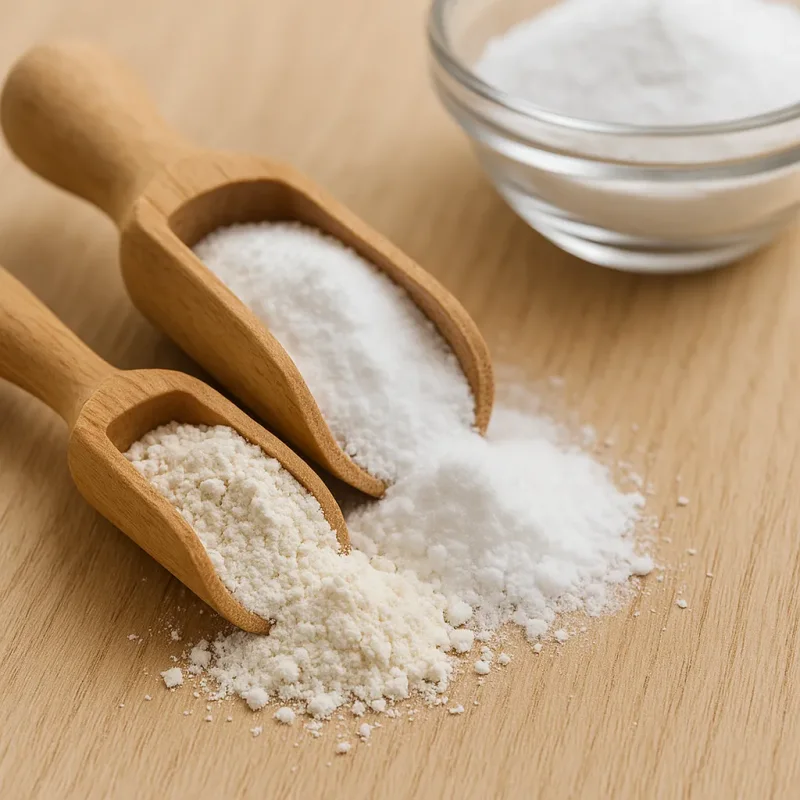
Baking powder instead of baking soda: the amount is only half the decision
If a recipe calls for baking soda and you only have baking powder, a common emergency starting point is about three times as much baking powder by volume. That does not make the two ingredients chemically equivalent.
Baking powder already contains acid components and a carrier in addition to sodium bicarbonate. Swapping it in changes more than lift: it can change the batter’s pH, flavor, color, crumb and spread.
First ask why the recipe uses baking soda
Baking soda is sodium bicarbonate, a base. With moisture and an acid, it produces carbon dioxide that helps leaven a batter or dough. Clear acid partners include buttermilk, yogurt, lemon juice, vinegar and natural cocoa.
Baking powder is a complete chemical-leavening system containing a base, one or more acids, and usually starch or another carrier. Many commercial products are double-acting, with gas released during mixing and again with heat. Formulations vary, so the package directions always outrank a generic rule.
What the 3:1 guideline really means
If a recipe asks for 1 teaspoon baking soda, about 3 teaspoons baking powder is a widely used emergency substitute for leavening power.
But that larger amount also adds the baking powder’s acids and carrier. It cannot reproduce baking soda’s role in neutralizing recipe acid or raising pH.
So 1 teaspoon soda = 3 teaspoons powder is not a recipe identity. It is a practical fallback when you accept that flavor, browning, crumb or spread may shift.
When is the swap least risky?
It is more workable in simple cakes, muffins and quick batters where soda’s main job is lift and a small pH change is not central to the product.
Use more caution in formulas with substantial buttermilk, yogurt, citrus or another acidic ingredient. Baking soda may be there specifically to neutralize part of that acidity. Remove it and the batter can remain more acidic.
Cookies deserve extra caution. Baking soda can raise pH, encourage browning and influence spread. Baking powder often pushes the balance toward a different height-to-spread profile.
Natural cocoa and Dutch-process cocoa are not interchangeable here
Natural cocoa is generally more acidic and can act as an acid partner for baking soda. Dutch-process cocoa is alkalized and less acidic.
That means “the recipe contains cocoa” is not enough information. Check the cocoa type and the rest of the formula before deciding what the soda is doing.
Why do some recipes use both leaveners?
Because the jobs can be complementary.
Baking soda can neutralize some acid, alter pH and contribute lift. Baking powder can provide additional, more self-contained chemical leavening. If a formula specifies both, do not assume one is unnecessary.
What can change after the substitution?
By increasing pH, baking soda can promote Maillard browning. Replace it with baking powder and a product may bake paler, spread differently or develop a different crumb. A large dose of baking powder can also create an unpleasant chemical or bitter note.
Those changes are not random. The chemistry of the formula has changed.
Three questions before you swap
- Does the recipe contain a clear acidic ingredient?
- Are strong browning or spread important to the intended result?
- Does the recipe use baking soda and baking powder together?
If the second or third answer is yes, the original formula is usually the safer choice. For a simple cake when you are genuinely out of soda, roughly three times the baking powder can be a reasonable emergency option.
What PEK recommends
Do not treat baking soda and baking powder as the same leavener in different packaging. Identify the acid and the function of the soda first.
Use the 3:1 guideline when you need a practical fallback, not as an automatic conversion. When pH, color, flavor or spread defines the bake, waiting for baking soda is the more reliable decision.
Frequently asked questions
Answers to common questions
Can I replace baking soda with baking powder 1:1?
No. Baking powder is less concentrated as a source of sodium bicarbonate and already contains acid. About three times the volume is a common emergency guide, but the baked result may still differ.
Why can the flavor change?
A larger dose of baking powder adds acid salts and carrier ingredients, while removing baking soda also changes how much recipe acid is neutralized.
Is the swap safe for cookies?
It is often more noticeable in cookies because baking soda can affect browning and spread. If those properties are part of the target texture, keep the original soda.
Why do some recipes use both?
Baking soda can neutralize acid and change pH, while baking powder supplies additional leavening. Their functions can be intentionally complementary.