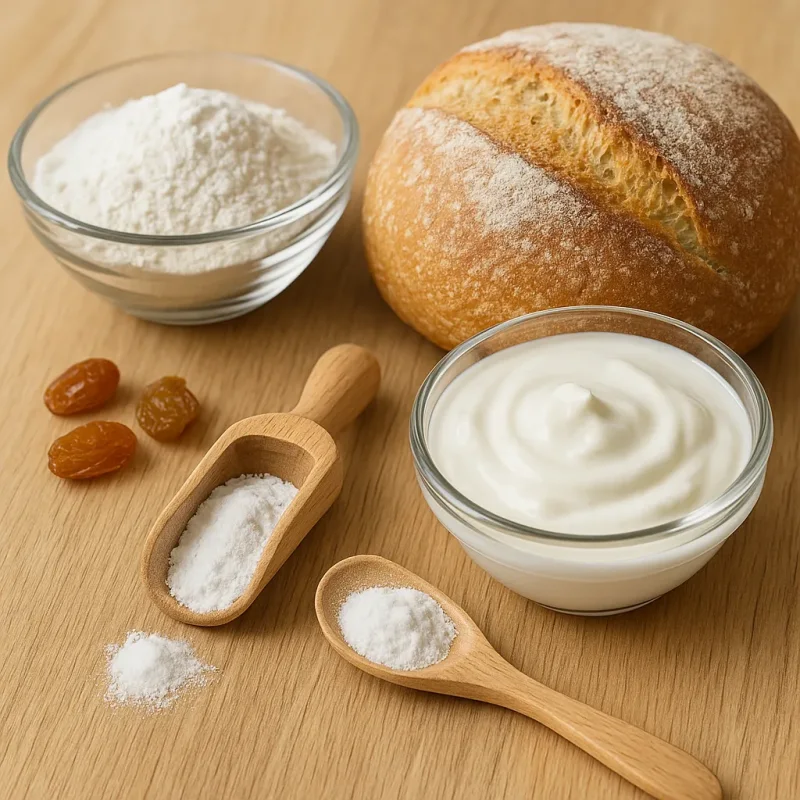
There is no universal 1:1 substitute for yeast
If you run out of baker’s yeast, answer one question first: do you still need fermentation, or are you happy to make a quick chemically leavened dough instead? That decision determines the right replacement.
Fresh yeast and dry baker’s yeast are different forms of the same biological leavening system and can be converted. An active sourdough starter can provide fermentation, but it changes the flour, water, timing, and often the flavor of the formula. Baking powder and baking soda work chemically and do not replace fermentation. They create a different type of dough.
Fresh yeast and dry baker’s yeast
The least disruptive swap is fresh yeast ↔ dry baker’s yeast because fermentation remains the same kind of process. For instant yeast, a useful starting point is about 1 g instant yeast for 3 g fresh yeast. In practical terms, 21 g fresh yeast is roughly 7 g instant yeast.
Active dry yeast and instant yeast are not always dosed in exactly the same way. Check the manufacturer’s directions; the package instructions take priority over any general conversion factor.
Can sourdough starter replace commercial yeast?
Yes, if you have an active starter and enough time. Sourdough contains wild yeasts and lactic acid bacteria, so it keeps biological fermentation in the recipe. But it is not a gram-for-gram replacement.
Starter contributes both flour and water. Those amounts need to be accounted for in the formula, and fermentation time will change. If your starter is not already active and ready to bake with, it is not an instant emergency substitute for yeast today.
Baking powder creates a different kind of bake
Baking powder releases carbon dioxide through a chemical reaction. It does not need hours of fermentation. It works well in quick breads, biscuits, muffins, cakes, and other formulas designed around chemical leavening.
It is not a true 1:1 replacement for baker’s yeast in classic bread, pizza, brioche, or other fermented doughs. If you need bread without yeast, choose a recipe developed for baking powder or baking soda rather than replacing one ingredient in a yeast dough and expecting the same result.
Baking soda needs acid
Baking soda needs enough acid in the formula, such as buttermilk, yogurt, kefir, lemon juice, or another appropriate acidic ingredient. The balance matters. Too much soda can leave an alkaline or soapy taste; too little acid can leave the reaction incomplete.
Yogurt, buttermilk, and kefir are not universal leaveners by themselves. In these recipes they mainly supply acidity for the baking soda reaction.
Choose by the result you need
| Situation | Best route | What changes |
|---|---|---|
| You have dry yeast instead of fresh | Convert baker’s yeast | Fermentation remains the same process |
| You have active sourdough starter | Adjust flour, water, and timing | Fermentation remains, but the formula changes |
| You have no yeast and need bread today | Use a quick-bread formula built for baking powder/soda | You are making a different type of dough |
| You want classic pizza or brioche texture | Use baker’s yeast or a properly adapted active starter | Do not swap in chemical leavening 1:1 |
Beer is not a reliable dose of yeast
Beer can contribute flavor and liquid, but commercial beer is not a standardized source of active baker’s yeast. It may be filtered or pasteurized, and its viable yeast content is unpredictable. Use beer in a recipe designed as beer bread, not as a substitute for a measured amount of baker’s yeast.
Raisin water or other fruit-based wild cultures are also separate fermentation systems. Their activity depends on how the culture was built and maintained. They can be useful advanced techniques, but they are not fast or predictable 1:1 yeast substitutes.
Sourdough is not “yeast-free”
Sourdough starter contains wild yeasts. A sourdough loaf is therefore not microbiologically yeast-free, even if it contains no added commercial baker’s yeast. If you avoid yeast for a medically confirmed reason, do not assume sourdough is automatically suitable; use an intentionally yeast-free recipe and follow individual medical guidance.
Common substitution mistakes
- Do not replace yeast with baking powder or baking soda gram for gram.
- Do not leave chemically leavened dough to proof for hours like a yeast dough.
- Do not use baking soda without sufficient acid.
- Do not add sourdough starter without accounting for its flour and water.
- Do not expect the same aroma, extensibility, and fermented structure from chemical leavening.
The rule that prevents most failures
When you change the family of leavening, you usually need to change the recipe method too. Fresh and dry baker’s yeast can be converted because both preserve fermentation. Active sourdough can take over fermentation with formula and timing adjustments. Baking powder and baking soda mean switching to a quick, chemically leavened dough.
Diagnostics
Common problems and solutions
A classic yeast dough lacks the expected structure after swapping in baking powder.
Cause: The leavening mechanism was changed, not just the form of yeast.
Solution: Use a formula designed for chemical leavening or return to baker’s yeast/an adapted sourdough formula.
Baking-soda dough tastes soapy or bitter.
Cause: There is too much soda or not enough acid.
Solution: Balance soda and acid using a tested formula.
A sourdough-converted dough is too soft.
Cause: The starter’s flour and water were not accounted for.
Solution: Subtract the flour and water already contained in the starter.
Technical terms
Terms worth understanding
- Baker’s yeast
- A Saccharomyces cerevisiae culture that leavens dough through biological fermentation.
- Sourdough starter
- An active flour-and-water culture containing wild yeasts and lactic acid bacteria.
- Baking powder
- A chemical leavener containing acid and base components that releases gas without fermentation.
- Baking soda
- Sodium bicarbonate, which needs enough acid in the formula to react effectively.
Frequently asked questions
Answers to common questions
Can I use baking powder instead of yeast?
Yes in a quick bread or bake designed for baking powder. In classic fermented bread or pizza it is not an equivalent 1:1 swap because there is no fermentation.
How much dry yeast replaces fresh yeast?
For instant yeast, fresh : instant at roughly 3 : 1 is a useful starting point. Follow the manufacturer’s directions for the specific product.
Can sourdough starter replace yeast?
An active starter can provide fermentation, but flour, water, and time must be adjusted. There is no universal gram-for-gram conversion.
Is sourdough bread yeast-free?
No. Sourdough starter contains wild yeasts, so sourdough is not microbiologically yeast-free.
Can I use beer instead of yeast?
Beer is not a reliable standardized dose of active baker’s yeast. Use it in a formula designed as beer bread rather than as a random yeast swap.