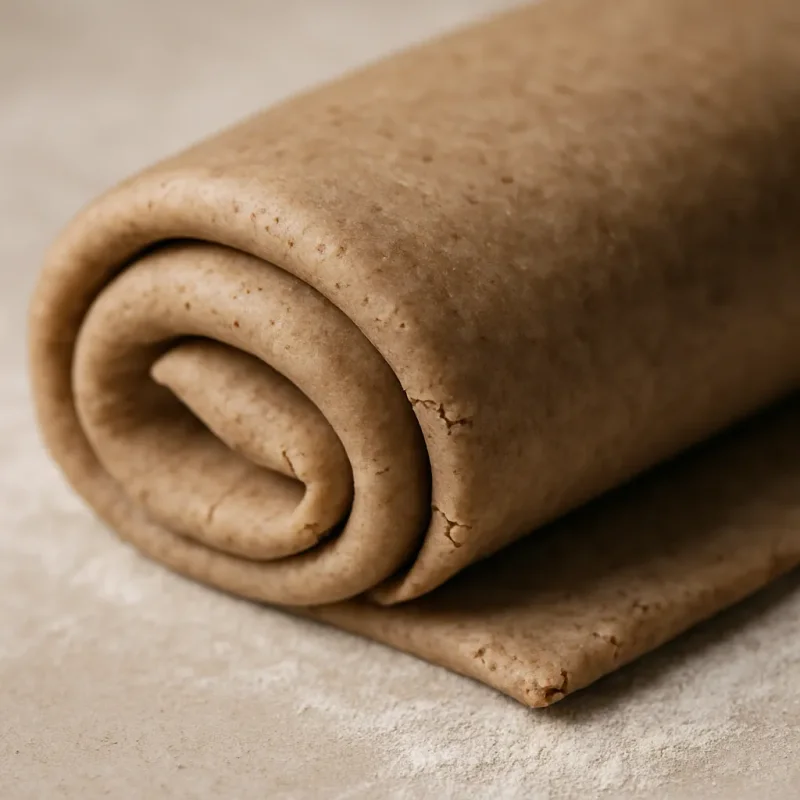
How to make buckwheat dough for paleo-style pastries without cracks
Too little liquid, incomplete hydration, or too much buckwheat flour. Add water 2–3 g at a time, bring the dough together and rest at least 10 minutes.
The dough breaks into dry pieces on the first pass of the rolling pin.
Too little liquid, incomplete hydration, or too much buckwheat flour. Add water 2–3 g at a time, bring the dough together and rest at least 10 minutes.
The centre stays smooth but the edge opens into deep radial cracks.
The edge is too thin, the dough too cold, or rolling pressure too strong. Temper 5–15 minutes, press damaged edges together through paper and roll more lightly.
The dough sticks to paper and loses shape during transfer.
The fat warmed up, there is too much liquid, or the rolled dough was not chilled. Chill about 10 minutes; if still too soft, add a little of the original dry blend.
Gluten-free and lactose-free baking.
Dough is sticky, dry or tearing.
Diagnostics
Common problems and solutions
The dough breaks into dry pieces on the first pass of the rolling pin.
Cause: Too little liquid, incomplete hydration, or too much buckwheat flour.
Solution: Add water 2–3 g at a time, bring the dough together and rest at least 10 minutes.
The centre stays smooth but the edge opens into deep radial cracks.
Cause: The edge is too thin, the dough too cold, or rolling pressure too strong.
Solution: Temper 5–15 minutes, press damaged edges together through paper and roll more lightly.
The dough sticks to paper and loses shape during transfer.
Cause: The fat warmed up, there is too much liquid, or the rolled dough was not chilled.
Solution: Chill about 10 minutes; if still too soft, add a little of the original dry blend.
The baked base is hard and rubbery.
Cause: Too much psyllium or another strong binder.
Solution: Limit psyllium to about 1–1.5% of the flour-and-starch blend by weight.
The base falls apart when lifted from the tin.
Cause: It was too thin, insufficiently bound, or removed before the structure stabilized.
Solution: Keep an even thickness and leave it in the tin for at least 10–15 minutes after baking.
Technical terms
Terms worth understanding
- Pseudocereal
- A plant that is not botanically a cereal but whose seeds are used similarly; buckwheat belongs to this group.
- Hydration
- The binding of water in flour, starch and fibre during mixing and resting.
- Binder
- An ingredient such as psyllium that retains water and helps bind gluten-free dough particles.
- Dough plasticity
- The ability of dough to change shape under pressure without tearing or immediately springing back.
Frequently asked questions
Answers to common questions
Is light or dark buckwheat flour better?
Finely milled lighter buckwheat flour usually gives a more delicate dough; darker flour may need more liquid and a longer rest.
Can I make the dough a day ahead?
Yes. Keep it tightly covered in the refrigerator and let it warm enough before rolling to bend without crumbling.
Can I replace almond flour with coconut flour?
Not 1:1. Coconut flour binds much more water, so the whole formula must be rebalanced.