Gluten-free dough structure does not come from one ingredient
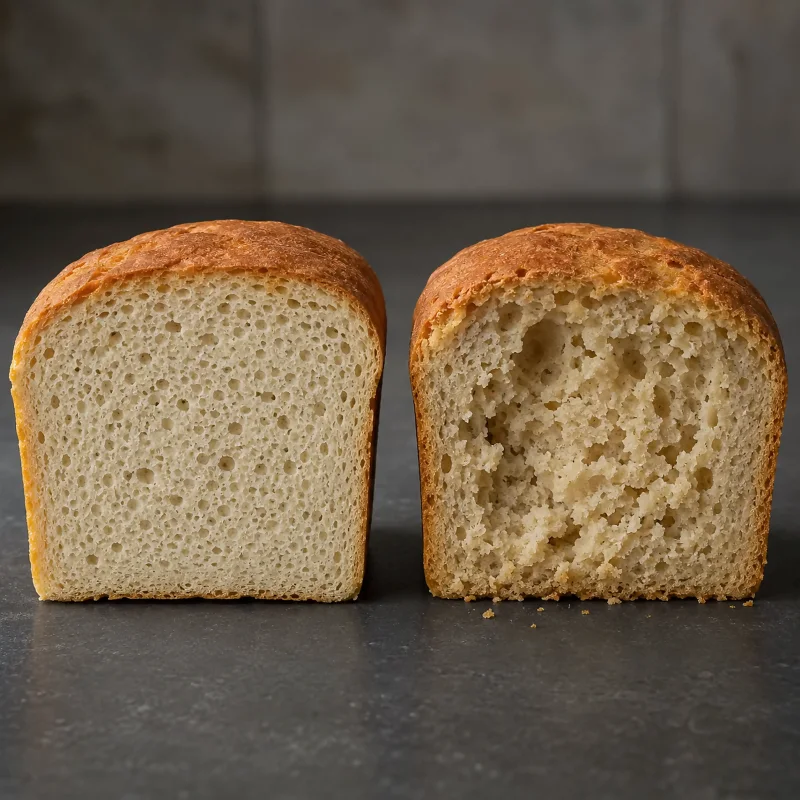
When gluten-free bread crumbles, leaves a sticky mark on the knife or develops a dense lower layer, the flour alone is rarely the whole problem. In gluten-free baking and wheat-flour replacement, starch, proteins, fibres, binders and water have to work as one system. Without a gluten network, each group takes over part of its structural job.
Starches create the basic crumb framework during baking
Rice, corn, potato and tapioca starch absorb water, swell and gelatinise as they heat. This thickens the batter and firms the walls around gas cells. Raw gluten-free bread dough can therefore resemble a very thick batter; much of its load-bearing structure develops in the oven. Tapioca can add stretch and chew, while other starches differ in water binding; see tapioca starch and substitutes. Too much pure starch combined with excess water or insufficient baking can produce a gummy crumb.
Proteins set with heat and support the starch network
Proteins from eggs, dairy, pulses, buckwheat, nuts and other gluten-free flours denature and set during baking. They do not behave like gluten, so extra mixing does not build the same extensible network. Almond flour is a useful example: it supplies fat and protein but little starch, so a light cake normally still needs eggs, starch or another flour for support.
Fibres hold water but can also weigh the dough down
Psyllium, chia, flax and whole-grain fibres bind free water and increase viscosity. Hydrated psyllium forms a gel that can connect flour particles and support gas-cell walls. Finely ground psyllium and whole husks do not hydrate identically, and increasing fibre requires a water adjustment. Too little water makes the dough rigid; too much psyllium or water can create a gummy crumb and firm crust.
Binders stabilise the mixture before the baked structure sets
Xanthan, guar and HPMC increase the viscosity of the water phase, slow gas loss and help bubbles survive until starch gelatinisation and protein setting take over. There is no universal dose. Stringy batter or a wet, gel-like crumb can signal too much binder, but also excess hydration, underbaking or slicing too early. Check binder-to-water balance first.
The right blend depends on what you are baking
Yeasted bread needs a mixture soft enough to expand but viscous enough to retain gas. Cakes obtain part of their structure from eggs and sugar, while cookies do not need a strong gas-holding network at all. One blend therefore cannot perform equally well in every product. A practical companion is the guide to a gluten-free flour blend that resists crumbling.
Hydration shows whether the system is balanced
Gluten-free ingredients absorb water at different rates, so a mixture that looks loose immediately after mixing may thicken substantially after resting. Hold back a little liquid and adjust after hydration. A 2% step based on dry-blend weight can be a cautious test—10 g water for 500 g dry blend—not a universal formula. Let baked bread cool completely before slicing.
Gluten-free ingredients do not automatically mean safe preparation
Rice, corn, buckwheat and almonds are naturally gluten-free, but cross-contact can occur during milling, packing or preparation. For someone with coeliac disease, use appropriately labelled ingredients and clean equipment and surfaces. Under EU rules, a food labelled “gluten-free” may contain no more than 20 mg gluten per kilogram.
For every new blend, assign a job to each ingredient first. If one structural function is missing, longer mixing or simply adding more flour will not repair the system.
Frequently asked questions
Answers to common questions
Can I use just one gluten-free flour in a recipe?
Yes, when the recipe is designed for it and eggs, starch, fat or a binder provide the missing structure. A direct one-for-one swap for wheat flour usually does not give the same result.
Are psyllium and xanthan interchangeable?
Not directly. They bind water differently and create different textures, so liquid and method also need adjustment.
Why can’t I shape gluten-free bread dough like wheat dough?
It has no extensible gluten network. It often needs to remain softer and stickier and may be shaped in a tin or with a wet or oiled spatula.
Does longer kneading improve gluten-free dough?
Not in the same way as wheat dough. Mixing hydrates and distributes ingredients, but without gluten it does not build a new elastic network.