You usually cannot replace wheat flour with one gluten-free flour
In gluten-free baking, wheat flour is rarely replaced successfully by one naturally gluten-free flour in a simple 1:1 swap. A more reliable system combines base flours with starches and, where the product needs extra support, a binder or fibre. Water then has to be adjusted to the actual blend and to the type of bake.
There is one important exception: some commercial 1:1 or measure-for-measure blends are deliberately formulated for direct substitution in specific, usually non-yeasted recipes. That does not mean rice flour, buckwheat flour, almond flour or another single flour can be treated as wheat flour gram for gram.
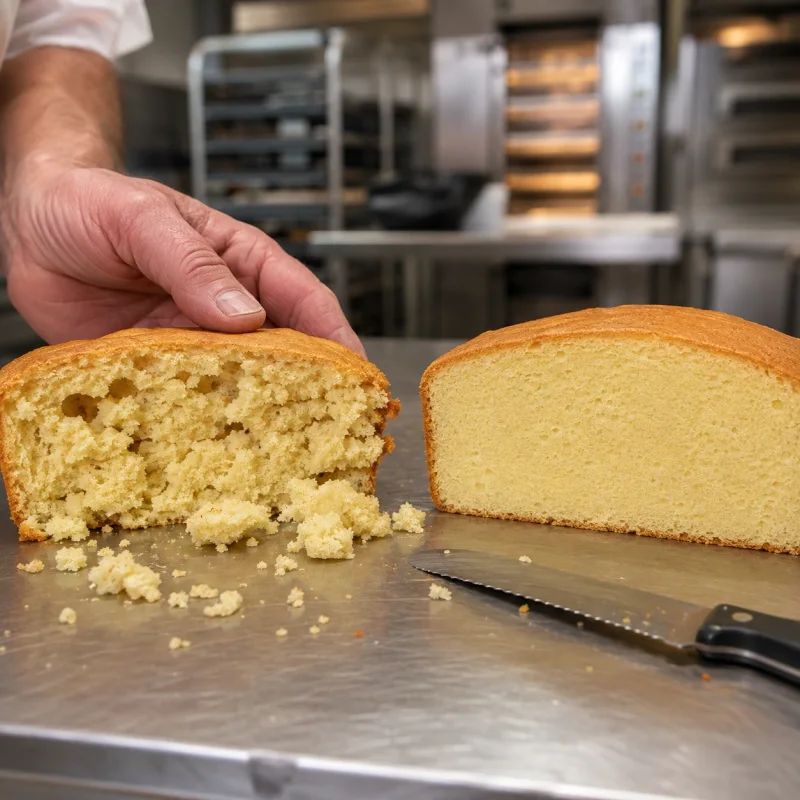
When a gluten-free cake crumbles into dry, sandy particles, the problem is not simply “missing gluten”. The whole structural system has changed. The batter still has to bind water and fat, hold air or gas bubbles, and set into a stable crumb as starch gelatinises and proteins coagulate.
Wheat flour supplies both starch and gluten-forming proteins. With water and mechanical work, gliadins and glutenins form a viscoelastic network that stretches around gas cells and helps the product hold its shape until heat sets the crumb. In gluten-free doughs and batters, several ingredients must divide those jobs: flours, starches, proteins, fibres and hydrocolloids.
That is why replacing 100 g of wheat flour with 100 g of a single gluten-free flour changes far more than the flour name. Water absorption, batter viscosity, gas retention, fat balance and setting behaviour may all shift. The result can be crumbly, dense, gummy or greasy even though the total flour weight has not changed.
A functional gluten-free blend has more than one job
A useful blend usually covers at least three functional groups:
- a base flour for flavour, solids and part of the protein structure;
- a starch for tenderness, lightness and setting during baking;
- a binder or fibre when the recipe needs more water binding, viscosity or gas retention.
The balance depends on the product. Gluten-free bread and yeast dough need a system that can hold fermentation gases. Cakes and muffins receive substantial support from eggs and protein coagulation. Short pastry and cookies do not need maximum elasticity at all; too much binder can make them tough or chewy instead of short and crisp.
Do not start by hunting for one universal flour-to-starch ratio. Start from a formulation developed for the same type of product and record the base flours, starches, binder and water by weight. Change one variable at a time. A different flour, particle size, starch, egg level, fat level, seed content or fibre can alter the optimum hydration.
Base flours control flavour, density and water demand
Rice flour is mild and versatile in cakes, biscuits and bread blends, but coarse rice flour can leave a gritty crumb. That does not always mean the batter needs much more liquid. The particles may simply need time to hydrate. Where the leavening system and recipe allow it, a short rest can improve hydration before you decide whether more liquid is necessary.
Buckwheat flour brings a stronger flavour, darker colour and more fibre, but it does not create an elastic gluten-like network. A high proportion of buckwheat without enough water and structural support can produce cracking edges during shaping and a crumb that breaks apart after cooling.
Almond flour is rich in fat, low in starch and structurally very different from cereal flour. It is excellent in formulas designed for it, but it is not a universal 1:1 wheat-flour replacement. In cakes it can increase moistness and density; at a high level it can also weigh down an egg foam, weaken volume or create a greasy edge.
Millet, oat, corn, chickpea and sorghum flours each bring different particle sizes, flavours, proteins and water absorption. Treat them as individual ingredients, not interchangeable beige powders. When testing a new flour, replace only part of the original blend first and keep the other variables as stable as possible.
Starch is a structural ingredient, not empty filler
During baking, starch granules absorb water, swell and gelatinise. The crumb thickens and begins to hold the shape previously created by incorporated air, steam or carbon dioxide. Too little starch can produce a heavy, fragile crumb. Too much starch, especially with excessive water, can create a sticky, translucent or gummy interior.
Tapioca, potato and corn starch do not behave identically. Tapioca often contributes flexibility and chew, potato starch can support softness and moisture retention, and corn starch can lighten the crumb. But no starch has a fixed “correct” percentage independent of the rest of the formula.
Starch used to thicken a cream or fruit filling is performing a different job from starch in bread. In a filling, the aim is to control free-flowing liquid. In bread, starch participates in the whole crumb structure. Do not transfer thickener dosages directly from one application to another.
Binders replace only part of what gluten does
Xanthan gum, guar gum, HPMC and psyllium husk are hydrocolloids. They bind water and modify viscosity. In gluten-free doughs they can help stabilise gas cells and improve structure, but they do not reproduce wheat gluten exactly.
There is no single xanthan, guar or psyllium dosage that is correct for every gluten-free formula. The useful level changes with flour, starch, water, protein and product type. Too much hydrocolloid can push viscosity too far and leave the crumb dense, sticky or rubbery. Research on gluten-free bread consistently shows that hydration and hydrocolloid choice interact; changing one often requires changing the other.
This matters especially when switching between whole psyllium husk and finely ground psyllium powder. They do not hydrate at exactly the same rate or create the same texture gram for gram, so water should be re-tested rather than copied blindly.
Cakes, muffins and sponge cakes often need less added binder than yeast bread. Egg proteins set during heating, yolks help emulsify fat and water, and starch fixes the crumb. Adding more xanthan cannot repair a collapsed egg foam and may make a delicate cake unpleasantly elastic.
Adjust the blend to the type of bake
Bread and yeast dough
A gluten-free bread dough has to retain fermentation gases and set late enough in the oven to keep its volume. Use a flour-and-starch blend designed for bread, add a tested binder such as psyllium or another hydrocolloid, and judge the final water level after hydration.
Many successful gluten-free bread doughs are softer and stickier than wheat dough. Adding extra flour only because the dough sticks to your hands can dry the finished loaf. A properly hydrated mixture may leave a clear groove when drawn through with a spatula and then slowly relax; a psyllium-rich dough may be shapeable with wet or lightly oiled hands without cracking at the edges.
Cakes, sponge cakes and muffins
Here, eggs, sugar foams and protein coagulation contribute much of the structure. Use finely milled flours and enough starch for tenderness without making the batter structurally empty. Mix only as much as the formula requires; vigorous mixing is useful when building an egg foam or emulsion, not as a universal fix after the dry ingredients have been added.
Cookies and short pastry
Maximum gas retention is not the goal. Too much binder reduces shortness and can produce flexible, chewy cookies. Control spread and shape through the balance of fat, sugar, flour and starch, and chill the dough when the formula requires it.
If short pastry cracks, first check fat temperature and hydration. A large dose of xanthan should not be the first correction.
Pancakes, waffles and pourable batters
These products need less self-support because the pan or waffle iron supports them as they set. Focus on even dispersion, a short hydration rest where appropriate and a repeatable viscosity. The batter should pour in a continuous ribbon rather than behave like water or fall in dry clumps.
Set water by the hydrated batter or dough, not by habit
Gluten-free flours and fibres do not absorb water at the same speed or to the same extent. Rice flour can hydrate more slowly than fine starch, while psyllium can turn a soft mixture into a firm gel within minutes. For an unfamiliar formula, it is often smarter to hold back a small portion of the liquid, mix thoroughly, allow hydration when the leavening system permits it, then add the remainder in small increments.
The aim is not to force the dough to match a familiar wheat-dough feel. The aim is to reach a repeatable target consistency for that gluten-free formula.
Do not correct water by repeatedly throwing in handfuls of flour. Every extra addition changes the effective percentages of salt, sugar, fat, yeast and binder as well.
Hydration is especially critical in gluten-free bread. Studies comparing rice-flour and corn-starch systems show that the optimum water level changes with the base material and with the hydrocolloid used. A hydration number that works in one formula is not a universal rule.
Mixing, baking and cooling finish the structure
In wheat bread, kneading develops gluten. In gluten-free bread, mixing mainly distributes water, binder, yeast and incorporated air evenly. Mix until there are no dry pockets, clumps of hydrocolloid or dense gel stuck to the bottom of the bowl. A rest can then complete hydration.
In the oven, gases expand first; starches gelatinise and proteins set afterwards. If the outside sets too quickly, the centre can remain wet and structurally weak. If the product sets too slowly, it may lose volume before the crumb stabilises.
Crust colour alone does not prove the centre is baked.
For cakes, check whether the centre springs back lightly and whether a tester comes out without wet batter. Gluten-free bread often continues to stabilise during cooling, so cutting it hot can release steam from a still-delicate crumb and leave the slice compressed or tacky. Let it cool fully before judging the final texture.
“Naturally gluten-free” does not automatically mean safe for coeliac disease
Rice, buckwheat, corn, potato, almonds and tapioca are naturally gluten-free ingredients, but contamination can occur during milling, packing, storage or preparation. When baking for someone with coeliac disease, use ingredients labelled appropriately for gluten-free use and check all starches, raising agents, flavourings, chocolate, sprinkles and prepared mixes.
In the European Union, the claim “gluten-free” may be used only when the food as sold to the final consumer contains no more than 20 mg/kg of gluten. Oats in food presented as gluten-free must also have been specially produced, prepared and/or processed to avoid contamination by wheat, rye, barley or their crossbred varieties, and the oats must not exceed the same 20 mg/kg limit.
Clean worktops, bowls and tools thoroughly with water and detergent, including crevices where flour dust or crumbs can remain. Avoid preparing gluten-free dough while wheat flour dust is airborne in the same workspace. Use clean oil, separate spreads and ingredients that have not been contacted by crumb-covered knives or spoons.
A practical way to develop your own blend
For a new blend, weigh 100 g of total dry flour-and-starch ingredients and write down the percentage of every component. Bake a small test. On the next test, change only one factor: water, starch level or binder level.
That turns each bake into controlled development rather than a new guess.
If the crumb is sandy and fragile, examine particle size, starch balance, hydration and binding. If it is wet and gummy, look at excess water, excessive starch or binder, and whether the centre was fully baked. If a psyllium dough becomes hard and cracks after resting, it probably needs more available water. If an almond-heavy cake is low and greasy, the flour system may need more starch or a lighter base flour rather than more raising agent.
The principle is simple: replace functions, not just grams of wheat flour. Once flour, starch, binder and water are treated as one system, gluten-free baking becomes much more predictable.
Diagnostics
Common problems and solutions
Cake breaks into fine, sandy crumbs when sliced.
Cause: The blend contains too much coarse single flour, too little starch, or insufficient water-binding structure.
Solution: Replace part of the base flour with starch, allow a short hydration rest when the process permits, and test a small amount of an appropriate binder in the next batch.
Bread has a wet, translucent and gummy crumb.
Cause: Too much tapioca or potato starch, excessive binder, too much water, or an underbaked centre.
Solution: Reduce starch or binder, add liquid progressively and allow the loaf to cool fully before slicing.
Dough becomes very firm and cracks after resting.
Cause: Psyllium or another fibre has bound more water than was available to the rest of the flour system.
Solution: Add water in small increments until the dough shapes without dry cracks while keeping the other variables unchanged.
Gluten-free bread rises in the oven and then collapses.
Cause: The batter held gas but the crumb did not stabilise quickly enough because hydration was too high, the flour/starch system was too weak, or baking ended too early.
Solution: Reduce water or starch if indicated, use an appropriate binder and extend baking at a moderate temperature so the centre sets before cooling.
Almond-flour cake is low, heavy and greasy.
Cause: Almond flour replaced too much wheat flour even though it contains much more fat and much less starch.
Solution: Replace part of the almond flour with a neutral gluten-free flour and starch, then reassess whether the added fat still suits the new formula.
Technical terms
Terms worth understanding
- Starch gelatinisation
- The swelling and thickening of starch granules when heated with water, helping a fluid batter set and hold shape.
- Hydrocolloid
- A water-binding ingredient such as xanthan, guar or psyllium that changes viscosity and cohesion in gluten-free doughs and batters.
- Hydration
- The amount and process of water absorption by flours, starches, proteins and fibres.
- Viscoelasticity
- The ability of a dough to stretch under force while partly retaining or recovering its shape.
- Cross-contact
- Unintentional transfer of gluten to gluten-free ingredients or food through surfaces, tools, crumbs or airborne flour.
Frequently asked questions
Answers to common questions
Can I always replace wheat flour with a gluten-free blend 1:1?
Only when the blend is specifically designed for direct substitution and for the same type of product. A cake-oriented 1:1 blend will not necessarily behave like a bread formulation.
Does every gluten-free blend need xanthan gum?
No. Eggs and starch can supply enough structure in some cakes, while bread may use psyllium or another tested binder. Choose the binder for the product.
Can I bake with only almond flour or only buckwheat flour?
Yes in recipes developed specifically for those flours. As a direct wheat-flour replacement they usually require changes to starch, liquid, eggs or binders.
Why can a gluten-free batter benefit from resting before baking?
A short rest can allow flour particles and fibres to hydrate more evenly, making the final viscosity easier to judge and reducing grittiness from coarse flours.
Is a homemade gluten-free flour blend automatically safe for coeliac disease?
No. Every ingredient must be suitable for gluten-free use and the blend must be prepared without cross-contact. In the EU, the “gluten-free” claim means no more than 20 mg gluten per kg of food.