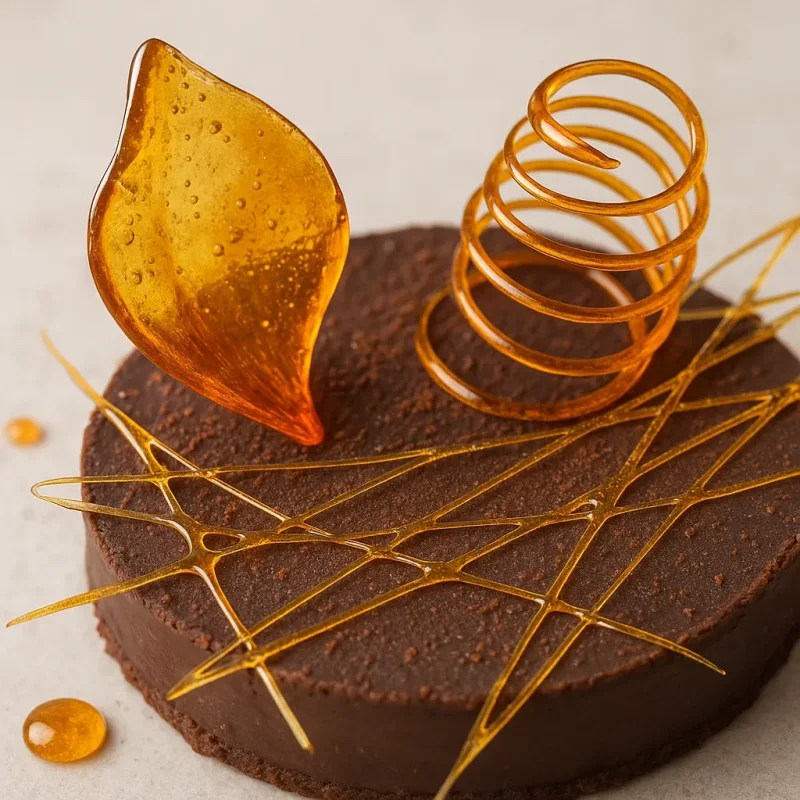
Cooked sugar and isomalt are different materials
The phrase liquid sugar is too broad for sugar decoration. For hard clear sheets, threads, drops and showpieces, the useful distinction is between sucrose syrup cooked to hard-crack and isomalt.
Ordinary sugar is inexpensive and excellent for sugar glass, but it crystallizes more readily, absorbs moisture faster and develops color as heat exposure increases. Isomalt is often easier when a very clear finish is the priority because it is less hygroscopic and crystallizes more slowly.
Hard-crack for sucrose
For hard brittle decorations, sucrose syrup is cooked to roughly 149–154 °C / 300–310 °F.
Once cool, the candy should snap cleanly rather than bend. If it stays below this stage, the piece may remain soft. If sucrose is heated much further, caramel color and flavor become more pronounced.
Working temperature for isomalt
There is no single correct temperature for every isomalt product or technique.
Professional instructions commonly place cast work around 160 °C, with some pulled or satin-finish methods using roughly 170–180 °C. Follow the technical guidance for the exact product you use.
Isomalt is less hygroscopic than sucrose, but it is not immune to humidity. High relative humidity or contact with moist pastry components can still dull and soften the surface.
Preventing sucrose crystallization
Use a perfectly clean pan, dissolve the sugar completely and avoid unnecessary stirring once the syrup is boiling. Sugar crystals on the side of the pan can seed crystallization throughout the batch.
If the syrup turns cloudy and grainy, more stirring will not fix it; crystallization has already started.
Clear sheets and sugar glass
Remove the syrup from heat at the target stage. If it contains large active bubbles, allow them a brief moment to settle, then pour carefully onto silicone or into an appropriate mold.
Avoid excessive spreading if optical clarity matters.
Sugar threads
For threads, the syrup needs to cool enough that it no longer pours like water but still stretches into a long fine strand.
Too hot gives heavy drops and thick strings. Too cool causes the sugar to snap during pulling.
Humidity and storage
Store finished pieces dry and airtight. Refrigerators and freezers are usually poor storage environments because condensation can form when a cold piece is moved into warmer air.
Place sugar decorations on mousse, whipped cream, fruit glaze or other moist surfaces as late as practical.
Safety
Molten sugar and isomalt can cause severe burns because the hot mass sticks to skin. Set up all tools before heating, use a stable heat-safe surface and suitable hand protection, and never taste the syrup while hot.
Common failures
| Problem | Likely cause | Fix |
|---|---|---|
| syrup turns grainy | sucrose crystallization | clean equipment and avoid unnecessary stirring after boiling |
| finished piece stays soft | temperature too low or moisture uptake | verify thermometer and storage |
| surface becomes sticky | absorbed humidity | dry airtight storage and later placement |
| isomalt yellows | excessive heat exposure | stay within the product’s working range |
Use ordinary sugar for classic sugar glass and spun elements when a slight warm tone is acceptable. Choose isomalt when clarity and somewhat better humidity resistance matter more.
Diagnostics
Common problems and solutions
The syrup turns grainy.
Cause: Sucrose crystallization has started.
Solution: Use clean equipment and avoid unnecessary stirring once boiling begins.
The decoration becomes sticky.
Cause: It has absorbed moisture from the air or dessert.
Solution: Store dry and airtight and place it on the dessert as late as practical.
Isomalt turns yellow.
Cause: Temperature or heating time is too high.
Solution: Stay within the manufacturer’s working range.
Frequently asked questions
Answers to common questions
When should I use ordinary sugar and when should I use isomalt?
Use ordinary sugar for classic sugar glass, spun threads and pieces where a slight warm color is acceptable. Isomalt is often better when you need greater clarity, slower moisture uptake and easier remelting.
What temperature is the hard-crack stage?
For sucrose syrup, hard-crack is about 149–154 °C / 300–310 °F. Once cooled, the candy should be hard and brittle.
What temperature should I use for isomalt?
There is no single number for every product. Cast pieces are often worked around 160 °C, while some pulled or satin-finish techniques use roughly 170–180 °C. Follow the instructions for the specific isomalt.
Why does a sugar decoration become sticky?
Humidity is the most common cause. Sugar materials absorb moisture from the air, which dulls and softens the surface. Isomalt is less hygroscopic than sucrose, but it is not humidity-proof.
Can sugar decorations be refrigerated or frozen?
Usually this is not ideal. The main risk is condensation when a cold piece returns to warmer air. Dry, airtight storage at a stable room temperature is usually safer.
How do I prevent sucrose syrup from crystallizing?
Use a clean pan, dissolve the sugar completely and avoid unnecessary stirring once boiling starts. Crystals on the side of the pan can seed crystallization throughout the batch.
How do I work safely with hot sugar?
Prepare a stable work area, heat-safe tools and suitable hand protection. Molten sugar sticks to skin and can cause severe burns; never taste it while hot.