Deeper chocolate flavor starts before you add more sugar
When the cream looks dark but tastes short
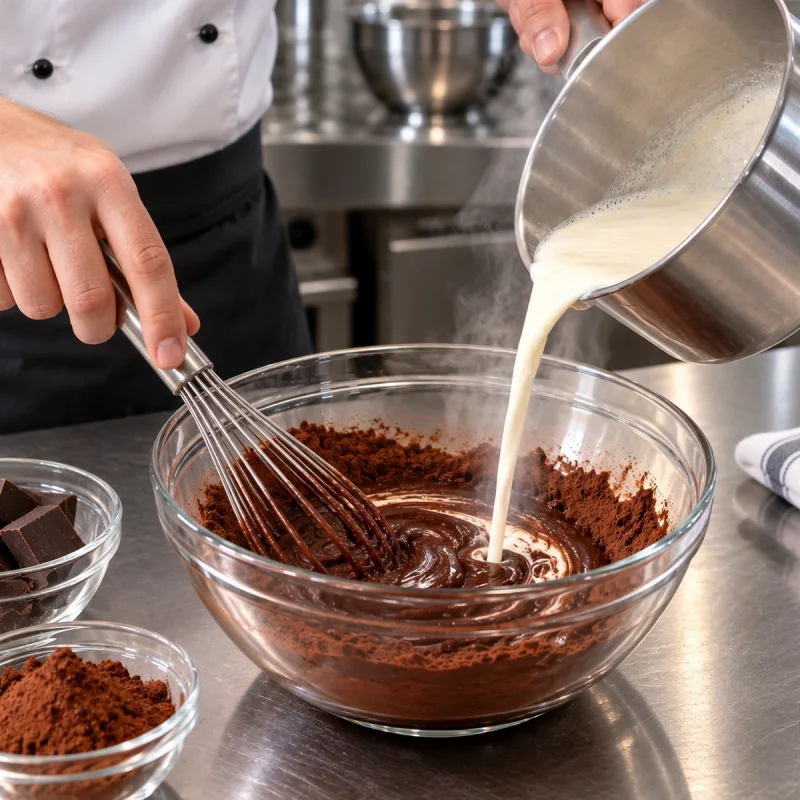
A whisk moves through a dark chocolate cream, yet tiny cocoa specks and dry streaks remain around the bowl. The color looks intense, but the flavor disappears after the first bite or ends in sharp bitterness. Chocolate depth is not determined by cocoa percentage alone. The balance of cocoa solids, cocoa butter, sugar, and liquid matters, as does how evenly the cocoa is hydrated and the mixture emulsified.
Sugar can soften bitterness, but it cannot release aroma from dry or unevenly wetted cocoa. Add more sugar to a flat cream and you will make it sweeter, not necessarily more chocolatey.
The problem is therefore not always “too little cocoa.” Low-aroma ingredients, poor fat-to-liquid balance, excessive heat, and dry cocoa pockets can all mute the flavor.
Chocolate choice sets the character; technique controls intensity
Cocoa percentage is not a flavor-quality score
A 70% label includes both cocoa solids and cocoa butter. Two chocolates with the same percentage can contain different amounts of nonfat cocoa solids, use different roast profiles, and taste completely different.
For creams, ganache, brownies, and chocolate cakes, 60–70% cacao is a useful starting range, not a universal rule. Formulas with plenty of cream, butter, or egg can often handle darker chocolate. In drier batters, very dark chocolate can push astringency forward and reduce the sense of moistness.
Taste the chocolate at room temperature before using it. Look for a clear cocoa character that develops rather than hitting hard and disappearing. Strong initial bitterness without a long finish is not the same as depth.
Natural and Dutch-process cocoa do different jobs
Natural cocoa is generally more acidic, lighter, and more aromatically lively. Dutch-process cocoa is darker, less acidic, and rounder. Black cocoa creates a very dark color, but heavy alkalization can narrow some of the fruity, bright, and roasted notes.
In creams, fillings, and brownie batters where cocoa acidity is not driving leavening, 3 parts Dutch-process cocoa to 1 part natural cocoa can be a useful test ratio. It is not a universal formula; it is simply a starting point for a darker base that still retains some aromatic lift.
Do not transfer that ratio blindly to cakes. If the formula relies on baking soda, reducing acidity can change rise, color, and crumb structure.
Blooming cocoa removes dustiness and opens up aroma
Hot liquid needs to reach every cocoa particle
Dry cocoa hydrates slowly and unevenly in cold liquid. The outside of a lump becomes wet while the center can stay dry. Once that lump enters a thick batter or cream, the powdery sensation may remain even after mixing.
For creams, fillings, and dense brownie batters, start with 30 g liquid for every 20 g cocoa, using liquid already present in the formula. If the paste remains too thick or shows dry edges, increase gradually to 40 g. Heat the liquid to 70–85 °C.
Add it in two or three additions and stir until the paste is smooth, dark, and slightly glossy. No dry powder should remain around the bowl, and you should not feel hard particles under the whisk. Rest for 30–60 seconds, then mix it into the rest of the formula.
Blooming does not turn average cocoa into premium cocoa. It does prevent part of the flavor from being trapped in dry pockets and uneven texture. Do not cook the paste for minutes; a sharp, nearly burnt aroma means heat is already stripping more delicate notes.
Salt and coffee work only while they stay in the background
Salt should lengthen the finish, not taste salty
A small amount of salt can soften harsh bitterness and make roasted notes easier to perceive. In unsalted creams, fillings, and dense chocolate mixtures, start around 1.5–2.5 g fine salt per 1000 g mixture.
Use less when the recipe already contains salted butter, salted nuts, or other salty ingredients. Dissolve the salt in warm liquid so a thick mixture does not develop isolated salty spots.
Correctly dosed salt is not perceived as “salt.” The chocolate finish becomes longer, rounder, and less hollow.
Coffee should stay hidden behind the cocoa
Instant espresso powder can deepen roasted notes, but it can take over quickly. In a cream or brownie batter, start with 0.5 g instant espresso per 500 g mixture. Increase cautiously, up to about 1.5 g, when the chocolate is mild or the formula contains more dairy fat.
Dissolve espresso powder in the liquid used to bloom the cocoa. If you use brewed coffee, replace an equal amount of water or milk from the recipe rather than adding extra liquid. Otherwise you change viscosity, baking time, and cream stability.
If the dessert clearly tastes like coffee, you have moved past the supporting role. Vanilla works differently: it rounds sharper edges and can increase perceived sweetness. With concentrated pure extract, about 1–2 ml per 500 g cream or batter is a sensible starting point.
Smoothness and temperature determine how much chocolate you perceive
A split cream can hide excellent chocolate
A smooth emulsion changes how fat melts, how the mixture contacts the tongue, and how evenly cocoa particles are distributed. In a stable emulsion, fat melts consistently and the flavor arrives without greasy, watery, or powdery interruptions. A split mixture feels grainy, oily, or wet and gives a less coherent finish.
For a smooth chocolate ganache, begin stirring in the center of the bowl. Once a small dark, glossy core forms, gradually widen the circle. Aggressive stirring across the entire surface increases the chance of fat separation.
If the cream is already split, do not fix it with sugar. Warm it gently, add a small amount of warm liquid, and re-emulsify from the center outward.
Very cold chocolate desserts release less aroma
A cream straight from the refrigerator may be neat and firm, but its fat melts more slowly on the tongue. That can make the flavor seem waxier and less expressive.
Temper stable chocolate creams and cakes before serving until the surface softens slightly and a spoon moves through without cracking. For many stable chocolate creams, 18–22 °C is a useful sensory target, but timing depends on the size of the dessert, its formula, and room temperature.
For baked goods, do not rely on dark color alone. Pull brownies when a tester has moist crumbs rather than raw batter. A chocolate cake should spring back after a gentle press in the center. Dark chocolate batter is a poor doneness indicator.
Let the product cool fully before judging flavor. A warm center has not yet reached a stable fat structure or even moisture distribution, so it can taste flatter or greasier than it will after cooling.
First check chocolate quality and cocoa type. Next bloom the cocoa with liquid already included in the formula. After cooling, judge texture and the length of the chocolate finish; adjust salt only then, and add coffee or vanilla last.
PEKI recommend a clear order: choose aromatic chocolate, hydrate the cocoa evenly, maintain a smooth emulsion, and serve at a temperature where the fat melts evenly. Stop when the flavor becomes longer and cleaner. More bitterness is not proof of deeper chocolate flavor.
Frequently asked questions
Answers to common questions
Does more cocoa always mean stronger chocolate flavor?
No. Too much cocoa can increase dryness and astringency without improving aromatic depth.
Can I bloom cocoa with water only?
Yes. Use water, milk, cream, or coffee that is already part of the recipe, and subtract it from the recipe’s total liquid.
Why is black cocoa very dark but not especially intense in flavor?
Black cocoa is heavily alkalized. The process deepens color but can reduce some fruity, acidic, and roasted notes.
Does coffee always improve chocolate flavor?
Only in a small amount. Once the coffee flavor is clearly identifiable, it no longer simply supports the chocolate; it changes the dessert’s flavor profile.