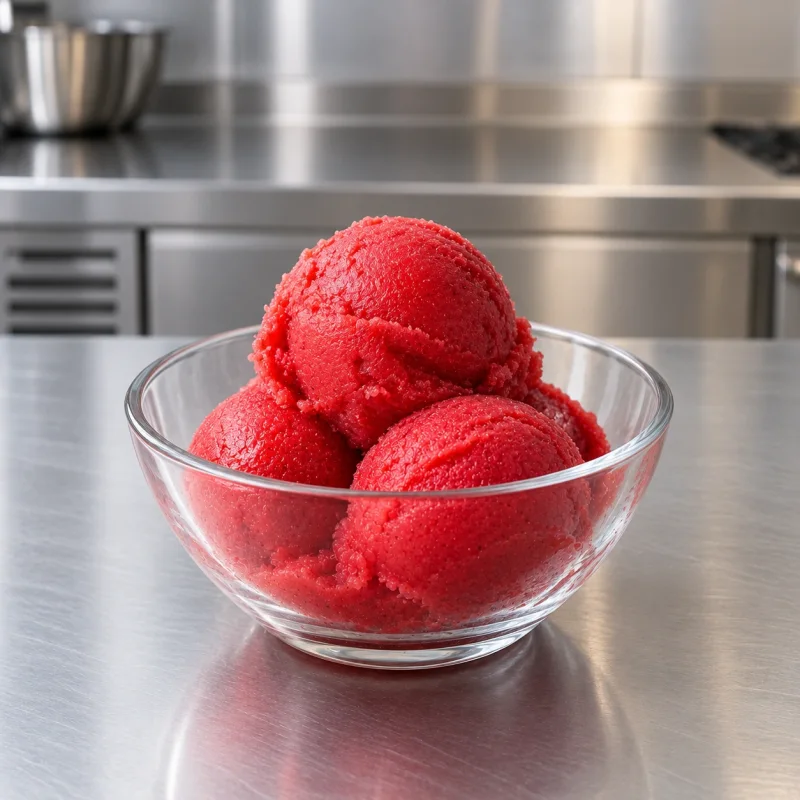
No-added-sugar fruit sorbet: what actually works
For fruit sorbet with no added sugar, the most reliable home method is simple: start with very ripe fruit, cut it into pieces, freeze it completely, then blend it with as little extra liquid as possible. This style of sorbet is usually at its best immediately after blending.
That distinction matters. In classic sorbet, sugar does more than provide sweetness. It also affects the freezing point, hardness and size of ice crystals. If you simply remove sugar from a standard formula, the mixture will often freeze much harder in a home freezer.
No added sugar is not the same as sugar-free
Fruit naturally contains sugars, so no added sugar does not mean the dessert contains no sugar. It means no sugar was added for the purpose of sweetening. The fruit’s own sugars contribute to flavour and, to a degree, texture.
Ripeness therefore matters. An underripe mango, peach or pear will taste even less sweet after freezing because cold reduces the perception of both sweetness and aroma.
Why some fruits blend creamy and others freeze icy
Mango, banana and very ripe stone fruit contain more solids and fibre, so they often blend into a thicker, smoother mass. Watermelon, oranges and other highly watery fruits contain much more free water and tend to become harder and more crystalline when there is no additional balancing.
Lemon or lime juice can sharpen fruit flavour, but it does not replace the functional role of sugar. Add acidity for flavour balance, not as a fix for hardness.
The most reliable method at home
Cut fruit into small, fairly even pieces and freeze them in a single layer until completely solid. Transfer them to a high-powered blender or food processor and begin without extra water. If the blades cannot move the mixture, add liquid in very small amounts.
Stop as soon as the mixture is smooth, thick and even. Over-blending warms the fruit and quickly turns sorbet into a loose puree. If it becomes too soft, return it to the freezer briefly.
How to avoid unnecessarily hard, icy sorbet
The most common mistake is adding too much water. More free water means more ice. For a softer result without added sugar, first choose riper or less watery fruit rather than adding more liquid.
If the sorbet becomes very hard overnight, that is not necessarily a preparation error. It is expected with this style. Before serving, leave it at room temperature for about 5–10 minutes and test whether it scoops. If it remains coarse, blend it again briefly.
Storage: keep it frozen, do not heat it
Store sorbet in an airtight container in the freezer. For the best texture, use it relatively soon because extended storage increases the chance of coarser crystals and a firmer mass.
Brief tempering or re-blending is enough to soften it. Do not heat sorbet in an oven. Heating does not repair its structure; it only thaws it unevenly.
Sorbet and ice cream are not the same thing
Classic fruit sorbet is built mainly from fruit or juice, water and sugars, without dairy fat. Ice cream usually has a dairy base and a different balance of fat, protein, sugars and water. Sorbet is therefore not automatically “lighter” or “healthier”; that depends on the actual formula and portion.
For a genuinely good no-added-sugar version, work with its strengths: very ripe fruit, minimal liquid, quick blending and prompt serving.
Diagnostics
Common problems and solutions
The sorbet becomes very hard after longer freezing.
Cause: The fruit has a high water content and too little dissolved sugar or other solids to limit how much water freezes solid.
Solution: Temper it briefly before serving and re-blend if needed. Next time use riper or less watery fruit and add less liquid.
The texture is coarse and full of larger ice crystals.
Cause: The mixture contains too much free water or froze slowly without being processed again.
Solution: Use less added liquid, freeze the fruit in smaller pieces and re-blend after storage for a finer texture.
Blending produces a thin fruit puree instead of thick sorbet.
Cause: The fruit thawed too long or too much liquid was added.
Solution: Start with fully frozen pieces and add liquid sparingly. If the mixture is already too soft, return it to the freezer briefly.
The frozen sorbet tastes less sweet and aromatic than the puree.
Cause: Low temperature suppresses the perception of sweetness and aroma.
Solution: Start with very ripe, aromatic fruit and adjust acidity to taste; freezing cannot compensate for underripe fruit.
Technical terms
Terms worth understanding
- No added sugar
- No sugar is added for sweetening during preparation; naturally occurring fruit sugars are still present.
- Freezing point
- The temperature at which water in a mixture begins to freeze; dissolved sugars lower it and therefore affect sorbet hardness.
- Ice crystals
- Crystals of frozen water; larger crystals create a coarse, icy texture while smaller crystals feel smoother.
Frequently asked questions
Answers to common questions
How can no-added-sugar fruit sorbet still taste sweet enough?
Use very ripe, aromatic fruit. Mango, ripe peach, pear or banana usually provides more natural sweetness than very tart or watery fruit. No added sugar still does not mean sugar-free because fruit contains naturally occurring sugars.
Which fruits give the creamiest texture without added sugar?
Mango, banana and ripe stone fruit generally provide more body because they contribute more solids and fibre. Watermelon and citrus juice contain a lot of water and are more likely to freeze with an icy texture.
Why does no-added-sugar sorbet freeze so hard?
Sugar in classic sorbet lowers the freezing point and reduces the amount of water that becomes hard ice. Without added sugar, a larger share of the water is usually frozen solid at home-freezer temperatures.
Can I make no-added-sugar sorbet ahead of time?
Yes, but the texture is usually best right after blending. Freeze it in an airtight container, temper it briefly before serving and re-blend if necessary. Do not warm sorbet in an oven.
What is the difference between sorbet and ice cream?
Sorbet is generally a fruit- or water-based frozen dessert without dairy fat, while ice cream usually contains milk or cream and has a different balance of fat, protein, sugar and water. Sorbet is not automatically sugar-free.