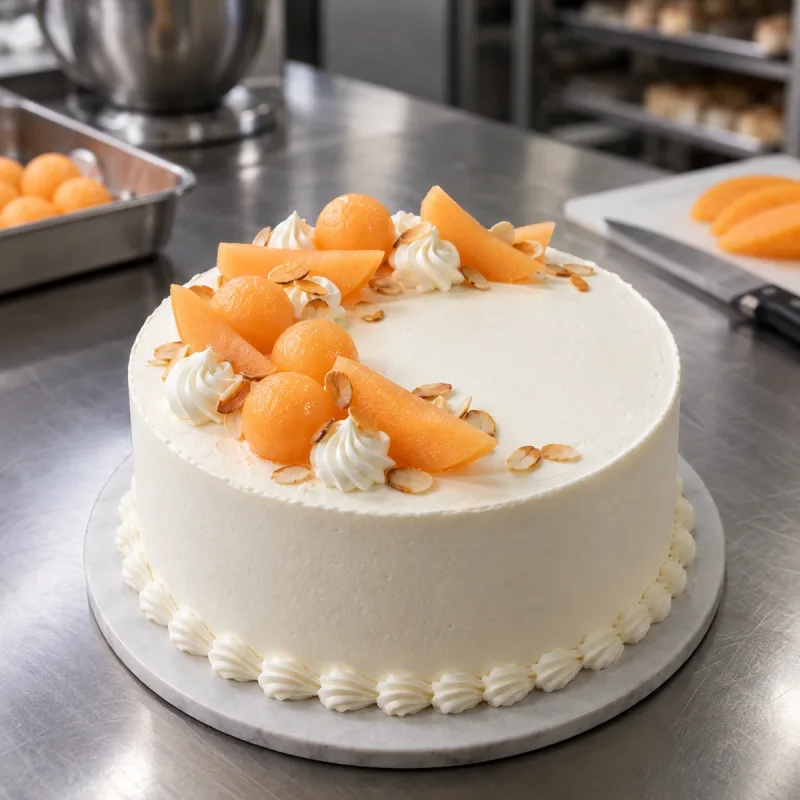
Melon on cake: the real challenge is moisture
Fresh melon can make a cake look clean and summery, but melon is a high-water fruit. Put freshly cut pieces straight onto soft cream and you can quickly get wet rings, sliding fruit and a softened contact layer.
So moisture control matters more than an elaborate arrangement.
Choose ripe but firm melon
For precise decoration, the softest melon is not the best melon. Good decorating fruit holds a clean cut, releases from a melon baller without ragged edges and does not immediately pool with juice.
Cantaloupe, Galia and honeydew give different colors; firmness matters more than variety.
Wash before the first cut
Even if you do not eat the rind, a knife can carry contamination from the outside into the flesh. Wash the whole melon under running water and scrub a firm textured rind with a clean produce brush if needed.
Balls, slices or cubes?
Melon balls create height but are heavier and need more support. Thin slices are lighter but slump easily when the fruit is too ripe. Small cubes are simple, but extra cut surface means more opportunity for juice release.
Choose the shape to match the cream, not just the visual design.
Drain, then blot
Let cut pieces sit in a strainer for a few minutes, then gently blot the surface without squeezing.
This removes free surface water. It does not turn melon into a dry fruit; moisture can still migrate later, so timing and temperature still matter.
Which creams hold melon best?
Firm, well-chilled surfaces provide better mechanical support.
On whipped cream, light dairy creams and mousse, add melon as late as practical. These soft surfaces show water marks faster and allow heavier fruit to move more easily.
Neutral glaze helps, but it is not waterproof
A very thin coat of neutral glaze adds shine and slows surface drying. It cannot completely stop juice moving from very ripe fruit.
Use glaze as a finishing tool, not as a replacement for draining, chilling and choosing firm melon.
When to decorate
For the cleanest finish, decorate the same day.
On a firm base you can work a little earlier, then return the cake to the refrigerator immediately. On whipped cream and mousse, decorate close to serving.
A useful test: place one dry piece on a chilled test area. If a shiny wet ring appears quickly, the combination is not suited to a long hold.
Frozen melon is not a shortcut
Freezing damages cell structure. After thawing, melon is usually softer and releases more liquid.
That is fine for purée, sorbet or drinks, but not for a crisp melon ball or clean slice on a cake.
Keep the cake cold
There is no reason to warm sponge before adding fresh melon. The cake and cream should be completely cool; warm cream is softer and less stable.
Common problems
| Symptom | Likely cause | Fix |
|---|---|---|
| wet ring under melon | too much surface liquid or very ripe fruit | drain, blot and decorate later |
| melon balls slide | soft cream or too much glaze | chill the base and reduce glaze |
| slices slump | overripe melon or slices too thin | use firmer fruit and slightly thicker slices |
| thawed fruit is mushy | freeze-thaw cell damage | use fresh melon for decoration |
Storage and service
Keep cakes with cut melon refrigerated until service. Do not leave them at room temperature for many hours; about 2 hours is a practical upper limit, and less in hot conditions.
Reliable sequence: wash → cut → drain → blot → chill the cake → glaze very lightly if needed → decorate as late as practical → keep cold.
Diagnostics
Common problems and solutions
A wet ring appears around the melon.
Cause: Too much surface water or very ripe fruit.
Solution: Drain, blot and decorate later.
Melon balls slide.
Cause: The cream is too soft or glaze is too thick.
Solution: Chill the cake more firmly and reduce glaze.
Thawed melon is mushy.
Cause: Freezing damaged the fruit structure.
Solution: Use fresh melon for precise decoration.
Frequently asked questions
Answers to common questions
What melon is best for cake decoration?
Firmness matters more than variety. Choose ripe, aromatic fruit that still cuts cleanly and has no soft spots. Cantaloupe adds orange color, Galia green tones and honeydew a paler look.
How do I stop melon from making cake cream watery?
Drain and gently blot the cut fruit, keep the cake very cold and add the melon as late as practical. A thin neutral glaze can help at the surface but cannot completely stop moisture migration.
Can I decorate a cake with melon the day before?
Sometimes on a very firm, cold base, but quality is not equally predictable. For the cleanest result, decorate the same day and place fruit on whipped cream or mousse close to serving.
Do I need to wash melon before cutting if I do not eat the rind?
Yes. A knife can carry microbes from the rind into the flesh. Wash the whole melon under running water and scrub firm textured rind with a clean produce brush.
Can I use frozen melon balls for decoration?
Not for precise fresh decoration. After thawing, melon is usually softer and releases more water. Frozen melon is better for purées, sorbet or drinks.
How do I get a professional shine on melon?
Brush a very thin layer of neutral nappage or fruit glaze over cold, dry pieces. It should create a light sheen; a thick layer can look rubbery and encourage slipping.
How long can a cake with fresh melon sit at room temperature?
A cake with cut melon and dairy cream is perishable. About 2 hours at room temperature is a practical upper limit, and less in very hot conditions.