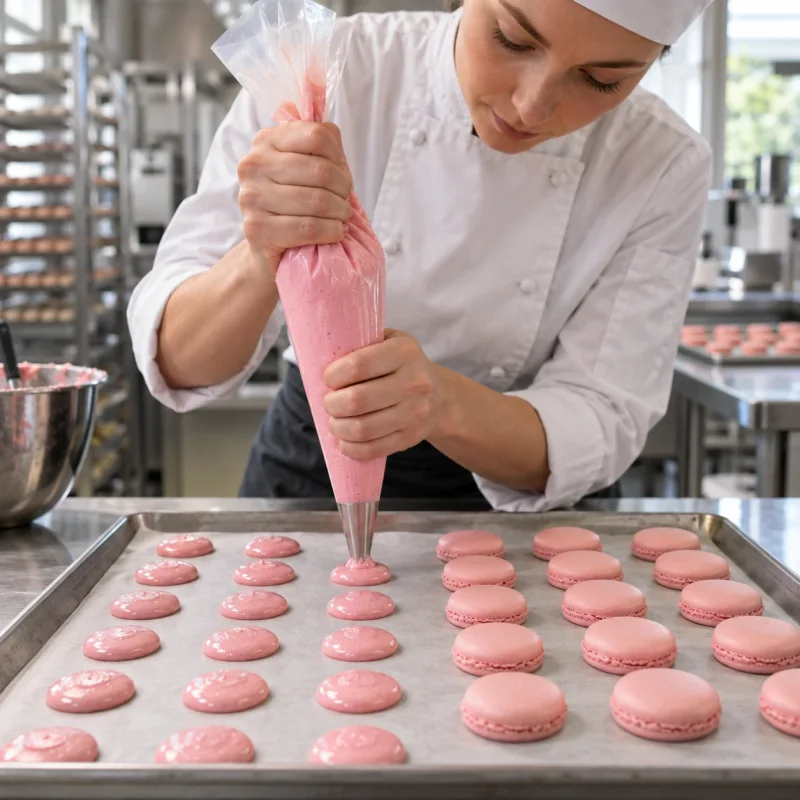
Macarons do not fail because of one “secret” oven temperature or a magic drying time. Repeatable results come from controlling meringue → macaronage → piping and bubbles → surface drying → oven. When a defect appears at the end, work backwards and change only one variable on the next tray.
This guide is about French almond macarons, not coconut macaroons. Use a tested formula for ingredient ratios; the focus here is recognising the correct batter state and tracing a visible fault back to the most likely process step.
Quick answer: what really matters
Smooth shells, even feet and a stable interior require a glossy flexible meringue, a fine dry almond mixture, correctly judged macaronage, uniform piping, appropriate surface drying for resting methods and a stable oven.
1. Meringue must carry structure without drying out
Underdeveloped foam lacks strength; overwhipped meringue can become dry, grainy and harder to combine evenly. Aim for a smooth, dense, glossy meringue with clearly defined peaks. Aging egg whites is not a universal requirement, so keep the same method while troubleshooting.
2. The almond mixture should be fine and dry
Coarse particles can create a rough shell, while over-processing fatty almonds can release oil. The target is an even, dry mixture without large lumps.
3. Macaronage is the main control point
Undermixed
The batter is too stiff, falls in broken pieces and keeps a pronounced peak after piping.
Correct
The batter falls from the spatula in a smooth continuous ribbon. The ribbon gradually merges into the surface, and piped rounds level without uncontrolled spreading.
Overmixed
The batter becomes very fluid and spreads too quickly. If the rounds are already flat before baking, changing the oven alone will not solve the problem. Do not rely on a universal fold count.
4. Piping and air bubbles
Hold the piping bag as vertically as possible over the centre of each circle. Tap the filled tray a few controlled times and pop large visible bubbles. Uniform shell size improves both baking consistency and diagnosis.
5. Drying: watch the surface, not the clock
With resting methods, the useful endpoint is a dry or slightly leathery surface that does not stick to a light touch. Humidity, room temperature and shell size change the required time, so a fixed number of minutes is not universal.
6. Oven: the dial is only a starting point
Actual temperature, rack position and fan flow affect feet, colour and the interior. Start with a tested recipe and adjust only in response to a repeatable symptom. For wider oven diagnosis, see convection vs conventional oven: temperature and rack position.
Troubleshoot by symptom
| Symptom | Check first | Distinguishing signal | First action |
|---|---|---|---|
| Cracks | drying, batter thickness, bubbles, heat | tacky surface → drying; persistent peak → undermixed | change only the most likely stage |
| No feet | meringue, macaronage, drying | raw rounds spread fast → overmixed | correct batter state first |
| Hollow shells | meringue, macaronage, rise speed | rapid rise → heat; sticky base → underbaked | do not simply bake longer |
| Lopsided shells | tray, piping angle, fan | most lean one way → tray or airflow | correct geometry and airflow |
| Sticking | doneness, cooling | cooled base still tears | test slightly longer at the same temperature |
Cracked shells
If the surface is tacky, check drying first. If the skin is dry but the batter stayed stiff, check macaronage. If otherwise correct shells crack similarly across the tray, investigate heat and airflow.
Hollow shells
Hollowness is multi-factorial. Overly stiff meringue, insufficient macaronage, very rapid rise or an interior that has not stabilised can all produce a similar cavity.
Lopsided or sticking shells
A consistent lean in one direction points first to tray geometry or airflow; random directions point more to piping. If fully cooled shells still tear away from the liner, doneness may be insufficient.
French or Italian meringue?
French meringue is simpler and needs less equipment. Italian meringue uses hot sugar syrup and is generally more stable, but requires tighter control. Do not switch method in the middle of diagnosing one problem.
Control procedure for the next tray
Keep the same formula, record meringue state, batter flow, surface condition, oven setting and the final result. On the next tray change one thing only.
Filling and resting
Cool shells completely before filling. Buttercream, fruit fillings or ganache should be stable enough not to soak the shells too quickly. Maturation time depends on filling and formula, so there is no single universal number.
Diagnostics
Common problems and solutions
Cracked shells
Cause: Insufficient drying, stiff batter, large bubbles or aggressive heat.
Solution: Tackiness points to drying, a persistent peak to undermixing, similar cracks across the tray to heat.
No feet
Cause: Weak meringue, over-fluid macaronage, insufficient drying or unsuitable initial heat.
Solution: If raw rounds spread, correct macaronage first; if they hold shape, inspect meringue and skin.
Hollow centre
Cause: Overly stiff meringue, insufficient macaronage, rapid rise or underbaking.
Solution: Do not automatically bake longer; check meringue, flow, rise and then doneness.
Lopsided shells
Cause: Warped tray, one-way airflow or angled piping.
Solution: Same-direction lean points to tray/airflow; random lean points to piping.
Sticking shells
Cause: Underbaked interior or removal before full cooling.
Solution: If the cooled base still tears, test slightly longer at the same temperature.
Rough or wrinkled surface
Cause: A coarse almond mixture, oily almond flour or unsuitable heat or doneness.
Solution: Large particles point to sifting, a greasy look to the ingredient, while wrinkling during cooling also requires checking doneness and oven behaviour.
Technical terms
Terms worth understanding
- Macaronage
- Stable glossy meringue carries structure; judge macaronage by batter flow rather than a fold count.
- Macaron foot
- Diagnose from batter state and fault pattern, not from a universal time or temperature.
- Skin
- Troubleshoot in process order: meringue → macaronage → piping → drying → oven.
Frequently asked questions
Answers to common questions
Cracked shells?
Tackiness points to drying, a persistent peak to undermixing, similar cracks across the tray to heat.
No feet?
If raw rounds spread, correct macaronage first; if they hold shape, inspect meringue and skin.
Hollow centre?
Do not automatically bake longer; check meringue, flow, rise and then doneness.
Why are my macarons hollow?
Hollowness is not a single fault. Possible causes include overly stiff meringue, insufficient macaronage, a rise that is too fast and an interior that has not stabilised enough. Identify the cause from batter state and baking behaviour.