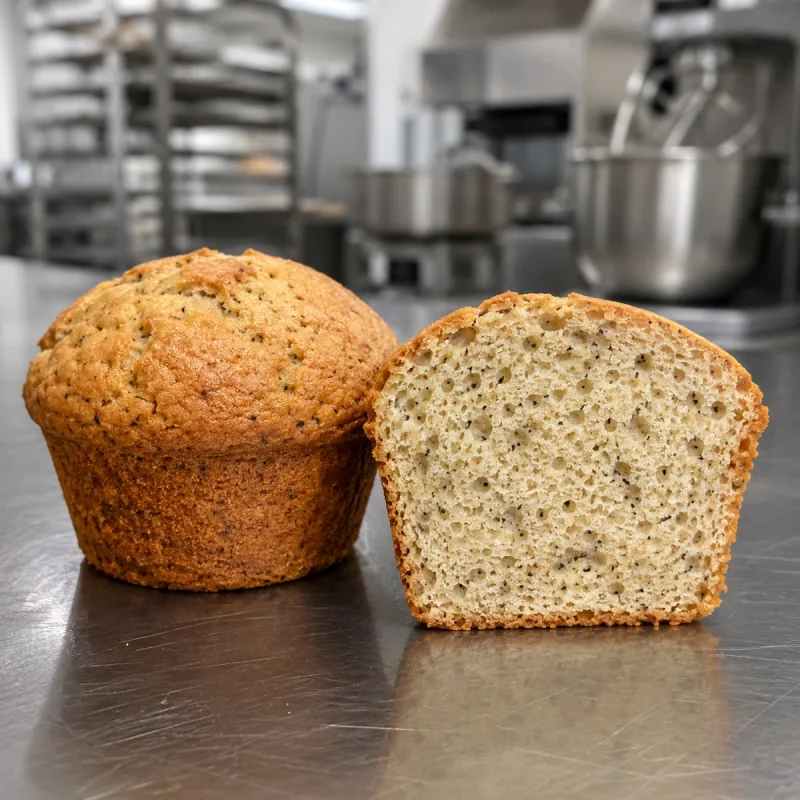
Why can a chia cupcake rise and then collapse?
A cupcake can look nicely domed in the oven, then sink in the centre and become sticky a few minutes later. In the wider system of vegan baking, chia is not a direct copy of egg. Its main role is to bind water and increase batter viscosity. Too much gel makes the batter heavy and limits gas expansion; too little can leave bubbles poorly supported after baking. The amounts below are starting formulation ranges that must be balanced with the rest of the recipe. A successful result has a springy crumb with small, even pores and does not smear onto the knife after cooling.
When finely ground chia meets water, mucilaginous polysaccharides at the seed surface form a hydrogel. This helps hold liquid in the batter and reduces crumbling. Chia does not, however, create the same heat-set protein network as egg and does not emulsify fat as effectively as yolk.
Chia can bind the batter, but it cannot create a light crumb on its own. Gelatinised starch, flour proteins and correctly dosed leavening still have to build the load-bearing structure during baking.
How much chia gel does cupcake batter need?
For 180–200 g wheat flour, a useful starting range is 8–10 g finely ground chia with 40–50 g water. This is a working starting point, not a universal replacement for one egg. Final amounts depend on flour absorption, sugar, plant milk, fat and additions such as cocoa, fruit purée or ground nuts.
Mix chia with water at roughly 1:5 and leave it for 8–12 minutes. The gel should be even, free of dry lumps and fall from a spoon as a thick, soft mass. If it stands much longer it may continue to thicken; do not automatically add more water before checking the consistency of the full batter.
Use finely ground chia. Whole seeds mainly hydrate around themselves and can leave soft gelatinous pockets while the rest of the crumb is drier. White chia leaves fewer dark specks, but its basic binding role is similar to dark chia.
Always count the gel water in the recipe’s total liquid. Adding chia gel on top of an unchanged amount of plant milk is a common route to a wet, heavy crumb.
How do you build a batter that stays light?
Chia solves binding, not every function of egg. For the broader framework, see egg substitutes in baking by function.
For 200 g flour, 70–90 g neutral oil is a useful working range for soft cupcakes, but it must be balanced with sugar and total liquid. Too little fat gives a dry, crumbly texture. Too much oil changes batter rheology and emulsion stability, dilutes structural ingredients and can weaken gas-cell retention.
Liquid ingredients around 20–24 °C are easier to mix evenly. With liquid neutral oil this mainly supports even blending; with coconut fat or another fat that partly sets when cool, it also helps prevent lumps and separation. Disperse the sugar well in the plant drink, then mix in the oil and prepared chia gel. The mixture should look uniform, without separate oil patches.
For 200 g flour, about 6–8 g baking powder is usually enough in this framework. Use baking soda only when the formula contains enough acid, such as lemon juice, vinegar or an appropriate fermented plant product. More leavening does not create a permanently lighter cupcake: the batter can rise too quickly, stretch bubble walls beyond their strength and then collapse.
Why is short mixing so important?
Mix the dry ingredients first so the baking powder is distributed evenly. Add them to the liquid mixture and fold only until the dry flour disappears. For a typical 12-cupcake batch, this is often about 20–30 seconds of calm mixing.
Long mixing develops more gluten in wheat flour and releases some of the small air bubbles already present. At the same time, chia continues to bind water, so the batter becomes thicker with every extra minute.
Correct batter falls from the spatula in a broad continuous ribbon and levels out within a few seconds. It should not run like pancake batter, but it should not sit as a stiff mound either. A paste-like batter before baking usually leads to an overly dense crumb.
Do not leave finished batter standing. Portion it within about five minutes after wet and dry ingredients are combined.
How do you bake the cupcakes evenly?
Fill standard wells to about 65–70% of their height, or portion roughly 50–55 g batter per cupcake. Equal portions matter because smaller cupcakes dry out before larger ones are baked through.
Bake at about 170 °C conventional or 160 °C fan-assisted. Standard cupcakes often need 18–22 minutes, but the actual time depends on the pan, batter amount and oven behaviour. A dark metal pan transfers heat to the edges faster than a light aluminium or silicone pan.
Do not open the oven during roughly the first two thirds of baking. A sudden temperature drop lowers gas pressure before the crumb has set. This matters especially in chia batter because the gel itself does not form a rigid protein network.
The cupcake is done when the centre springs back lightly, the surface is no longer wet and glossy, and a wooden pick comes out with a few fine moist crumbs but no raw batter. Colour alone is not a reliable signal; an egg-free vegan crumb may stay relatively pale even when it is fully baked.
How does the crumb stabilise while cooling?
A freshly baked cupcake is still very soft. The starch network contains hot bound water, fat is fluid and steam creates internal pressure. Leave the pan undisturbed for about five minutes, then transfer the cupcakes to a rack.
If they remain in the hot pan too long, the edges continue to heat and dry. If they are sealed in a container immediately, steam condenses on the surface, the paper cases become damp and the crust turns sticky.
A properly cooled crumb is springy and evenly porous. It returns after a light press and does not smear across the knife when cut. The crumbs should be soft and connected, not rubbery.
Wait until the cupcakes are cool in the centre before frosting or closing them in a container. During cooling, the crumb firms, steam escapes and fat cools, so the cut surface becomes less sticky and more stable.
How do you adjust the recipe without breaking the balance?
Ingredients that bind water or bring extra water into the batter change viscosity. Do not transfer the base ratio unchanged to formulas with cocoa, wholemeal flour, ground nuts or fruit purée. Adjust liquid in small steps and judge the final batter consistency.
On the first correction, change only one factor. If the crumb is rubbery, reduce chia or gel water first. If it is dry, shorten the bake or slightly increase liquid or fat. Changing chia, milk, oil and leavening at the same time hides the real cause.
Record the batter weight per cupcake, oven temperature, bake time and appearance of the cut crumb. Those notes let you change one variable next time and compare the result directly.
Diagnostics
Common problems and solutions
The centre is wet and rubbery and sticks to the knife when cut.
Cause: There may be too much chia gel or total liquid, or the centre may be underbaked.
Solution: Reduce ground chia by 1–2 g per 200 g flour or reduce gel water by 5–10 g. At the same time, confirm doneness in the centre rather than extending baking only because the crumb looks pale.
The cupcakes are low, heavy and have very few small pores.
Cause: The batter was mixed too long, chia thickened it for too long before baking, or too much gel was used.
Solution: Fold in the dry ingredients for about 20–30 seconds, portion immediately and use the lower end of the chia-gel range next time.
The cupcakes rise strongly in the oven and then sink in the centre.
Cause: Too much leavening, excessive oven heat or a centre that had not set enough.
Solution: For 200 g flour, keep baking powder around 6–8 g, verify the real oven temperature and bake until the centre springs back.
The crumb is dry and crumbly even though chia gel was used.
Cause: The bake was too long, or there is too little fat or total liquid. Chia can hold water but cannot replace missing fat.
Solution: Shorten baking by 2–3 minutes or increase liquid or oil slightly. Change only one factor at a time.
Wet gelatinous pockets are visible around seeds in the crumb.
Cause: Whole seeds were used or the chia was not evenly hydrated before addition.
Solution: Use finely ground chia, mix it thoroughly with water and hydrate for 8–12 minutes without dry lumps.
Technical terms
Terms worth understanding
- Chia gel
- A thick mixture of ground chia and water that binds part of the batter liquid and helps reduce crumbling.
- Mucilage
- Gel-forming polysaccharides on the surface of chia seeds that swell in water and increase viscosity.
- Viscosity
- The batter’s resistance to flow; excessive viscosity restricts the expansion of air and gas bubbles.
- Starch gelatinisation
- The heat-driven setting of starch that helps turn fluid batter into a load-bearing crumb.
Frequently asked questions
Answers to common questions
Is whole or ground chia better for cupcakes?
Finely ground chia disperses more evenly and reduces the risk of wet gelatinous pockets around individual seeds.
Can I use white chia instead of black chia?
Yes. White chia has a comparable binding role and leaves fewer visible dark specks in a pale crumb.
Can I prepare chia cupcake batter in advance?
No. Chia keeps binding water after mixing and the leavening system starts reacting. Portion and bake within roughly five minutes after adding the flour.
Can I directly replace chia with ground flax?
Not without adjustment. Flax and chia affect flavour, colour, water binding and viscosity differently, so equal seed and water weights do not guarantee the same crumb.