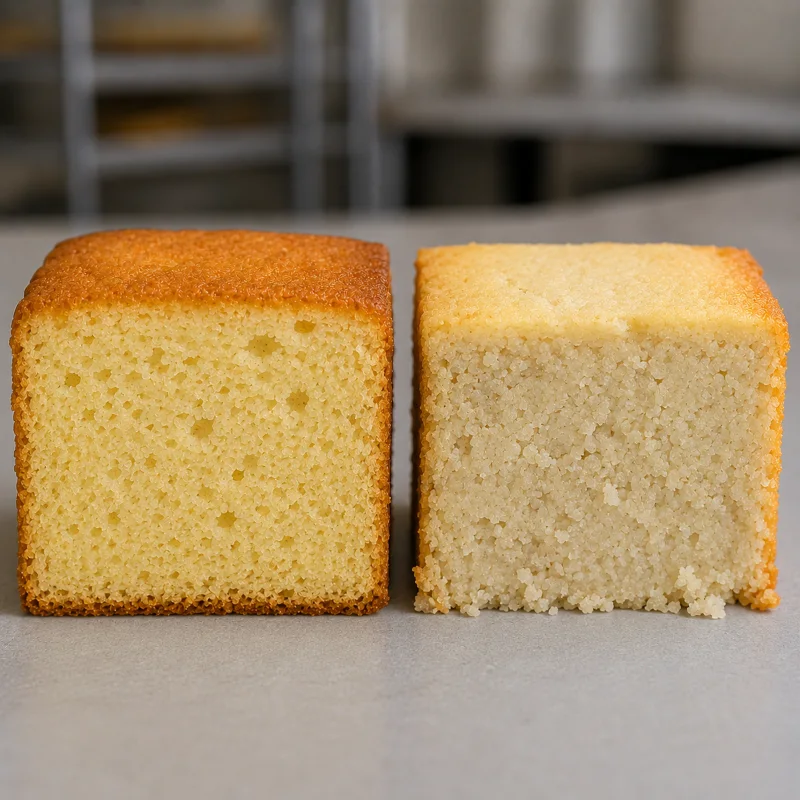
Why replacing an egg with one ingredient often fails
A vegan cake can rise well and still crumble under the knife. A cookie can be sweet enough yet turn out pale, greasy and overly spread. The problem is usually not that “vegan baking does not work”; it is that the egg was treated only as a quantity of liquid. Within the wider system of vegan baking, each of its jobs has to be replaced deliberately.
About 50 g of egg without shell is not functionally equal to 50 g of an arbitrary substitute. Egg proteins set with heat, yolk helps emulsify fat and water, whipped whites stabilize air bubbles, and whole egg contributes liquid, color and browning reactants. That is why one plant ingredient rarely provides binding, aeration, emulsification and color at the same time.
Replace the job of the egg, not just the ingredient called “egg.”
In cookies, binding may be the main need. In muffins, binding and water retention both matter. In a light sponge, egg also builds an aerated structure that has to survive heating, so a spoon of starch or mashed banana is not a complete replacement.
Which substitute fits each egg function?
Ground flax and chia release hydrocolloids when hydrated. The resulting gel can link flour particles, reduce crumbling and hold water, but it does not create the same protein network as heat-set egg. For a starting binder, use 7–8 g finely ground flax or chia with 28–32 g water and rest it for 10–15 minutes. A useful gel should slide slowly from a spoon as one connected mass rather than remain runny or set into a hard lump.
This approach is most useful for cookies, muffins and denser cakes. In recipes such as vegan chia cupcakes, too much gel can increase binding while making it harder for the batter to expand around gas bubbles, producing a heavy, damp crumb.
Fruit purées and plant yogurts behave differently. About 45–60 g applesauce, banana or unsweetened plant yogurt can replace part of the mass and moisture contributed by one egg in a moist cake or brownie. They increase moisture but do not provide strong aeration; banana also brings flavor, sugar and density.
Starch is useful when the mixture needs to firm as it heats. A starting slurry of 8–10 g cornstarch or potato starch with 25–30 g water can help bind cookies, pancakes or simple cakes. Too much creates a sticky, gummy crumb and does not replace foam or yolk emulsification.
Aquafaba is more appropriate when foam is needed. Roughly 25–30 g is a practical starting range for one egg white, but the liquid’s actual whipping behavior matters more than the number. Concentration, viscosity and foam stability vary between brands and cooking methods. Aquafaba can stabilize air and emulsify to a degree, but it does not mimic every property of a whole egg.
How do vegan fats change volume, tenderness and spread?
Fat does more than add richness. It coats flour particles, limits gluten linking, lubricates the structure and changes how quickly dough softens and spreads in the oven. A solid plastic fat can hold small air pockets during creaming; liquid oil cannot do that in the same way.
For recipes that rely on creaming fat with sugar, use a firm plant-based baking block at roughly 75–80 % fat rather than a soft, water-rich spread. It should be cool yet pliable: a finger should leave an indentation without oil leaking out.
In muffins, oil cakes and brownies, a workable starting conversion is about 80–85 g neutral oil plus 15–20 g extra liquid for 100 g butter. This is not a suitable swap for puff pastry, shortcrust or cookies where solid fat controls shape and spread.
For vegan cookies that bake evenly crisp, fat temperature has to match the balance of sugar, flour and water. Coconut fat is solid but has a different plastic range from a bakery fat block: it can be brittle when cold and melt quickly in the oven.
How do you balance liquid, binding and air bubbles?
Any water added to flax, chia or starch counts toward total hydration. If you add another 30 g water through an egg replacer without reducing other liquid, the batter becomes softer even when the replacer itself looks thick.
Cookie dough should hold the shape of a scoop rather than slowly puddle on the tray. Muffin batter should fall from a spatula in a broad, broken ribbon rather than pour like sauce. If it is too soft, reduce another liquid first by 5–10 g. Add extra flour only afterward and in small steps, because excess flour quickly makes the crumb dry and chalky.
Plant milk supplies liquid, not automatic binding or aeration. Almond and soy milk differ in protein and fat, while homemade milk can contain blender foam that makes texture harder to judge. For sensitive batters, use almond milk without excess foam.
Do not automatically add more baking powder just because there is no egg. Leavening creates gas; it does not build strong walls around the bubbles. If binding is weak, extra gas can cause rapid expansion followed by collapse.
How do you get golden browning without egg wash?
Browning is not only a matter of time in the oven. The Maillard reaction needs reducing sugars and amino compounds, and its rate also depends on pH, temperature and surface water. A very wet surface heats more slowly and stays paler.
For sweet yeasted or laminated pastries, a useful starting wash is 30 g unsweetened soy milk, 3 g maple or glucose syrup and 2 g neutral oil. Apply it very thinly; it should not pool in creases. For less sweet items, soy milk alone may be enough.
Do not add extra baking soda only for a darker color. Higher pH can speed browning, but it also increases cookie spread and may leave an alkaline, soapy taste. If the crumb is already baked but the surface is pale, correct the wash or surface moisture in the next batch instead of drying out the interior with extra baking time.
How do you check whether the substitute covers the egg’s important jobs?
Write down what the egg does in that specific recipe: bind, emulsify, aerate, moisten, set or brown. Then assign a replacement strategy to each important job.
On the first test, change one main variable. If the replacer adds water, subtract that water from another liquid; adjust fat in a later test. Record dough or batter mass, spread, when the edges set, final height and crumb condition after complete cooling. A warm vegan cake may seem under-bound even though starch and plant gels continue to stabilize as it cools.
Recipes with one egg can often be adapted with one main binder and a small liquid correction. Sponge cakes, soufflés, meringues and custards in which several eggs carry most of the structure should not be approached as a simple one-for-one swap. They need a new balance of foam, emulsifier, starch, protein and water.
Before the next bake, do not ask only “What can I use instead of egg?” Ask “Which job of the egg is still uncovered?”
Diagnostics
Common problems and solutions
The cake is moist but crumbles when sliced.
Cause: Fruit purée or plant milk added water but did not provide enough binding and heat-set structure.
Solution: Replace part of the purée with flax or chia gel, or add a measured amount of starch. Cool completely before slicing.
The crumb is dense, sticky and gummy.
Cause: Too much plant gel or starch was used, and its added water was not subtracted from other liquid.
Solution: As a test, reduce the binder by 15–25 %, then adjust for the specific binder; change other liquid in 5–10 g steps.
Vegan cookies spread into a thin greasy sheet.
Cause: Solid fat was replaced with an equal weight of liquid oil, or the plant fat block was too warm before baking.
Solution: Use a firm, plastic plant fat around 75–80 % fat and chill the shaped dough before baking.
The surface stays pale even though the crumb is baked.
Cause: The surface contains little protein and reducing sugar, or it was too wet.
Solution: Brush on a very thin wash of 30 g unsweetened soy milk, 3 g maple or glucose syrup and 2 g neutral oil. Do not extend baking just for color.
Cookies are dark, over-spread and taste soapy.
Cause: Baking soda was increased to speed browning without balancing the acids in the recipe.
Solution: Return to the original baking soda amount and improve color through the surface formulation and the temperature specified for the recipe.
Technical terms
Terms worth understanding
- Emulsification
- Dispersing fat through a water phase as fine stable droplets so the batter stays uniform instead of separating.
- Hydrocolloid
- A substance that swells or forms a gel in water, increasing viscosity, binding and water retention.
- Coagulation
- Heat-driven protein denaturation and linking into a firmer network that helps set a baked structure.
- Fat plasticity
- The ability of a solid fat to deform and hold small air pockets without crumbling or leaking oil.
- Maillard reaction
- Heat-driven reactions between reducing sugars and amino compounds that create brown color and characteristic baked aromas.
Frequently asked questions
Answers to common questions
Can I use the same egg substitute in every recipe?
No. Choose the substitute according to whether the recipe mainly needs binding, foam, emulsification, moisture or heat-set structure.
Does aquafaba replace a whole egg?
Usually not by itself. It best reproduces part of egg white behavior, especially foaming; yolk fat, emulsification and color often need other ingredients.
Which vegan fat works for puff pastry or laminated yeast dough?
Use a firm, plastic fat designed for laminating or baking. Liquid oil and very brittle cold coconut fat do not create the same stable separated layers.
Can almond milk replace egg wash?
It can wet the surface and add some shine, but it usually browns less than higher-protein soy milk. The result also depends on the drink’s sugar content.