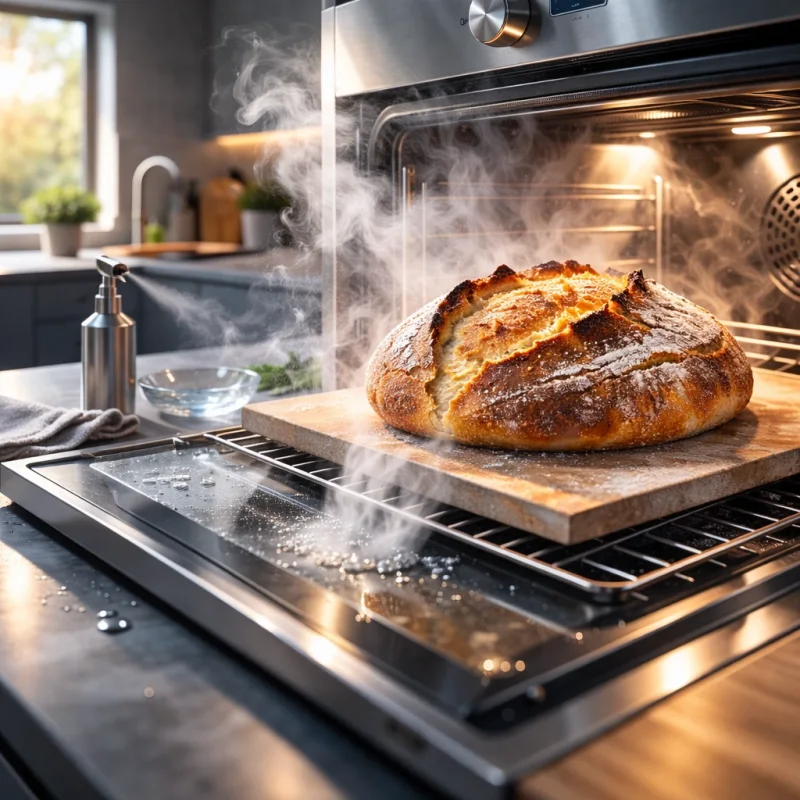
Control steam and drying for better bread structure
The balance of moisture, heat, and crust is the foundation of predictable bread baking
The moment bread enters a hot oven, moisture and drying begin working in opposite directions. Too little steam lets the surface set too early and restricts oven spring. Too much moisture for too long prevents the crust from drying and browning properly. This balance helps determine whether a loaf develops a soft, resilient crumb and a thin, properly dried crust.
Managing moisture means understanding how water moves through the dough and oven. During the opening minutes, steam keeps the surface flexible while gases expand. For the narrower mechanism of early steam, see the guide to steam in bread baking for a flexible crust, better volume, and controlled oven spring. Once the main expansion is over, the objective changes: excess moisture needs to leave so the crust can dry, set, and brown.
The broader baking system is a combination of moisture, temperature, and time. Stronger heat speeds energy transfer; convection speeds moisture removal. The same formula can therefore need a different transition from humid to dry conditions in different ovens.
How moisture changes crumb and crust
In higher-hydration bread, water affects how freely the dough can move and how the internal structure sets during heating. Oven steam acts mainly at the surface: it delays premature crust setting and gives the loaf more time to expand.
Key effects of early steam include:
- more potential for oven spring,
- a more flexible dough surface,
- cleaner score opening,
- less risk of the crust restricting volume too early.
After that point, steam is no longer the goal. During the dry phase, the surface must lose water so browning and crispness can develop. If the crust darkens too quickly while the crumb is still developing, read how to control bread crust color without drying the crumb or burning it. If the crumb feels gummy or damp, do not assume that simply baking longer is always the answer; retained moisture and slicing too early can produce similar symptoms.
Steam, the Maillard reaction, and gluten
Steam keeps the dough surface wetter during the early stage and delays the formation of a rigid crust.
The Maillard reaction becomes more pronounced once the surface is dry enough and hot enough, producing deeper color and toasted aromas.
The gluten network gives dough the ability to retain expanding gases, but the final baked structure also depends on heat, water, and starch setting.
A good crust should crack lightly under pressure after cooling without crumbling like a dry shell. The crumb should spring back gently and should not feel wet or sticky.
What matters when managing moisture
- Steam matters most at the beginning of the bake.
- A humid oven for too long slows browning and crust drying.
- A very dry start can tighten the surface early and restrict volume.
- Higher actual oven temperature speeds both expansion and moisture loss.
- After the main oven spring, moisture needs a route out of the oven.
A common mistake is to create steam and then treat it as a permanent baking condition. A more reliable process uses two deliberate phases: retain moisture early and actively dry later. Because both depend on actual oven heat, it also helps to understand how to control oven temperature when baking bread for an even crust and stable crumb.
Practical baking tips
- Thoroughly preheat a stone, steel, heavy sheet pan, or covered baking vessel.
- Generate steam only with a method that is safe for your oven; a covered vessel reliably traps moisture released by the dough itself.
- After the main oven spring, remove the steam source, uncover the vessel, or briefly vent the oven as appropriate for your method.
- If the crust darkens too quickly while the center still needs time, lower the temperature rather than removing the loaf too early.
- Cool bread completely on a rack because internal moisture continues to redistribute after baking.
Oven mode can change the result significantly. Convection removes moisture faster, rack position changes exposure to heating elements, and actual oven temperature may differ from the setting. For setup choices, see convection vs. conventional oven baking, temperature, and rack position.
Why this approach is useful
- It explains moisture in bread baking as a process rather than a single trick.
- It links visible symptoms to the phase where the error most likely occurred.
- It helps preserve a soft crumb without sacrificing a crisp crust.
- It separates steam problems from temperature, drying, and cooling problems.
- It turns oven microclimate into something you can control systematically and repeatably.
Once moisture is treated as a timed tool rather than a side effect, the oven stops being a black box. First you give the loaf room to expand; then you deliberately let the surface lose enough water to form a stable, aromatic crust.
Frequently asked questions
Answers to common questions
How do I know there is enough steam in the oven?
Enough early steam usually means the dough surface stays flexible during the first minutes and the score opens instead of sealing immediately. If the surface turns dull and firm very quickly or the loaf bursts elsewhere, the opening environment may be too dry. Steam needs to be present from the start, not added only after the crust has begun to set.
When should I vent the steam?
Start venting when the loaf has achieved most of its oven spring, the score has opened, and the surface is beginning to color. Vent too early and expansion may be restricted; vent too late and the crust can stay pale and soft. The goal is a clear transition from a humid opening phase to a dry finish.
Why is my crust too thick even though I used steam?
Steam mainly solves the opening phase. A thick crust can still form if the loaf then bakes too long in very dry, high heat or if surface moisture is driven off too aggressively. After venting, adjust temperature and total bake time to the loaf size and shape instead of simply extending the bake at the same heat.
Why is the crumb gummy even when the crust looks well baked?
A gummy crumb often means structure and moisture had not stabilized before slicing. Possible causes include an underbaked interior, too much retained moisture, or cutting while the loaf is still very hot. Cool completely on a rack; larger loaves often need 60–90 minutes or more before slicing.
Does steam help lower-hydration bread too?
Yes. In firmer doughs, steam mainly prevents the surface from setting too early and helps scoring open cleanly. It will not create an open crumb by itself, but it can improve oven spring and crust quality. These loaves may move into the dry phase earlier.
How do I stop bread from bursting where I did not score it?
Unwanted ruptures can happen when the surface dries too quickly, the score is too shallow, or the loaf is still expanding after the crust has become rigid. Score cleanly just before baking and provide stable early moisture so expansion follows the intended weak point rather than breaking through the side or base.