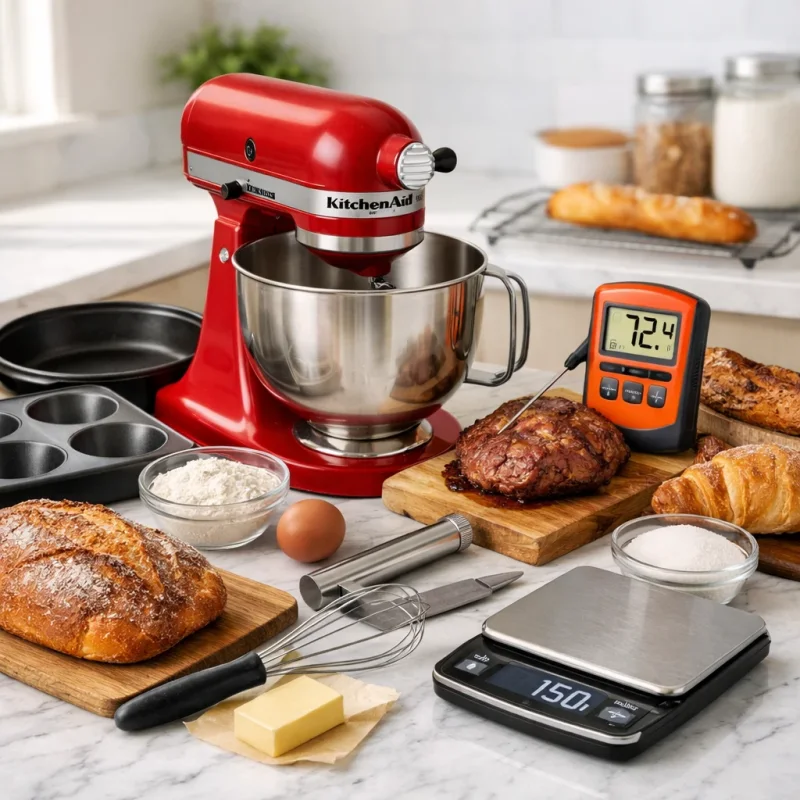
A good baking tool controls one important variable
Bakes rarely fail because the kitchen lacks the most expensive mixer. More often the problem is a misweighed liquid, the wrong pan size, an unchecked oven temperature or a spatula that leaves flour unmixed at the bottom of the bowl. A tool earns its place when it gives better control over quantity, temperature, geometry, time or batter structure.
Build your kit around the work you actually do rather than the number of gadgets you can own. If you are starting out, the guide to essential baking tools for beginners gives a useful baseline: measure first, then mix, shape, bake and cool correctly.
The basic kit should cover the full workflow
For most home bakers, a digital scale, two adequately sized bowls, a whisk, a firm silicone spatula, a bench scraper, one useful pan or tray, baking parchment and a cooling rack cover the core process. Add a measuring jug for larger liquid quantities and a thermometer if you often make bread, chocolate, caramel or temperature-sensitive creams.
Bowls need spare capacity for mixing and fermentation. Stainless steel is light and responds quickly to temperature changes; glass gives a clear view but retains heat; scratched plastic can hold grease and odours. A whisk, spatula and scraper do different jobs and should not be treated as interchangeable.
Accurate measuring matters more than mixer power
In baking, the ratio of flour, water, fat, sugar, egg and leavening determines structure. A scale that reads to 1 g is adequate for most ingredients. For small quantities of salt, yeast, gelatine, pectin or chemical leaveners, a small scale reading to 0.1 g can be more useful.
Use the scale on a firm, level surface and tare deliberately. Measuring jugs are best for larger volumes of free-flowing liquids; viscous ingredients are better weighed when precision matters. Infrared thermometers measure surfaces, while probe thermometers measure inside a product, so they solve different questions.
The pan controls thickness, heat transfer and baking time
Put the same amount of batter in a wider pan and the layer becomes shallower, shortening the distance heat must travel to the centre. In a narrower pan the centre takes longer to set while the edges may already be firm and dark. Round-pan area changes with the square of the radius, so diameter is not a linear guide to batter quantity.
Light-coloured metal responds quickly and usually makes browning easier to control. Dark metal often browns the base and edges faster. Glass and ceramic heat more slowly but retain heat longer after leaving the oven. Silicone conducts heat poorly and needs rigid support when it is filled and moved.
Mixing tools must match the structure you want
More speed is not always better. In whipped cream, meringue, buttercream and dough, excessive mechanical work can change temperature, bubble size or gluten development. A balloon whisk introduces air, a paddle mixes butter and denser batters, and a dough hook stretches and folds yeasted dough.
Start slowly when adding flour, starch or cocoa. A spatula should be firm enough to lift dense mixture from the bottom but flexible enough to follow the bowl wall.
Parchment, mats and cooling racks control surface contact
Baking parchment reduces sticking but cannot fix the wrong pan or oven temperature. It should lie flat without large creases and must stay away from exposed heating elements or flame. Silicone mats create a thicker insulating layer than paper, so the underside and spread of high-fat doughs can change.
A cooling rack does something a solid tray cannot: it lets steam escape. Leave a hot bake on a solid surface and moisture can condense underneath, softening the base or crust.
Specialist tools only make sense when they solve a repeating problem
Rolling guides, piping bags, tips, cake rings, adjustable frames and cutters are excellent when they control a specific process. Uneven cookie thickness may justify rolling guides; uneven cake layers may call for a long serrated knife or leveller. A specialist tool should either save meaningful time or make the result more reproducible.
Before buying, check four things: size for your usual batch, ease of cleaning, stable geometry and whether the material is rated for the intended temperature and food contact.
Cleaning preserves both life and accuracy
Grease in a bowl interferes with whipping egg whites. Burnt residue on a tray creates dark areas that absorb heat more quickly. Water in a scale or thermometer joint can damage electronics. Let pans cool, use non-abrasive tools on coatings and dry silicone completely before storage.
Check a scale occasionally with a known mass. Check thermometers according to the manufacturer’s method because the correct procedure depends on the sensor and measuring range.
Build the kit around what you bake most often
For bread, prioritise a scale, large bowl, scraper, thermometer, stable pan or vessel and cooling rack. For cakes, pan geometry, a reliable spatula, whisk, ring and accurate portioning matter more. For cookies, flat trays, parchment or a mat, controlled rolling thickness and a large cooling rack are especially useful.
Look back at your last ten bakes and identify where the result varied most. Then choose the tool that controls that variable. That produces a small kit in which every item has a job.
Frequently asked questions
Answers to common questions
Is a hand mixer or stand mixer better for home baking?
A hand mixer is enough for small batches, cream, egg whites and many cake batters. A stand mixer becomes more useful for frequent bread doughs and long mixing of larger batches.
How many baking pans do I need?
Two or three good pans that match the recipes you bake most often are enough for many home bakers.
Can a silicone mould go directly on the oven rack?
A soft silicone mould is safer to fill, carry and bake on a flat rigid tray so it does not distort and the batter stays level.
When is an infrared thermometer useful in baking?
It is useful for checking the surface of a tray, baking stone or worktop. It does not measure the centre of bread, custard or a thick bake.
Can baking parchment be reused?
Reuse it only while it is clean, flat, free of charred edges and not saturated with grease or food residue, and always respect the maker’s temperature limit.