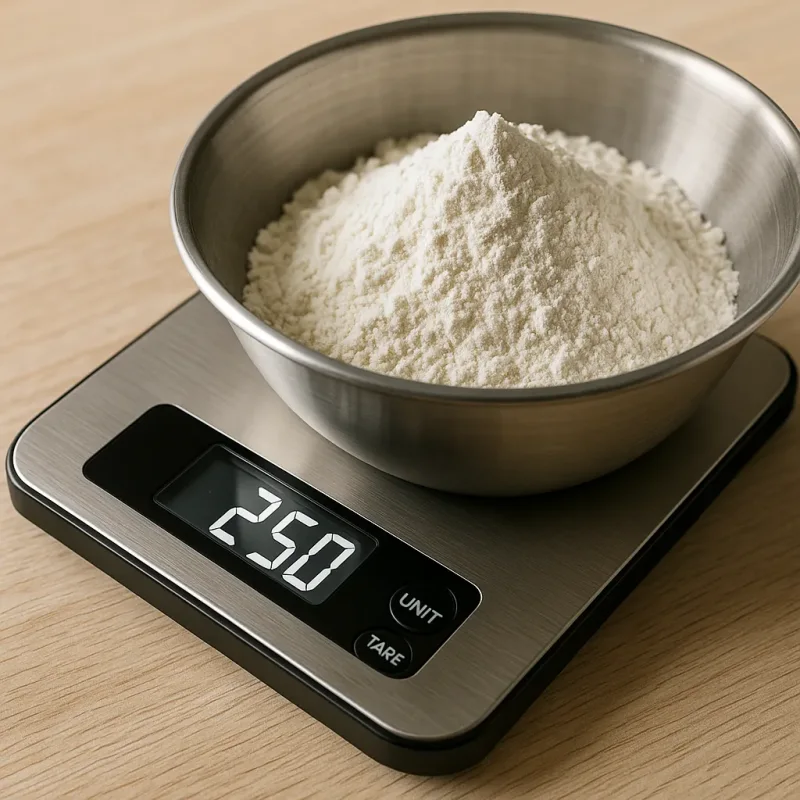
Why a few grams can change dough or batter
Cooking often tolerates a small measuring error. Baking is less forgiving because a few grams can change dough hydration, batter viscosity, or the balance between flour, sugar, fat and leavening. That is why a digital scale belongs among the most useful baking tools for home baking: it makes ratios controllable and results easier to repeat.
If a formula contains 500 g flour and 325 g water, hydration is 65%. Add 30 g extra flour by accident and the same water now gives about 61% hydration. The dough becomes firmer, stretches less readily and may produce a tighter crumb.
The same principle applies to cakes. Extra flour increases starch and protein relative to eggs, sugar and fat. The batter can become more viscous, air bubbles expand less easily, and the finished cake may be dry or dense.
Volume measures are particularly variable for flour and other compressible dry ingredients because the amount depends on scooping, settling and packing. Weighing removes much of that variability.
What kind of kitchen scale is useful for baking?
For most doughs, batters, creams and fillings, a digital kitchen scale with 1 g resolution and roughly 3–5 kg capacity is practical. Remember that the bowl counts toward the maximum load. A 1.5 kg glass bowl on a 3 kg scale leaves only about 1.5 kg available for ingredients.
Among the essential baking tools for beginners, a scale has a special role: it does not replace technique, but it prevents you from trying to fix a wrong ingredient ratio only after mixing has started.
Resolution is not the same as accuracy
Resolution tells you the size of the display increment. A scale that reads in 1 g steps displays whole grams. That does not prove that every reading is actually accurate to within 1 g.
Accuracy describes how close a reading is to the true mass. Repeatability describes whether the same load, measured under the same conditions, gives a similar result each time. For home baking, stable repeatability is often more useful than an impressive number of decimal places.
If the same object reads 100 g, then 103 g, then 98 g, the scale is not giving reliable repeat measurements even though the display uses whole grams.
Weigh very small quantities separately
Yeast, salt, baking powder, bicarbonate of soda, gelatine and hydrocolloids may be used in quantities where a 1 g difference is proportionally large. As a practical starting point, amounts below about 5 g are better weighed on a separate 0.1 g scale. The real threshold depends on the specific device and the recipe.
Do not try to add 1 g of bicarbonate into a heavy bowl already holding 2 kg of mixture. Such a small change can disappear within the display increment, minimum responsive load or internal smoothing. Weigh critical small ingredients separately, then add them to the main mix.
How to weigh ingredients correctly
Place the scale on a hard, level and stable surface. A soft mat, uneven board or bowl touching a wall can change how force reaches the sensor.
Before weighing, check that:
- the scale and bowl do not touch surrounding objects;
- the bowl sits roughly in the centre of the platform;
- the display is stable at zero;
- the total load stays below the rated capacity;
- no cable, cloth or overhanging container is carrying part of the weight.
Place the bowl on the scale and press TARE. Add the ingredient gradually, slowing down for the final few grams. You can tare again after each ingredient when building a recipe in one bowl, but tare cannot undo an ingredient that has already been added in the wrong amount.
For salt, yeast and chemical leaveners, separate weighing is safer when the recipe allows only a small margin of error.
Millilitres are not automatically grams
Weighing liquids is often faster and more repeatable than reading a jug, but millilitres and grams are not interchangeable units in general.
For water, the kitchen approximation 1 ml ≈ 1 g is useful under ordinary conditions. Oil is less dense, while honey and concentrated syrups are denser than water. So 100 ml of oil does not automatically weigh 100 g.
If a recipe specifies mass, weigh the liquid. If it specifies volume, use a suitable measuring vessel or a verified conversion for that particular ingredient.
Sticky ingredients can be easier to portion with negative tare. Put the jar of honey or glucose syrup on the scale, tare it, then remove product until the display reaches, for example, –80 g. That tells you how much mass has actually left the container.
Why the display can lag
Digital scales often smooth rapid changes so the number does not constantly jump. If you pour flour quickly, the reading may pause and then overshoot the target. Slow down a few grams before the target and wait for the display to settle.
Weak batteries, bench vibration, draughts when weighing very small quantities, an oversized bowl touching its surroundings, overload, or auto-off during a long weighing step can also cause problems.
Do not place a hot pan or bowl directly on the scale unless the manufacturer specifically permits it.
How to check repeatability
Switch the scale on while it is standing on a stable surface and wait for zero. Weigh the same stable object, remove it, and repeat the process several times. The readings should stay close together rather than wandering randomly over several display increments.
For a more deliberate check, use a known reference weight or another stable object whose mass has been independently verified. You can also place it at different positions on the platform; a large centre-to-edge difference may indicate uneven loading or a damaged platform.
A kitchen scale is not a laboratory balance. Its job is to produce dependable, repeatable measurements across the range you actually use for baking.
A sensible routine is simple: check zero and capacity, weigh the smallest and most critical ingredients separately, and add larger quantities slowly while the display stabilises. Once mass is under control, temperature becomes the next major variable — for chocolate, sugar syrups, creams and baked doughs, use a suitable thermometer.
Frequently asked questions
Answers to common questions
Should I weigh flour before or after sifting?
Unless the recipe says otherwise, weigh it before sifting. Sifting changes volume and aeration, not the mass of the same flour.
How do I divide dough into equal pieces with a scale?
Weigh the whole dough, divide the mass by the number of pieces, then adjust each portion to the calculated target.
How do I weigh an egg without the shell?
Crack the egg into a separate bowl, weigh the contents, then portion the mass required by the recipe. This is useful when egg size affects liquid and protein ratios.
What if my scale shows ounces instead of grams?
Switch to grams before taring and check the unit again before adding ingredients. Avoid changing units unnecessarily during the same recipe.