Your first baking kit should remove guesswork, not fill a drawer
The bowl is on the counter and the ingredients are ready, then improvisation begins: flour is scooped with a cup, butter is estimated with a spoon, and oven temperature is judged by the glow of the heating elements. Reproducibility can disappear before the batter is even mixed. A useful beginner baking kit is not a collection of specialist gadgets. It is a small control system for quantity, mixing, shape, and temperature.
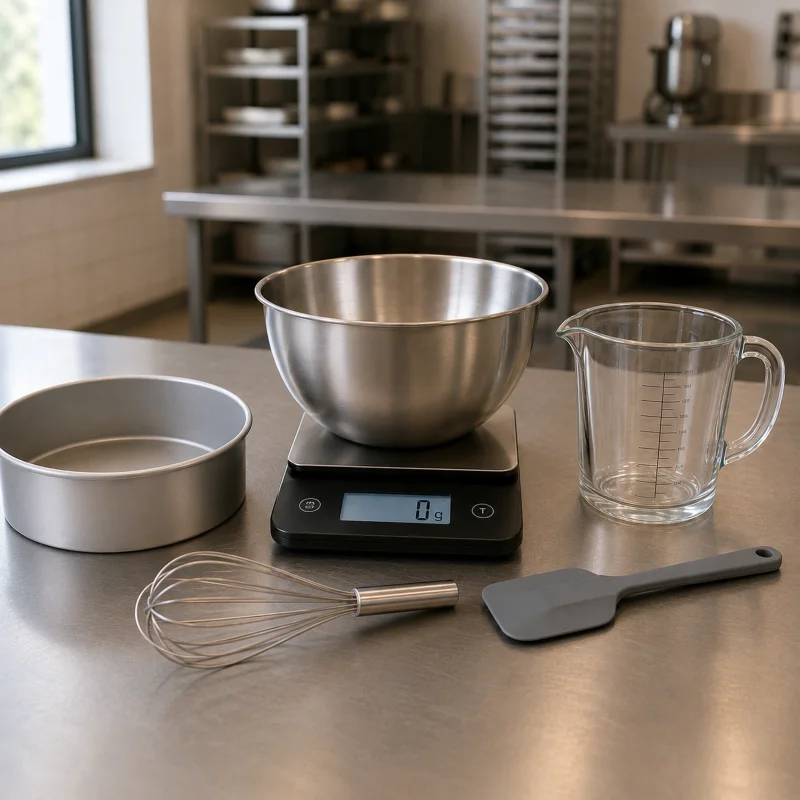
To start, you need a digital kitchen scale, a liquid measuring jug, a suitable mixing bowl, a whisk, a silicone spatula, and at least one pan or tin that matches what you actually plan to bake. A sieve is a useful addition for cocoa, icing sugar, lumpy dry ingredients, and even distribution of chemical leaveners, but it is not essential for every basic recipe. Your phone can time a bake, and a clean oven rack can temporarily serve as a cooling rack. A stand mixer, multiple pan sets, and a large decorating kit can wait.
A tool is essential when, without it, you cannot control an important measurement or process well enough. Price is not the deciding factor.
A digital scale usually matters more than an electric mixer
Flour can pack into a measuring cup in very different ways. Scooping directly from a bag can put substantially more flour into the same volume than gently filling a cup with loosened flour. Sugar, cocoa, and ground nuts have their own packing behaviour. Measuring by mass removes much of this uncertainty.
Weigh liquids when a recipe gives their quantity in grams. If the recipe specifies millilitres, use a liquid measuring jug: millilitres measure volume, grams measure mass.
For ordinary home baking, choose a scale with 1 g resolution, a tare function, and at least 3 kg capacity; around 5 kg is more practical. Tare lets you reset the display and weigh several ingredients into the same bowl. A 0.1 g scale is valuable for tiny amounts of yeast, enzymes, hydrocolloids, or concentrated additives, but it is not a first-kit requirement.
Place the scale on a firm, level surface. A soft mat, uneven worktop, or bowl touching a wall can make the reading unstable.
Bowl, whisk, and spatula should work as one system
One medium bowl of roughly 2.5–3.5 litres covers many small cakes, creams, cookie mixtures, and pancake batters. For bread or larger batches, around 4–5 litres is more useful because dough needs room during mixing and fermentation.
Do not fill the bowl to the rim. Whisking needs headroom for the mixture to circulate. Stainless steel is light and durable; glass lets you see the mixture but is heavier; plastic should be free from deep scratches and old grease odours.
A balloon whisk works for eggs, fluid batters, custards, and combining dry ingredients. It is a poor tool for dense cookie dough, where a sturdy spatula or wooden spoon is better. A silicone spatula should have a firm enough neck not to collapse under load and an edge that follows the bowl wall. Its job is not merely stirring: it scrapes flour and fat from the bottom so dry pockets are not left behind.
A sieve is useful, but not a ritual
A fine metal sieve breaks up cocoa, icing sugar, and leavener lumps and helps distribute dry powders evenly. That is not the same as claiming every flour must be sifted to “add air”.
A lump of bicarbonate of soda can leave a strongly alkaline spot. A pocket of baking powder can taste chemical or bitter and produce uneven lift. Cocoa lumps can survive as dark bitter patches. A sieve around 14–18 cm across is large enough for many home recipes without taking up excessive space.
Do not sift flour automatically. Sift it when it is compressed, visibly lumpy, or when you need cocoa, starch, and leaveners distributed especially evenly.
Buy pans for the products you actually bake
There is no universal pan for every bake. A flat metal sheet with a low rim suits cookies and small pastries but cannot replace a deeper cake tin. For cakes, a round metal tin of roughly 20–24 cm is a versatile starting point, depending on the recipes you make most often.
Changing diameter changes batter depth and therefore bake time. Material also affects the result: dark metal often browns edges faster, glass retains heat longer, and flexible silicone moulds need firm support.
One good pan in a useful size is a better first purchase than five novelty shapes with unstable walls or poor heat contact.
Oven temperature is a measurement, not a dial setting
Setting the control to 180 °C tells you what you requested from the oven, not necessarily the temperature around the pan. Domestic ovens regulate heat by cycling elements on and off, so the temperature is not perfectly constant.
A beginner does not need every type of thermometer. If the oven clearly bakes unevenly, a simple oven thermometer is a sensible diagnostic tool. Place it close to the position where the pan normally sits and watch several heating cycles. To compare hot and cool areas, repeat the test at the left, centre, and right of the same shelf level.
Preheat before baking. The indicator can switch off as soon as the oven sensor reaches its target while the walls and rack are still coming up to temperature. For temperature-sensitive baking, allowing roughly another 10–15 minutes after the signal can improve stability unless the appliance manufacturer specifies otherwise.
What can stay in the shop for now
A stand mixer saves labour when you frequently knead, whip large batches, or mix for long periods. It does not correct a bad ingredient ratio, overmixing, or poor temperature control. A scale, bowl, and hand tools can handle basic cakes, muffins, cookies, and many simple doughs.
Buy a rolling pin when rolled pastry or dough becomes a regular part of your baking. Piping bags and nozzles are useful for decoration but are not a prerequisite for a properly baked sponge. A dedicated cooling rack can initially be replaced by a clean oven rack raised so air can circulate underneath.
The worst beginner purchase is a large set where two pieces are used and the rest occupy storage space. A single sturdy tool with a clear job is almost always more useful.
Equipment care affects the next bake
Old fat can cling to silicone and develop stale odours. Moisture can remain in cracks in wooden handles. A damaged non-stick coating may start to peel or grab food. A tool is not automatically fit for purpose simply because it is still in the cupboard.
Dry pans completely before storing them. Do not cut on coated surfaces or scour them with metal wool unless the manufacturer permits it. Do not immerse a kitchen scale; wipe it with a lightly damp cloth. Rinse a sieve promptly after contact with wet batter before residue dries into the mesh.
For a first kit, use one simple purchasing rule: choose a tool that will improve control of quantity, temperature, mixing, or shape in your next five bakes. Anything without a clear job can wait.
Diagnostics
Common problems and solutions
The scale reading will not settle.
Cause: The scale is on a soft/uneven surface or the bowl is touching something.
Solution: Move it to a hard, level surface and ensure the bowl is free.
Cake edges darken while the centre is still unstable.
Cause: The pan may be too small/dark or the actual oven temperature too high.
Solution: Check the specified pan size first, then measure actual oven temperature if needed.
Dry flour pockets remain at the bottom.
Cause: The mixing tool is not scraping the bowl-wall transition.
Solution: After initial mixing, scrape the bottom and sides with a firm spatula.
A silicone pan flexes while being carried and the batter runs to one side.
Cause: The soft pan has no rigid support underneath it.
Solution: Place the empty silicone pan on a flat metal baking sheet first, then fill it and transfer both together to the oven.
Tools smell unpleasant after washing or retain a greasy film.
Cause: Fat remains in scratches, joints or porous material, or the tools were stored while still damp.
Solution: Wash tools promptly after use, rinse thoroughly and dry completely; replace damaged spatulas or cracked handles.
Technical terms
Terms worth understanding
- Tare
- Scale function that resets the display to zero after a container is placed on it.
- Scale resolution
- The smallest change in mass a scale displays, such as 1 g or 0.1 g.
- Heat transfer
- Movement of heat from oven air and bakeware into the batter or dough; affected by material, colour, thickness and shape.
Frequently asked questions
Answers to common questions
Is a digital scale the most important first tool?
For recipes written in grams, yes: it removes much of the variation caused by measuring flour and other ingredients by volume.
Does a beginner need a stand mixer?
No. Many cakes, muffins, cookies and simple doughs can be made with hand tools; a mixer becomes justified when you knead often or whip for long periods.
Do I need to sift all flour?
No. Sift when ingredients are lumpy or when cocoa, starch and leaveners need especially even distribution.
When is an oven thermometer worth using?
When bakes repeatedly run fast, slow or uneven despite correct recipe quantities and pan size.