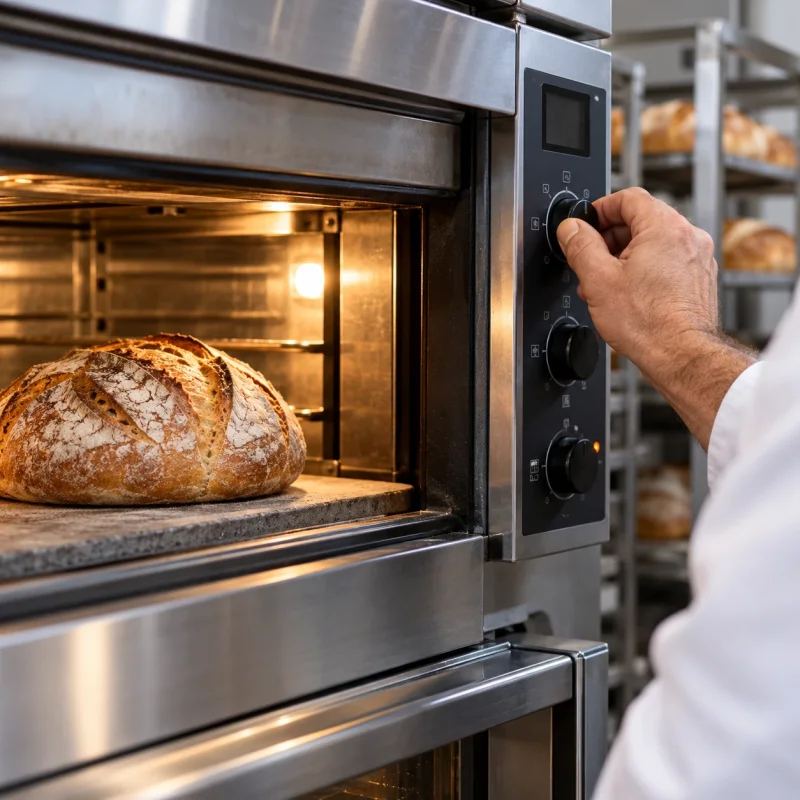
There is no single correct temperature for bread
If you want to know what temperature to bake bread at, start with the dough and the way the loaf is baked. A lean, free-standing wheat loaf usually benefits from more initial heat than a pan loaf or brioche. A fan oven often needs a slightly lower setting than conventional top-and-bottom heat, while a Dutch oven, stone or steel needs enough time to store heat before the dough goes in.
That makes a temperature matrix more useful than one universal number.
| Bread type or method | Practical starting setting | What to watch next |
|---|---|---|
| Free-standing white or light wheat loaf | about 235–250 °C | After the initial oven spring, recipes often reduce heat and finish in a drier environment. |
| Wheat pan loaf | about 210–230 °C | The pan also conducts heat through the sides, so excessive heat can darken the edges early. |
| Whole-grain or mixed-flour loaf | about 220–240 °C | Greater mass and water binding often benefit from a calmer, longer finish. |
| Rye-rich bread | about 220–240 °C | Do not judge it by colour alone; a dense, moist crumb needs enough time to set. |
| Enriched bread with milk, eggs, butter or sugar | about 175–205 °C | Sugars and milk proteins accelerate browning, so very high heat can be too aggressive. |
| Baguettes and small lean breads | about 220–250 °C | Their smaller cross-section means they bake much faster than a large loaf. |
These are starting points, not universal “correct temperatures”. The recipe, dough mass, oven and baking equipment still take priority.
Choose the dough type before choosing the number
Two doughs of the same weight can react very differently at the same oven setting. Lean wheat dough is built mainly from flour, water, salt and yeast or sourdough starter. It generally tolerates strong initial heat because the goal is good oven spring and a developed crust.
Add more sugar, milk, eggs or fat and the surface browns faster. That is why brioche and other enriched doughs are commonly baked much lower than lean artisan loaves.
A useful decision order is: lean or enriched dough; free-standing loaf, pan loaf or small pieces; conventional or fan oven; stone, steel or heavy covered vessel; then the starting temperature.
Conventional heat is the clearest baseline
Unless a recipe says otherwise, top-and-bottom heat is a good baseline for a new bread recipe. The surface dries more slowly and it is easier to compare one bake with the next.
Fan heat is not wrong—it is simply different. Moving hot air increases heat transfer and strips moisture from the crust. Starting roughly 10–20 °C lower than the conventional setting is often sensible, but it is not a mathematical conversion because fan power, heater placement and oven size differ.
For a deeper explanation of modes and rack placement, see convection vs conventional oven for baking.
Preheating means heating the equipment too
An oven light mainly tells you that the thermostat has reached its control range. It does not tell you that a stone, steel or heavy covered pot has stored enough heat.
Heavy equipment often needs 30–45 minutes or more of preheating, depending on its thickness and the oven. In a well-preheated covered vessel, steam released by the dough remains around the loaf, so an extra tray of water is usually unnecessary. Always respect the cookware manufacturer's heat limits.
Oven temperature is not crumb temperature
A 230 °C oven does not make the centre of bread 230 °C. The crumb contains a lot of water and heats much more slowly.
For a lean wheat loaf, about 95–98 °C in the thickest part is a useful doneness check. It is not a universal target for every bread. Enriched breads may finish at lower internal temperatures, while rye-heavy or very wet breads need their own recipe and enough cooling time.
A thermometer is a check, not a substitute for the recipe.
Pan bread usually needs gentler heat
A pan changes heat transfer. Metal sides conduct heat directly into the dough, so a temperature that works beautifully for a free-standing loaf on stone can over-brown the sides of a pan loaf.
Around 190–220 °C is often a useful band for common wheat or whole-grain pan breads, although individual recipes can legitimately sit outside it. Sweet and fatty doughs are usually lower still.
Why “220 °C for every bread” fails
One number ignores loaf mass and shape, hydration, wheat versus rye composition, sugar and fat, pan material, fan versus conventional heat, thermal mass and the oven's actual calibration.
The goal is not to discover one magic temperature. It is to find the right starting setting for this bread.
If the same recipe repeatedly bakes too dark or too pale at identical settings, check how to test and calibrate oven temperature.
Diagnostics
Common problems and solutions
The crust darkens quickly but the centre is still underbaked.
The loaf is pale and has weak oven spring.
With fan heat, the surface sets, browns and dries too quickly.
A pan loaf has dark sides while the top looks properly browned.
Technical terms
Terms worth understanding
- Lean dough
- Dough with little or no added sugar, fat, milk or eggs, typical of many classic breads.
- Enriched dough
- Dough containing more sugar, fat, milk or eggs, so its surface generally browns faster.
- Thermal mass
- The ability of a stone, steel or heavy vessel to store heat and release it strongly when the dough is loaded.
- Conventional oven
- Top-and-bottom heat without active fan-driven air circulation.
Frequently asked questions
Answers to common questions
What temperature should I bake homemade bread at?
For a lean free-standing wheat loaf, about 235–250 °C is often a good starting range. Pan breads and enriched doughs usually need lower temperatures, so the recipe and bread type still matter.
Should I bake bread with the fan on?
You can, but forced air transfers heat and removes moisture from the surface more aggressively. As a starting point, use roughly 10–20 °C less than conventional heat and adjust to your oven.
How long should I preheat the oven for bread?
For an ordinary tray, follow the recipe. A stone, steel or heavy covered pot often needs about 30–45 minutes or longer so its mass is fully heated.
Is 220 °C right for every bread?
No. It can suit some breads, but flour type, enrichment, loaf size, shape, pan material and oven mode can justify a substantially different temperature.
What internal temperature means bread is done?
For a lean wheat loaf, about 95–98 °C in the thickest part is a useful check. Enriched, rye-heavy and other specialty breads should follow their own recipe and structural cues.