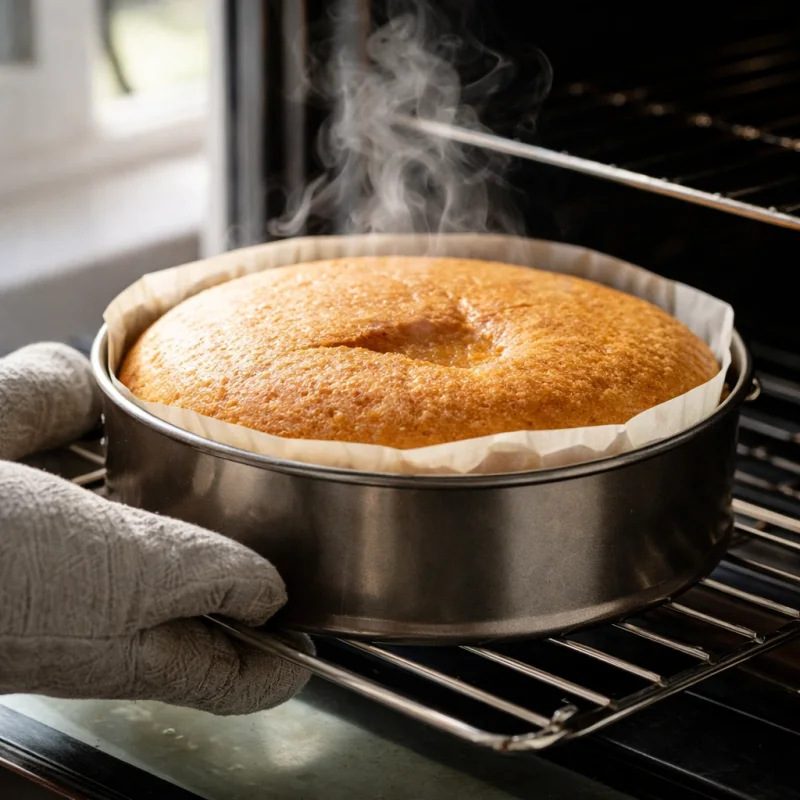
Oven humidity is not the main control for sponge-cake stability
It is tempting to explain a sponge cake with one variable: the oven was too dry, or there was too much steam. The actual mechanism is more useful than that.
Oven humidity mainly changes heat transfer, evaporation and crust development. The crumb becomes load-bearing only when starch and proteins set sufficiently during heating. Added steam therefore does not automatically make a sponge cake taller or more stable.
If a cake rises well and then sinks, start with the causes covered in why sponge cake sinks after baking rather than adding water to the oven by default.
What actually happens while a sponge cake rises
At the start of baking, the batter is a foam containing many small air cells. As it heats, trapped air and water vapour expand. Some formulas also generate gas from chemical leavening.
Expansion alone is not enough.
As temperature rises, starch gelatinises and egg proteins denature and polymerise. The batter gradually changes from a mobile foam into a crumb strong enough to support the expanded gas cells.
If that structure has not set far enough when the cake is removed, the cake can look impressively high in the oven and still collapse during cooling.
What steam really changes
Steam can influence the bake. It may change:
- surface heat transfer,
- evaporation from the surface,
- crust formation and thickness,
- browning,
- the balance between a soft crumb and a drier outer layer.
Experimental sponge-cake work that included steam injection does not produce a simple rule that steam always improves height or texture. Separate work using superheated steam found faster heat transfer and changes such as more expansion and cracking together with a darker, harder crust.
That distinction matters: steam can change the baking path, but it is not a universal rise booster.
Should you put a pan of water in the oven?
Not as a general rule for a classic sponge cake.
A pan of hot water in a domestic oven is not the same as controlled steam injection. You do not know exactly how much vapour it produces, how long it remains in the cavity or how quickly the oven vents it.
A steam oven with a low-humidity cake programme is a different case. Follow the appliance programme and a recipe designed for it. Do not assume that the high-steam logic used for bread should be transferred to sponge cake.
For a useful test, keep the recipe, tin, batter weight and temperature the same and change only one variable.
Surface shine and door condensation are not enough
As a cake bakes, the surface dries and may lose its shine. That can be a useful observation, but it is not a direct measurement of the centre.
The same applies to condensation on the oven door. It also depends on oven design, ventilation, the temperature of the glass and the amount of moisture released by the food.
Judge doneness from several cues together:
- the expected recipe time,
- a reasonably verified actual oven temperature,
- spring-back in the centre,
- no liquid-like wobble in the middle,
- a skewer test or another suitable test for that particular sponge.
One visual signal is not enough.
If the cake sinks, troubleshoot in this order
1. Was the centre baked enough?
A strongly browned outside with a soft or wet centre points to a mismatch between heat and time. The centre needs enough time for the starch-protein network to become load-bearing.
2. Is the oven actually at the set temperature?
An oven running hot can colour the outside early while the centre lags behind. An oven running cool can extend the period in which the foam loses stability before the crumb sets.
For recurring problems, an oven thermometer often tells you more than an extra pan of water.
3. Was the egg foam stable?
In a foam-based sponge, incorporated air is the starting source of volume. A weak foam, or excessive deflation while folding in flour, cannot be repaired with steam.
See how to whip eggs and sugar to ribbon stage for the batter-side control.
4. Was the oven opened while the centre was still weak?
Opening the door changes temperature and the oven atmosphere. Once the crumb has set, that matters much less. During active expansion, when the centre is still soft, the disturbance can add stress to an unstable structure.
A more useful home-baking target
You do not need a single ideal relative-humidity number for a home sponge cake. Most classic formulas already release a substantial amount of moisture from the batter itself.
For repeatable results:
- weigh the ingredients,
- bake soon after the batter is ready,
- preheat fully,
- use the same tin and rack position,
- avoid changing temperature, steam and time at once,
- judge the result after the cake has fully cooled.
Humidity is a real process variable. It is not the foundation of sponge-cake strength. That comes from a well-aerated batter and a crumb that has had enough controlled heat to set.
Frequently asked questions
Answers to common questions
Does steam in the oven make sponge cake rise higher?
It can change surface heating and evaporation, but it is not a universal way to increase volume. Experimental sponge-cake comparisons with steam injection do not show a simple rule that steam alone improves every quality measure. Preserving air in the batter and baking until the crumb has set are more important.
Should I put a pan of hot water in the oven?
Not as a general rule. If the recipe or a dedicated steam programme does not call for it, first bake without extra water. A pan of water changes the oven atmosphere but is not the same as controlled steam injection and can make results less repeatable.
What actually sets sponge cake during baking?
Air cells and water vapour expand as the batter heats, but the foam then has to become a load-bearing crumb. Starch gelatinisation and protein denaturation/polymerisation are key parts of that transition. This network is what retains volume as the cake cools.
Why does a sponge cake sink even though it looked tall in the oven?
A tall cake is not necessarily a set cake. Common causes include an underbaked centre, inaccurate oven temperature, weak or damaged egg foam, an unbalanced formula or opening the oven before the structure is strong enough.
Does condensation on the oven door mean there is too much humidity?
Not reliably. Condensation also depends on oven design, ventilation, the amount of food and the temperature of the glass. It cannot tell you on its own whether the cake centre is baked.
Is loss of surface shine a good doneness test?
It can be one visual cue, but it should not be the only one. Use the expected recipe time, verified oven temperature, spring-back in the centre and, where appropriate, a skewer or other doneness test suited to that sponge.
Which matters more: oven humidity or properly whipped eggs?
For a foam-based sponge, a stable egg foam is the foundation of initial volume. Humidity can alter surface conditions and heat transfer, but it cannot replace a well-prepared batter. Extra steam will not repair foam that was weak or deflated during folding.