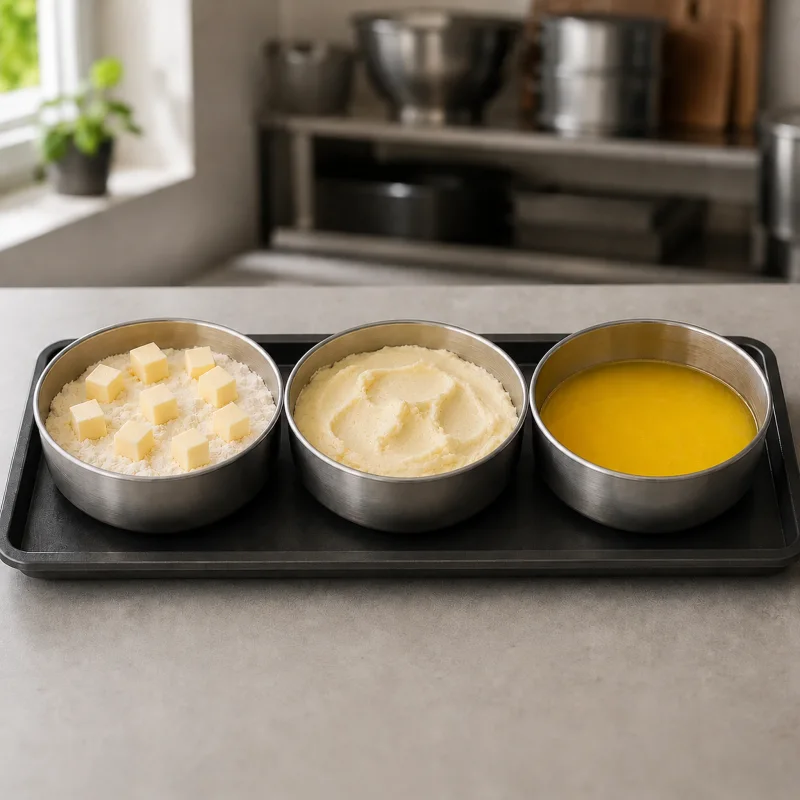
Butter temperature is really a question about function
Butter behaves differently depending on whether it is hard, plastic, softened or fully melted. That matters because butter is not pure fat: standard butter contains roughly 82% milk fat, up to about 16% water, plus small amounts of milk solids. The fat limits gluten development, the water becomes steam, and the milk solids contribute flavor and browning.
So “room temperature butter” is not a complete technical instruction. In a cool kitchen it may be 17 °C; in summer it may be 27 °C. Those two butters do not behave the same.
Use butter according to the job it must do. Keep it cold when you want separate pieces and flakiness, make it pliable for lamination, soften it for creaming, and melt it only when the recipe does not depend on the air created during creaming. If your only question is whether softened butter is still too hard or already too soft, use the narrower guide Softened butter for baking: how soft should it be?.
Practical working states of butter
| Butter state | Practical range | Typical use | What to look for |
|---|---|---|---|
| Very cold | 4–8 °C | coarse pastry, biscuits, crumble | sharp edges, no greasy smear |
| Cold but plastic | 12–16 °C | croissants, puff pastry, laminated dough | bends without cracking or leaking oil |
| Softened | 18–21 °C | creaming, butter cakes, buttercream | matte, holds shape, shallow finger dent |
| Too warm | above roughly 23–24 °C | usually unsuitable for creaming | glossy surface, slumped edges, greasy feel |
| Melted | 35–45 °C | brownies, some cookies, muffins and fluid batters | completely liquid, no solid pieces |
| Cooled melted | 28–32 °C | adding to eggs or delicate batters | still liquid but only warm |
These are working ranges, not laws. Brand, fat composition, season and room conditions change how butter feels at the same temperature.
Cold butter: pieces, steam and layers
When cold butter is worked into flour and still remains in visible pieces, those pieces melt later in the oven. Their water turns to steam while the fat melts, helping create small gaps and flaky structure. If the butter smears completely into the flour too early, the result becomes more uniform and less flaky.
For a coarse pastry method, start with butter around 4–8 °C, cut into pieces roughly 10–15 mm. Work only until the intended particle size is reached.
Frozen butter is not automatically better. In laminated dough, butter that is too hard can crack into plates and tear the dough. The real goal is a butter block that is cold but bendable.
Lamination: match plasticity, not just temperature
For croissants and puff pastry, butter and dough should deform at a similar rate under the rolling pin. A butter block around 12–16 °C can be a useful starting point, but the tactile test matters more: it should lengthen with the dough without shattering or squeezing out.
If the butter breaks into hard plates, let the dough rest until the two components are closer in plasticity. If butter begins to smear or leak, chill the dough for about 20–30 minutes at 4–6 °C and reassess before rolling again.
The surface of the dough is a diagnostic tool. Hard ridges under the dough, greasy patches and butter escaping at the edges all mean the butter and dough are no longer moving together.
Softened butter for creaming
For classic creaming, use butter that is soft enough to accept the sugar crystals but still structured enough to hold the air pockets they create. Around 18–21 °C is a practical starting range for many butters.
A better test is visual and tactile. Properly softened butter is matte and keeps its edges. Pressing with a finger leaves a shallow indentation, not a collapsed crater. Glossy butter that smears like ointment is already too warm.
Cutting butter into pieces about 20 mm thick speeds up softening and keeps the temperature more even. At a moderate kitchen temperature, this often takes 30–60 minutes.
Cream butter and sugar only until the mixture becomes lighter and visibly aerated. Longer mixing is not always better: friction warms the fat and can destroy the crystal network that holds air.
If eggs make the mixture look curdled, the emulsion has become unstable. Add eggs gradually and keep them near the temperature of the butter. Gentle warming can help a cold mixture reconnect; in formulas that contain flour, a small amount taken from the recipe can sometimes help bind free water.
Melted and browned butter change the structure
Melted butter is useful when the recipe does not require mechanical aeration. It is common in brownies, some muffins and cookies where a denser or chewier texture is desirable.
Melt slowly and remove from heat while a few small soft pieces remain; residual heat will finish the job. Before adding melted butter to eggs, cool it to roughly 28–32 °C or until it feels warm rather than hot.
Melted butter is not a neutral replacement for softened butter in a creamed recipe. Without the air trapped during creaming, the batter starts denser and usually bakes differently.
Brown butter changes even more than flavor. Water is lost while the milk solids brown, so the final weight is lower than the starting weight. Weigh it after browning when precision matters, and remember that replacing the lost water may be necessary only when the formula can tolerate that adjustment.
Cookies: butter state controls spread
Cookies begin to spread when the fat melts before proteins and starch have set the structure. Warm butter, warm dough and a hot baking sheet all push spread earlier.
For classic creamed cookies, start with butter around 18–20 °C and chill shaped dough for about 30 minutes when the design needs to hold. Always use a cool baking sheet for the next batch.
Melted butter usually gives a denser, chewier cookie and can increase spread. Cold-butter methods can also work, but they are separate formulas and mixing methods rather than a shortcut for a creamed-butter recipe.
Butter, oil and salt are not interchangeable details
Butter and oil are not equivalent by weight. About 100 g of standard butter contributes roughly 82 g fat plus water and milk solids, while 100 g oil is almost entirely fat. A direct 1:1 swap therefore changes both fat and water balance.
For the full calculation, see How to replace butter with oil in baking: ratios, moisture and texture.
Unsalted butter gives the best control over salt. If salted butter contains 1.5 g salt per 100 g, then 200 g butter contributes about 3 g salt. Subtract that from the salt in the formula when the recipe needs precision.
Enriched yeast dough: add butter after structure begins to form
In enriched yeast dough, add butter after flour, liquid, eggs and yeast have already combined and gluten development has started. Fat added too early coats flour particles and can slow hydration.
Use softened but still plastic butter and add it gradually in pieces of about 10–20 g. The dough may look temporarily torn or greasy, but with proper mixing it should become smooth and elastic again. For many sweet enriched doughs, a final dough temperature around 24–26 °C is a useful target; if the dough rises above roughly 27–28 °C, the butter can become too soft and the dough loses strength.
Store and measure butter for repeatable results
Store butter well wrapped at about 4–6 °C and protect it from strong odors. Weigh it without packaging. If a recipe asks for 200 g softened butter, weigh 200 g while cold and then soften it; the amount should not change materially.
The key decision is simple: choose the state before you choose the temperature. Keep butter cold for layering, plastic for aeration and lamination, and melted only when the formula is designed for liquid fat. If you are deciding between different fats at recipe level, see Butter, oil or lard for baking: what to use and when.
Diagnostics
Common problems and solutions
Butter remains in hard lumps during creaming and will not combine evenly with the sugar.
Cause: The butter is too cold or not plastic enough for the chosen mixing method.
Solution: Stop mixing and let the butter or mixture soften evenly; continue only when it is flexible but still holds its shape.
The creamed mixture looks glossy and greasy and does not gain volume even with more mixing.
Cause: The butter is too warm and no longer has enough solid crystal structure to hold air reliably.
Solution: Chill the mixture briefly until it becomes plastic again. If the butter has actually melted, restarting is safer for precision formulas.
Hard butter plates can be felt while rolling laminated dough, or butter breaks through the dough.
Cause: Butter and dough do not have comparable plasticity; the butter is too hard relative to the dough.
Solution: Rest the dough until butter and dough move more similarly, then resume rolling with gentle, even pressure.
Cookies spread much more than expected.
Cause: The butter or dough is too warm, the baking sheet is still hot, or the formula contains more free fat than the structure can hold.
Solution: Chill the shaped dough and use a cool baking sheet; if the problem repeats, also check flour, sugar and fat ratios.
Technical terms
Terms worth understanding
- Butter plasticity
- A state in which butter is soft enough to shape but still retains a solid fat crystal network and does not flow.
- Creaming
- Mechanical mixing of plastic butter and sugar so that small air cells are created and retained in the fat structure.
- Lamination
- Rolling and folding dough around a distinct fat layer to create many thin layers during baking.
Frequently asked questions
Answers to common questions
What is the fastest way to soften butter without a microwave?
Cut it into slices or cubes about 20 mm thick and spread them in one layer. At a moderate room temperature, they commonly become workable in roughly 30–45 minutes.
Can I use butter straight from the refrigerator for cookies?
Only when the method specifically calls for cold butter or for working cold pieces into dry ingredients. For classic creaming, soften the butter until matte and plastic first.
Why do cookies made with melted butter turn out differently?
Melted butter cannot retain the air cells created during creaming, so the dough is denser and often bakes into a chewier, more compact cookie.
Do butter and dough need to have exactly the same temperature for lamination?
No. What matters is comparable plasticity: under the rolling pin they should lengthen together without the butter cracking or squeezing out.
Is more expensive butter always better for baking?
No. Freshness, milk-fat content, consistent structure and clean flavor matter more than price. For repeatable production, check the label and use the same type consistently.