How soft should butter be for baking?
If the mixer is running but the butter stays in hard yellow lumps — or turns into a greasy, shiny paste within seconds — the problem is usually not mixing time. It is the physical state of the fat. A change of only a few degrees can alter butter's ability to hold air, emulsify with eggs, and control how dough or batter spreads.
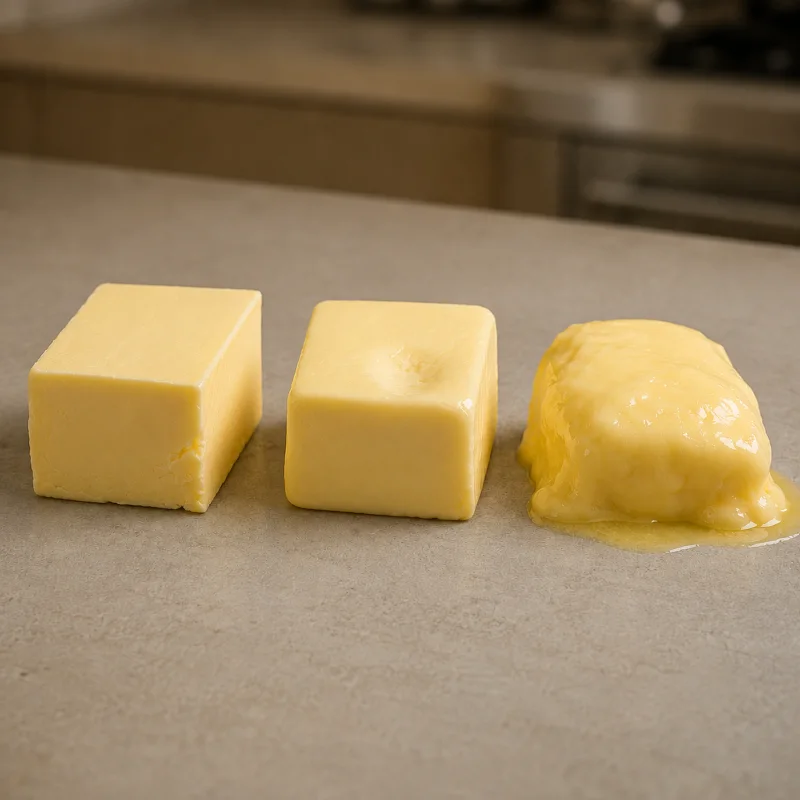
For most recipes that call for softened butter or room-temperature butter, the butter should be pliable but still hold its shape. A light finger press should leave a shallow indentation. The edges should remain visible, the surface should not look oily or glossy, and your finger should not slide straight through the butter.
“Room temperature” is not a precise measure of butter condition. In an 18°C / 64°F kitchen, butter may still be too firm after an hour. In a 26°C / 79°F kitchen, it may become too soft in twenty minutes.
Why a few degrees make such a difference
Butter typically contains about 80–82% milk fat, plus water and a small amount of milk solids. Milk fat is not made of one single crystal type. Different fat fractions soften and melt across a range of temperatures, so butter does not switch from solid to liquid at one sharp point.
At a useful working temperature, some solid fat crystals still form a supporting network while the rest of the fat is soft enough to deform. This is plasticity: the butter moves under pressure but does not flow.
When butter and sugar are creamed, mechanical mixing incorporates air and the sugar crystals help create tiny air cells. A solid fat-crystal network helps stabilise those cells. Butter that is too cold resists deformation and does not aerate efficiently. Butter that is too warm or partly melted has lost too much solid structure to hold the air network well.
Temperature is therefore not the goal by itself. The goal is the right physical state for the technique.
Too cold, properly softened, or too warm: the practical signs
Butter that is too cold keeps sharp edges and may snap into firm pieces when cut. A mixer pushes it around the bowl and visible pale lumps remain. If eggs are added too soon, the liquid phase struggles to disperse evenly around the cold fat.
Properly softened butter spreads smoothly under a spatula but does not run. When beaten with sugar, it becomes paler, gains some volume, and leaves soft, airy ridges on the side of the bowl. The mixture looks creamy rather than wet and glossy.
Butter that is too soft loses its edges, sticks to the wrapper, and leaves a greasy film on your fingers. It may look smooth when first mixed with sugar, but the mixture stays heavy, dense, and shiny. Air cells merge and escape more easily, so extra mixing cannot reliably repair the wrong starting condition.
If you can already see liquid fat around the edges, the butter is no longer simply softened. It is too warm for conventional creaming.
What butter condition does each technique need?
The same butter temperature is not correct for every recipe. “Room-temperature butter” only makes sense when the butter's job is clear.
| Technique | Working state | Practical sign |
|---|---|---|
| Creaming butter and sugar | for standard table butter, often around 20°C / 68°F; texture matters more than the number | A shallow finger dent, butter still holds its shape, no greasy shine |
| Cutting or rubbing butter into flour | cold | Firm cold pieces stay distinct instead of smearing completely into the flour |
| Laminating puff pastry or yeasted laminated dough | cold but pliable; exact range depends on the butter and process | The butter sheet bends without cracking or squeezing out and has similar firmness to the dough |
| Recipe using melted butter | as specified by the recipe | Butter is liquid but should not unintentionally heat other ingredients before mixing |
For creaming, temperature is a useful reference, not a standalone target. Butter composition, egg temperature, mixing speed, and room temperature all affect the result.
For lamination, the important point is that the butter is cold, pliable, and close to the dough in firmness. Butter that is too hard fractures during rolling; butter that is too soft squeezes between the layers.
In short pastry, colder butter helps keep fat particles distinct and supports a short, crumbly texture. In a butter cake, the same ingredient needs to be soft enough to incorporate air during creaming. Same ingredient, different function.
How butter temperature changes cakes and cookies
In a butter cake, butter that is too cold produces an uneven starting mixture. Once eggs are added, the batter can look grainy or split, especially if the eggs are also cold. A slightly curdled appearance is not always fatal, but large butter lumps show that the emulsion has not formed properly.
Butter that is too warm creates fewer stable air cells. The cake may bake lower, heavier, and greasier even after prolonged mixing. Adding more baking powder is not a dependable fix because chemical leavening cannot recreate the missing mechanical aeration.
In cookies, butter that is too soft liquefies earlier, before flour, egg proteins, and sugar have set enough structure. The dough can spread excessively, the edges become too thin, and the centre may seem greasy. If the finished dough is warm, chilling it before shaping or baking can help control spread, but it cannot fully restore air that was never captured during creaming.
Oil remains liquid at temperatures where butter is still plastic, so it cannot provide the same crystal framework for the creaming method. Replacing butter with oil therefore changes more than the fat quantity: aeration, water content, and final texture change too.
How to soften butter without melting it
Cut the butter into roughly equal cubes and arrange them in a single layer. Check condition rather than relying on a fixed number of minutes. The butter is ready when light finger pressure leaves a shallow dent, the edges remain visible, and the surface is not greasy or shiny.
A large block warms unevenly. The outside may already be soft and oily while the centre remains firm, so do not judge the butter from the surface alone.
A microwave can heat butter unevenly and create liquid pockets before the centre is pliable. If you use one, choose low power and very short intervals. Turn the butter after each interval and reassess it. Stop as soon as the surface begins to look glossy.
If the butter is too soft but not fully melted, chill it briefly and stir it a few times as it cools. If liquid pools of fat have already formed, do not rely on it for creaming; save it for a recipe that calls for melted butter instead.
Before mixing, use three checks: press it, look at the edges, and check the shine. A shallow dent, retained shape, and matte surface are more dependable than the clock.
Diagnostics
Common problems and solutions
Hard butter lumps remain in the mixture after beating.
Cause: The centre of the butter was still too cold or the pieces were too large.
Solution: Stop the mixer, move the bowl to a slightly warmer place for a few minutes, then mix slowly. Next time cut the butter into roughly 2 cm / 3/4-inch cubes.
Butter and sugar become shiny, heavy and greasy instead of light.
Cause: The butter was too warm and lost too much of its solid crystal structure.
Solution: Chill the mixture briefly, stir it, and reassess firmness. If the butter is already partly liquid, use freshly and properly softened butter for reliable creaming.
Cookies spread rapidly into thin sheets in the oven.
Cause: The butter or finished dough was too warm, so the fat liquefied before enough structure set.
Solution: Chill the shaped dough until firm before baking and always place it into a properly preheated oven.
The mixture turns grainy or split after adding eggs.
Cause: There was too large a temperature difference between butter and eggs, or the eggs were added too quickly.
Solution: Use eggs at a similar temperature to the butter and add them gradually, allowing each addition to emulsify before the next.
Technical terms
Terms worth understanding
- Plasticity
- A state in which butter deforms under pressure but does not crack or flow.
- Creaming
- Beating plastic butter with sugar so small air pockets are created and retained within the fat.
- Emulsion
- An even distribution of water and fat phases; large temperature differences can destabilise a butter-based mixture.
- Fat crystal network
- The structure of solid fat crystals that gives butter shape and helps stabilise incorporated air during mixing.
Frequently asked questions
Answers to common questions
Does “room temperature” always mean 20°C / 68°F?
No. Room temperatures vary, so judge butter by a shallow finger dent, retained edges and the absence of a greasy shine.
Does margarine soften the same way as butter?
Not necessarily. Margarines vary in fat-to-water ratio and plastic range, so assess the specific product and follow the recipe.
Why is butter soft outside but still hard in the centre?
A large block warms from the outside inward. Cut butter into smaller equal pieces so it tempers more evenly without melting at the edges.