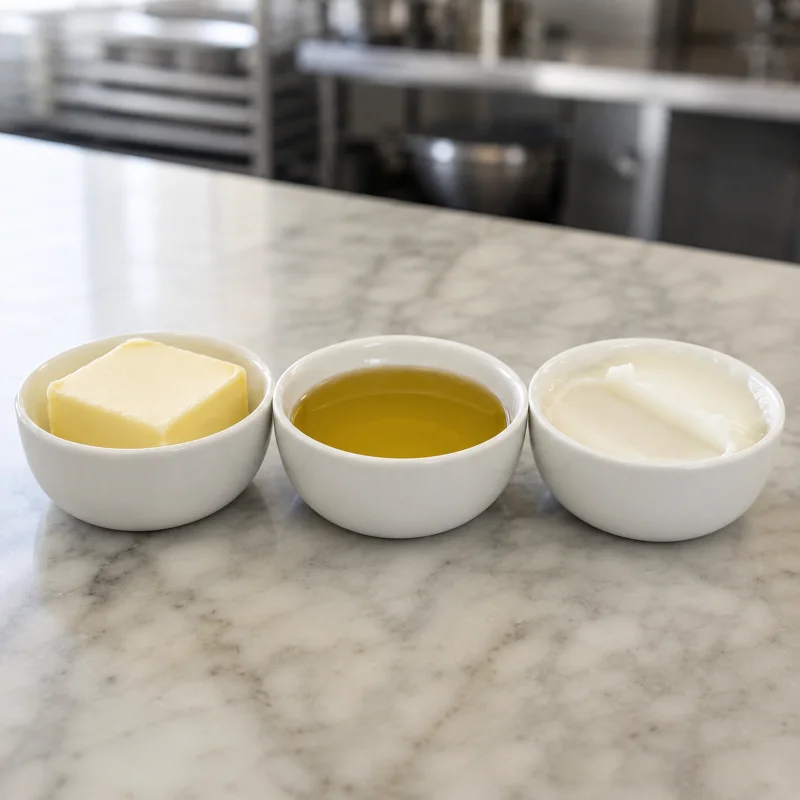
Why the same recipe behaves differently with butter, oil, or lard
Butter, oil, and lard do more than change flavor. They differ in fat and water content, physical state, and their ability to trap air or remain in separate layers. That is why equal weights of different fats do not necessarily produce the same dough or crumb.
Butter is a water-in-fat emulsion, liquid vegetable oil is almost entirely fat, and lard is also nearly all fat but remains plastic or semi-solid at typical room temperature. Choose the fat by function: does the recipe need aeration, lamination, gluten limitation, a soft crumb, or a distinctive flavor?
When butter is the best choice
Butter is especially useful when the recipe relies on creaming with sugar, when butter flavor and browning matter, or when solid fat needs to remain in discrete layers in pastry.
For creaming, butter should be soft but not greasy or partly melted. In many cake formulas, roughly 18–21°C can be a useful working range, but texture is the better test. A finger should leave a shallow indentation while the butter still feels slightly cool, holds its shape, and offers some resistance. Butter that is too cold traps air poorly; butter that is too warm cannot hold the air network well. See the guide to properly softened butter for baking.
Butter is a strong choice for butter cakes, cookies, brioche, shortcrust, puff pastry, laminated yeasted doughs, and products where butter flavor is part of their identity.
When oil gives a better result
Oil remains liquid after cooling, so it often keeps the crumb of cakes and muffins softer over time. It works particularly well in carrot cake, chocolate cake, muffins, banana bread, and similar batters whose lift comes mainly from eggs and chemical leaveners rather than creamed butter.
Liquid oil cannot directly replace plastic butter in classic creaming or lamination. If the formula relies on solid fat to hold air or physically separate layers, changing only the weight is not enough.
Flavor matters too. Neutral refined oils leave room for vanilla and delicate fruit. Extra-virgin olive oil can deliberately add fruity, grassy, or slightly bitter notes that pair well with citrus, chocolate, nuts, and spices.
What does lard do in dough?
Well-rendered lard contains very little water and is plastic at room temperature. In short pastry it can strongly limit gluten development and create a pronounced tender, crumbly texture. In pie-style pastry, cold pieces of lard can leave small gaps as they melt and help create flakiness.
Because lard contains less water than butter, a 1:1 replacement changes both pure fat and liquid in the formula. It is therefore better to think about function rather than weight alone. Lard can work especially well in traditional cookies, savory pastry, and formulas where a buttery dairy flavor is not essential.
Is 100 g butter the same as 100 g oil?
No. Under the EU definition, butter contains at least 80% milk fat and no more than 16% water. Liquid oil is almost entirely fat. Replacing 100 g butter with 100 g oil therefore increases fat and removes the water that butter contributed.
For many cakes, muffins, and similar batters where butter is not the main aeration system, 75–80 g neutral oil per 100 g butter is a useful starting range. It is not a universal conversion. If the recipe depends on creaming butter with sugar or on solid fat for layers, a partial substitution is safer. The detailed method is covered in replacing butter with oil in baking.
Which fat works best for different baked goods?
For cookies and classic butter cakes, butter contributes flavor, browning, and aeration. For a soft crumb in batters that do not rely on creaming, oil can be more direct. For very tender pastry and some traditional bakes, lard can be effective. Puff pastry and laminated dough require a solid, plastic fat that stays in distinct layers while rolling; ordinary liquid oil cannot do that job.
Start by asking what the fat must do. If it needs to hold air, use a plastic fat. If it must separate layers, keep it solid during handling. If the goal is a soft crumb without creaming, oil is often appropriate.
How to test a substitution without guessing
Change one main variable at a time. Record the type and weight of fat and any change to the liquid phase. Properly creamed butter should look paler and aerated; an oil batter should be smooth and uniform without separated greasy patches; short pastry should hold together without leaving an oily film.
This turns fat choice into a controlled formulation decision rather than a simple 1:1 swap.
Diagnostics
Common problems and solutions
Problem
Problem
Technical terms
Terms worth understanding
- Creaming
- Beating plastic fat with sugar so fine air bubbles are created and retained.
- Fat plasticity
- The ability of a solid fat to deform and spread while remaining non-liquid.
- Lamination
- Building alternating layers of dough and solid fat by rolling and folding.
- Emulsion
- A system in which fat and water phases are finely dispersed and stably combined.
Frequently asked questions
Answers to common questions
Can butter always be replaced with oil?
No. It is easiest in cakes and muffins that do not depend on creaming or solid fat layers. In laminated dough, buttercream, and many cookies, butter's physical function is essential.
How much oil replaces 100 g butter?
For many suitable cakes and muffins, 75–80 g neutral oil is a useful starting range. It is not universal, and partial replacement is safer in creamed formulas.
Why does oil cake often stay softer the next day?
Oil remains liquid at cooler temperatures, so the cooled crumb often feels softer. That does not necessarily mean the cake contains more water.
When is lard useful instead of butter?
Lard can be useful when pronounced tenderness or a traditional texture is wanted and butter flavor is not essential. Its low water content means a 1:1 swap is not automatically neutral.
Does butter for creaming have to be exactly 20°C?
No. Roughly 18–21°C can be useful, but plasticity, slight coolness, lack of greasiness, and shape retention matter more than one exact number.