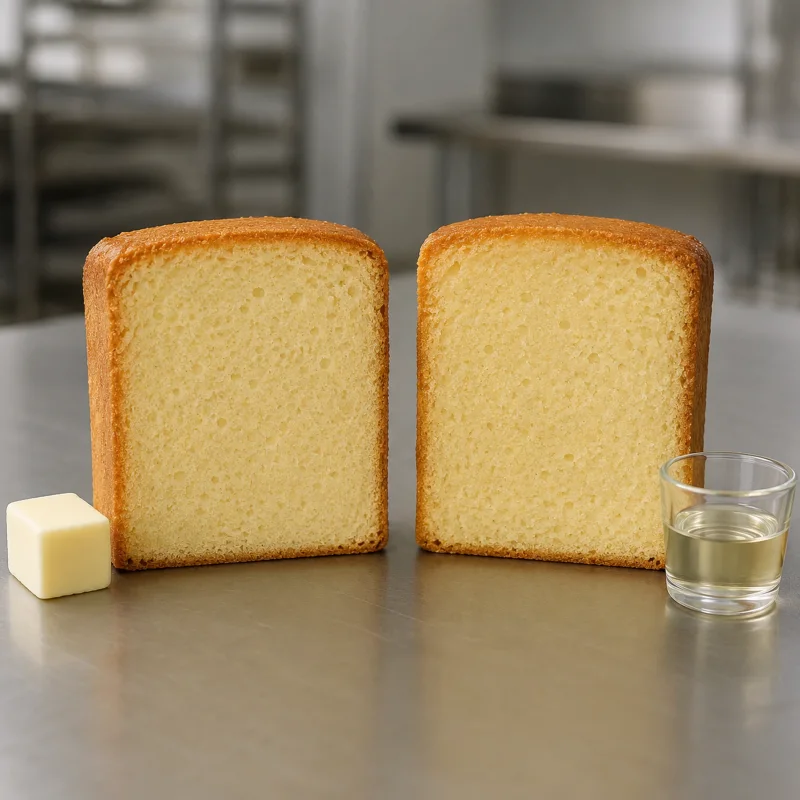
100 g of butter is not the same as 100 g of oil
For many cakes, muffins and similar batters, 75–80 g of neutral oil for every 100 g of butter is a useful starting test, not a universal conversion. If the recipe relies on creaming butter with sugar or on solid fat to create layers, a full swap is much riskier.
When softened or melted butter is replaced with oil, the batter often looks looser. That does not mean it contains more water. Oil mechanically softens the mixture, but it does not hydrate flour the way the water in butter, milk or eggs does. The substitution is therefore about function as much as quantity.
Typical butter contains about 80% milk fat, with the rest mainly water and milk solids. Liquid vegetable oil is almost entirely fat. Replacing 100 g of butter with 100 g of oil therefore changes the formula: fat rises and the water phase disappears. The result can be a greasy, heavy crumb or an oily ring on the paper or pan.
A practical starting range is 75–80 g oil per 100 g butter. Treat this as a working range for cakes, muffins, banana bread, carrot cake and similar batters where butter is not the main aeration system.
Calculate the first test by weight
Multiply the butter by 0.75 to 0.80:
| Butter in recipe | Starting amount of oil |
|---|---|
| 50 g | 38–40 g |
| 100 g | 75–80 g |
| 150 g | 113–120 g |
| 200 g | 150–160 g |
| 250 g | 188–200 g |
Use the lower end when the recipe already contains plenty of egg yolks, nuts, chocolate or other fatty ingredients. The upper end is more suitable for simple cakes and muffins where the butter is used melted and the formula contains enough flour and egg to support the structure.
Weight is far more reliable than cup conversions. Butter, melted butter and oil do not have the same density, so volume-based rules from different sources can represent quite different amounts of fat.
When to add back liquid
Matching the rough fat-and-water balance of 100 g butter would suggest about 80 g oil plus up to 15–20 g water or another liquid. That mixture still does not recreate butter's emulsion, milk solids or crystalline fat structure, so do not add liquid automatically. Eggs, milk, yogurt, fruit purée or another ingredient may already provide enough water.
Make the batter with oil first. If it is unusually thick after the ingredients are combined, tears off the spatula and does not fall in a slow broad ribbon, add 10 g milk or water. Mix and reassess. If it is still too thick, increase by another 5 g in the next test. Without recalculating the whole formula, avoid going much beyond about 20 g extra liquid per 100 g butter replaced.
A fluid batter is not necessarily a well-hydrated batter. Oil can create flow even when the flour has less water available.
Why oil changes the crumb
Butter is plastic at the right temperature. During creaming, sugar crystals help create tiny air pockets in the solid-fat network. In the oven those bubbles expand, while baking powder or soda adds gas. Liquid oil cannot create the same aerated structure during creaming, so a full swap in a creamed cake can reduce volume and make the crumb denser.
Oil, however, is a strong tenderizer. It coats flour particles and limits their contact with water, reducing gluten development. Because it remains liquid at room temperature, a cooled oil-based crumb often feels softer and moister than one made with the same amount of fat from butter.
That is also why an oil cake can cut more softly the next day while a butter-based crumb firms as the fat cools. The perception of moisture does not necessarily mean there is more water; part of the sensation comes from liquid fat remaining soft in the mouth.
Butter also contributes dairy flavour and milk solids. With neutral oil the flavour is cleaner but less buttery. The difference is most obvious in vanilla and other delicate light cakes and less obvious in chocolate, spiced or fruit cakes.
Melted butter and creamed butter need different strategies
The recipe uses melted butter
In cakes and muffins where butter is melted and is not the principal source of aeration or structure, the swap is usually least risky. Start with 75–80 g oil for 100 g melted butter. Mix the oil with the liquid ingredients and do not continue mixing longer than needed once the flour is added.
Add extra liquid only when the batter is clearly too thick or the formula contains very little other water. A thick muffin batter can fall from the spoon in heavy, uneven folds; a pourable cake batter should run from the spatula in a thick ribbon that stays visible briefly on the surface.
The recipe creams butter and sugar
A full replacement is much more disruptive. Creaming is an aeration process, not simply mixing two ingredients. Removing solid fat removes the structure that holds many of the air cells.
For a first test, replace only 25% of the butter. In a formula with 100 g butter, keep 75 g butter and add about 20 g oil. If volume and structure remain good, try 50% in the next test: 50 g butter plus about 40 g oil.
Cream the remaining butter with the sugar first, then incorporate the oil later in a thin stream, similar to building an emulsion.
This is a technological starting point, not a universal conversion. A formula with all butter removed may also need changes to egg aeration, liquid, flour and leavening. Without the full recipe, an exact correction cannot be predicted.
Where the swap works — and where it breaks the product
Oil works best when chemical leavening or egg foam contributes more to volume than creamed butter. Many muffins, quick breads, carrot and chocolate cakes and some egg-foam cakes fall into this group.
In brownies, oil can emphasize a dense, soft texture. Too much can leave separate fat on the surface or bottom. That is not extra "moistness"; it means the emulsion and dry ingredients can no longer hold all the fat.
In cookies, oil changes spread, edge texture and snap. Because the fat is already liquid, the dough loses shape differently from a butter dough. Partial replacement can work, but a full switch often needs a reformulated recipe rather than a new number in the ingredient list.
Oil is not a direct substitute for butter in laminated dough, puff-pastry-style products, shortcrust, sablé and other formulas where solid fat must physically separate layers or create a crumbly structure. Nor is it a direct substitute in buttercream, where cooled butter provides the load-bearing structure.
Choose the oil for flavour and temperature
For vanilla, lemon and delicate light batters, use a fresh neutral oil such as refined sunflower or rapeseed/canola oil. Any stale or rancid note will survive baking.
Use olive oil when its flavour belongs in the recipe. Mild olive oil works well with citrus, almonds and chocolate; a very grassy or bitter oil can dominate vanilla and dairy flavours.
Treat coconut oil separately. It can solidify at cooler room temperatures, so it behaves differently from sunflower or rapeseed oil in both batter and cooled cake. The 75–80 g range can be a starting quantity, not a guarantee of the same texture.
Judge the batter before baking and the crumb after cooling
After the flour is added, mix only until dry patches disappear. Extra mixing does not repair an emulsion; it can develop more gluten and create a rubbery crumb.
A balanced batter should be uniform, with no visible oil puddles or greasy ring around the bowl. If liquid fat glistens on the surface during baking or a translucent greasy layer forms on the bottom after cooling, there was too much oil or the formula did not form a stable enough emulsion.
Cool the cake completely before judging the final texture. Warm crumb is softer because of steam and still-fluid fat. A balanced oil cake should spring back gently, slice without leaving a wet streak on the knife, and avoid a pronounced oily stain on paper.
For the first test, change only one variable: use 75–80 g oil per 100 g butter and record the result. In the next batch, change only the oil or only the added liquid, in steps of no more than about 5 g per 100 g original butter. That makes the effect of each adjustment visible.
Diagnostics
Common problems and solutions
A greasy stain remains on the bottom of the cake.
Cause: Too much oil or an unstable emulsion.
Solution: Reduce the oil slightly in the next test and keep the other ingredients unchanged.
A creamed cake loses volume.
Cause: Liquid oil replaced too much of the plastic butter that carried the aeration.
Solution: Restore some butter and begin with a partial substitution.
Frequently asked questions
Answers to common questions
Is coconut oil the same as liquid vegetable oil?
No. Coconut oil can solidify at cooler room temperatures, so it behaves differently from sunflower or canola oil in both batter and cooled cake. The 75–80 g range can be a starting point, not a guarantee of identical texture.
Do I always need to add milk or water when making the swap?
No. Add liquid only if the batter remains unusually thick and the formula contains little water from other ingredients. Start with 10 g.
Which oil is best for a light-flavoured cake?
Use a fresh refined mild oil such as sunflower or canola. Choose olive oil only when its flavour is intended to be part of the product.
Why does an oil cake often stay softer after cooling?
Oil remains liquid at room temperature while butterfat firms as it cools. The crumb can therefore feel softer without necessarily containing more water.