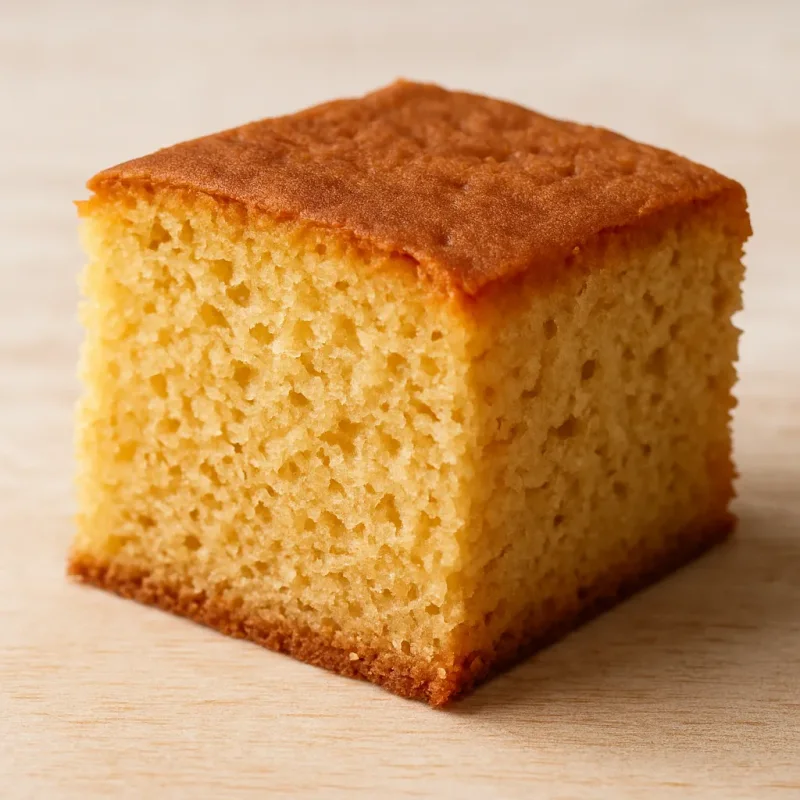
Coconut sugar sponge cake: keep the foam light and control the colour
Coconut sugar can be tested in many cake batters as a 1:1 replacement by weight for white or brown sugar, but the result is not automatically identical. It is darker, carries caramel or toffee notes, and may have coarser crystals. In a light sponge, crystal size, sugar dissolution, and the way air is built into the batter matter most.
If the formula relies on whipped eggs, briefly refine coarse coconut sugar if needed. Whip until the mixture is thick, glossy, and leaves a stable ribbon on the surface. If many dry crystals are still obvious, give the sugar more time to dissolve. In a butter cake, adequate creaming of butter and sugar is equally important.
What changes in the cake
- Colour: both batter and crumb will usually be darker than with white sugar.
- Flavour: expect caramel, malt, or toffee notes rather than a strong coconut flavour.
- Dissolution: coarse crystals dissolve more slowly, especially in egg foams.
- Structure: volume and crumb can change in formulas that depend heavily on aeration.
- Perceived sweetness: it may differ slightly, so judge the baked result rather than the dry ingredient alone.
Can you replace white sugar 1:1?
For a controlled first test, use the same weight of coconut sugar. Treat that as a starting point, not a guarantee of identical structure. Muffins and denser cakes are usually more forgiving than genoise or very airy sponge cakes.
Method for an airy sponge
- Weigh the coconut sugar.
- If the crystals are coarse, briefly process them finer.
- Prepare the eggs according to the original recipe's warm or cold whipping method.
- Whip to a stable ribbon that remains visible for several seconds.
- Fold in the flour gently so the trapped air is not forced out.
- Start with the oven profile specified by the original formula; coconut sugar already darkens the batter, so colour alone is not a reliable doneness test.
- Check the centre with a skewer and spring-back. If the top darkens too soon, shield it lightly near the end.
Three PEK control points
Before baking: the sugar is fine enough and there are no large dry crystals in the foam or creamed mixture.
Before flour: the batter is visibly aerated and stable.
Before removing from the oven: the centre is baked and springy. Colour alone is not enough.
Common problems
The sponge is dense
Check sugar dissolution, whipping time, and whether flour was folded in too aggressively.
The top is dark but the centre is underbaked
Do not automatically lower the oven temperature. Check actual oven temperature, rack position, and pan colour. Shield the surface if necessary and finish baking the centre.
The crumb is coarse or slightly gritty
Use more finely processed coconut sugar next time and allow more time for it to dissolve.
The cake collapses after baking
Coconut sugar is not the only possible cause. Check for an underbaked centre, lost air during folding, too much leavener, or opening the oven too early.
What about glycaemic index?
Coconut sugar is still an added sugar. Some studies report lower glycaemic-index measurements, but the evidence is limited and products vary. That is not a technical reason to recommend it here. Choose it for flavour, colour, and the effect you want in the formula, not for a health promise.
When coconut sugar is a good fit
It pairs especially well with cocoa, coffee, banana, nuts, vanilla, cinnamon, and citrus. If you want a very pale vanilla sponge or an exceptionally fine, neutral egg foam, fine white sugar is usually the more predictable choice.
Diagnostics
Common problems and solutions
Sponge is dense.
Cause: Sugar did not dissolve enough, the egg foam was underdeveloped, or flour was folded too aggressively.
Solution: Use finer sugar, whip to a stable ribbon, and fold flour more gently.
Top is dark but centre is raw.
Cause: The batter starts darker; oven temperature, pan colour, or rack position may also contribute.
Solution: Check oven temperature, shield the top if needed, and finish baking the centre.
Crumb is coarse or gritty.
Cause: Crystals were large and did not dissolve sufficiently.
Solution: Refine the sugar more finely next time and allow more dissolution time.
Technical terms
Terms worth understanding
- ribbon stage
- Whipped egg mixture falls in a broad ribbon and leaves a visible trail for several seconds.
- creaming
- Beating fat with crystalline sugar to incorporate fine air cells into the fat phase.
Frequently asked questions
Answers to common questions
Can I replace white sugar 1:1 with coconut sugar in sponge cake?
Yes as a controlled starting test, preferably by weight. In a very airy sponge, volume and crumb may still change because crystal size and dissolution affect aeration.
Why is my coconut sugar sponge darker?
Coconut sugar is already brown, so the batter starts darker before baking. Colour alone is therefore not a reliable indicator of doneness.
Should I lower the oven temperature?
Not automatically. Run the first test at the original recipe temperature and judge the centre. If the top darkens early, shield it near the end.
Should I grind coconut sugar before baking?
If the crystals are coarse and the formula relies on egg foam, briefly refining them can improve dissolution. Stop before the sugar turns into a paste.
Why is the crumb dense?
Check sugar dissolution, egg-foam development, and gentle folding first. An underbaked centre can also produce a heavy texture.
Is coconut sugar a healthier substitute?
It is still an added sugar. Glycaemic-index data are not consistent enough to make a health claim the reason for this baking recommendation; use it for flavour and functional effect.
How should I store the sponge?
Cool it completely and wrap it well. Room-temperature storage depends on the other ingredients in the formula; freeze well wrapped for longer storage.