Sugar does not create the air – it helps the foam keep it
The volume of an airy sponge is created first by mechanically whipping the eggs. Sugar does not create that air by itself. Instead, it changes the liquid phase of the foam and the way egg proteins behave during whipping and heating.
When sucrose dissolves in the water from the eggs, the continuous phase becomes more viscous. That can slow liquid drainage from the thin films between bubbles. At the same time, sugar can slow initial foam formation, so more sugar does not automatically mean greater initial volume.
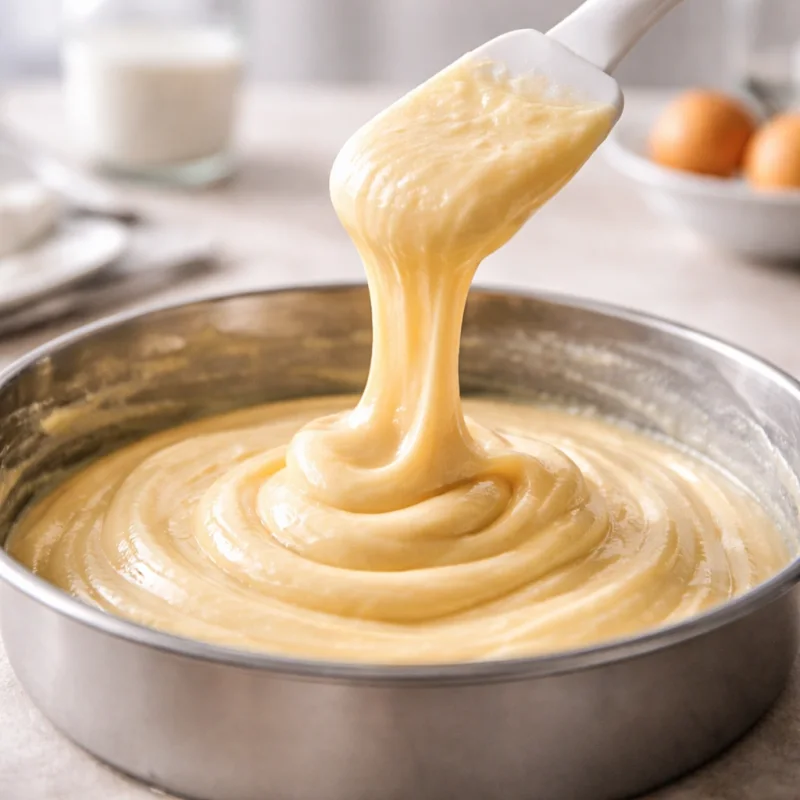
For whole-egg sponge, How to whip eggs and sugar to ribbon stage for sponge cake is a useful checkpoint: the mixture is pale, greatly expanded, and falls in a broad ribbon that stays visible for several seconds.
Foamability and foam stability are different
A foam can initially contain plenty of air and still lose it quickly. Dissolved sugar raises the viscosity of the water phase and can reduce drainage between bubbles.
The more accurate statement is that sugar changes the balance between foamability and foam stability. A higher sugar concentration may slow initial foaming while helping the foam that has formed remain stable for longer.
During baking, sugar delays structural setting
In the oven, gas cells first expand as gases warm and water turns to vapour. A supporting network then has to form through egg-protein setting and starch gelatinization.
Sugar ties up some of the available water and changes the hydration of proteins and starch. This can delay their setting. In a balanced formula, the expanding cells gain more time before the structure locks.
In an unbalanced formula, too much sugar can delay setting too far.
Reducing sugar changes more than sweetness
A substantial sugar reduction changes foam stability, water binding, structural setting, tenderness, and browning.
Large reductions can produce a shorter sponge and a firmer or more rubbery crumb. Treat sugar reduction as a structural formula change rather than a sweetness-only adjustment.
Ribbon stage does not guarantee success after flour is added
Properly whipped eggs and sugar are pale, thick, and greatly expanded. But aggressive folding can still remove much of that incorporated air.
Add flour in portions and fold gently. Some volume loss is normal; a sudden change into thin, fluid batter is not.
This handling is central to Soft, even sponge cake for layer cakes: foam, flour and baking.
Separate sugar problems from other causes
If the mixture lacks volume before flour is added, check whipping, egg temperature, bowl size, and mixer speed.
If volume disappears mainly during folding, mechanical deflation is often more likely than sugar alone.
If the sponge rises and then sinks badly, possible causes include an underbaked centre, too much aeration for the supporting network, or altered ingredient ratios. Compare the symptoms with Why sponge cake sinks after baking: structure, moisture and stability.
After baking, sugar helps retain moisture
Sugar is hygroscopic and holds water. This helps the crumb stay softer and less brittle.
That does not mean more sugar always gives a better sponge. The useful amount is part of the balance among air, water, protein, and starch.
Three PEK control points
Before flour: the egg-sugar mixture has the volume and ribbon required by the method.
During folding: the batter remains visibly aerated and does not suddenly become thin.
After baking: the centre is resilient, with no major crater or wet, rubbery zone.
Frequently asked questions
Answers to common questions
Does sugar create the air in sponge cake?
No. Air is incorporated mainly by whipping the eggs. Sugar changes viscosity and foam stability.
Why beat eggs and sugar to ribbon stage?
Ribbon stage shows a highly aerated, thickened mixture that leaves a visible trail for several seconds.
Does sugar have to dissolve completely?
It depends on the method. Better dissolution supports smoothness and viscosity, but volume and ribbon stage also matter.
Why can a lower-sugar sponge be shorter?
Reducing sugar changes foam stability, water binding, and the temperature at which proteins and starch set.
Is more sugar always better for stability?
No. Higher sugar can improve foam stability but reduce initial foamability and delay structural setting too much.
Why does sponge cake sink even when the foam looked good?
Possible causes include deflation while folding, an underbaked centre, or altered ingredient ratios.