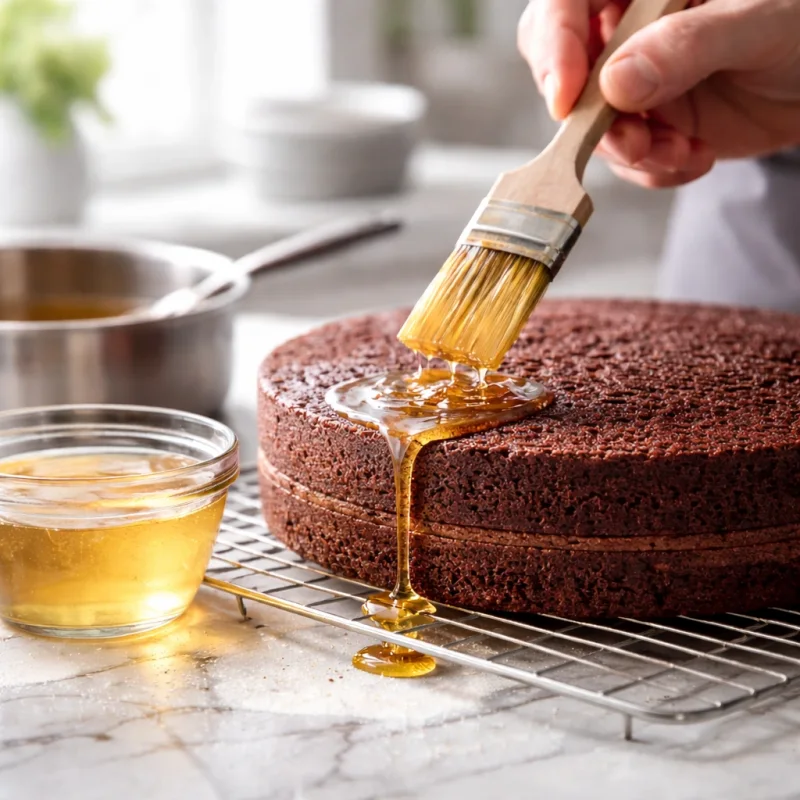
Invert sugar is a formulation tool, not a “better sugar”
Invert sugar is a mixture of glucose and fructose made by hydrolysing sucrose. Pastry chefs use it because it behaves differently from granulated sugar: it interferes with sucrose crystallization, holds moisture strongly, tastes sweeter and lowers the freezing point of water more effectively than sucrose.
That makes it useful in soft cakes, fondants, caramel systems, ganache and ice cream. It does not mean that invert sugar is a universal stabilizer for creams, nor that one percentage works in every recipe.
What invert sugar actually is
Sucrose is a disaccharide built from glucose and fructose. During inversion, that bond is hydrolysed by acid, the enzyme invertase, or a controlled process involving water, time, temperature and pH.
Commercial invert syrup is not necessarily a dry 50:50 mixture. It may still contain water and residual sucrose, so products vary in dry matter, inversion level, sweetness and viscosity. That is why 100 g of one syrup may not behave exactly like 100 g of another.
Four practical effects
1. Crystallization control
Free glucose and fructose disrupt the orderly growth of sucrose crystals. This is valuable in fondant, caramel sauces, fillings and confectionery where coarse graining is a defect.
More is not automatically better. Excess invert sugar can make a product too soft, sticky or overly sweet.
2. Moisture retention
Invert sugar is hygroscopic. In baked goods it can slow drying and help maintain softness; in fillings and ganache it changes how water is held in the system.
This is not the same as simply adding water. Syrup also brings its own water, and its sugars bind water differently from sucrose. A recipe therefore needs rebalancing rather than an extra spoonful on top.
3. Sweetness and browning
Because of its fructose content, invert sugar is generally sweeter than sucrose. Glucose and fructose are reducing sugars, so they can also increase browning reactions during baking.
When part of the sucrose is replaced, monitor colour, baking time, moisture and crumb firmness — not just sweetness.
4. Freezing-point depression
In ice cream and sorbet, glucose and fructose lower the freezing point more strongly by weight than sucrose. Used correctly, invert sugar can produce a softer, more scoopable texture and help reduce large ice crystals.
But frozen desserts are balanced systems. Changing invert sugar also changes sweetness and freezing behaviour, so all sugars must be considered together.
How much should you use?
There is no universal percentage.
Professional suppliers publish different starting ranges for different applications. Some pastry guidance uses roughly 10–15% sucrose replacement as a starting point, while industrial recommendations can be much broader depending on the product.
A better method is to define the problem first: crystallization, staling, frozen hardness or another target. Then check the syrup specification, replace part of the sucrose rather than simply adding more sugar, and rebalance water, sweetness and colour.
If the recipe already contains honey, glucose syrup, fructose or other functional sugars, the calculation changes again.
Cakes and baked goods
Invert sugar can help cakes stay softer for longer, but it does not replace correct aeration, protein setting or starch gelatinization. A collapsed sponge is not repaired by adding invert sugar.
Treat it mainly as a sugar-and-water management tool. If the product becomes sticky or browns too quickly, reassess the replacement level and the liquid balance.
Ganache, fondant and caramel
In ganache and soft fillings, invert sugar is useful for its humectant and anti-crystallization effects. In fondant it can influence sucrose crystal development; in caramel and syrups it helps reduce unwanted recrystallization.
Do not confuse three different problems: smoothness from crystallization control, softness from water balance, and emulsion stability. Invert sugar can support the first two, but it does not fix a broken chocolate emulsion by itself.
Ice cream and sorbet
Invert sugar can noticeably change scoopability because it affects both sweetness and freezing point. If an ice cream is too hard, however, the answer is not automatically “add more invert sugar”.
Review the complete sugar profile, total solids, fat, proteins, stabilizers and serving temperature. Too much invert sugar can make the product too soft or too sweet.
Invert sugar, glucose syrup and honey are not interchangeable
| Ingredient | Main composition | Typical role |
|---|---|---|
| Sucrose | glucose + fructose bound as a disaccharide | base sweetness, solids and structure |
| Invert sugar | free glucose + fructose, often water and some residual sucrose | humectancy, crystallization control, higher sweetness, freezing-point effect |
| Glucose syrup | glucose and shorter carbohydrates from starch | viscosity and crystallization control, sweetness depends on DE |
| Honey | glucose, fructose, water and many minor compounds | some similar functional effects, plus a distinct flavour and variable composition |
A blanket 1:1 substitution rule is therefore unreliable.
Can you make it at home?
Yes. Sucrose can be partially inverted with acid and heat. But the degree of inversion depends on pH, concentration, time and temperature, so a homemade syrup is not automatically equivalent to a standardized commercial product.
For repeatable professional formulas, a syrup with a known specification is easier to control. Fixed instructions such as “always cook for 20 minutes at one temperature” should not be treated as universal chemistry.
Troubleshooting
| Symptom | Likely issue | Check first |
|---|---|---|
| sticky or overly soft cake | too much invert syrup or too much total water | replacement level and liquid balance |
| product browns too fast | more reducing sugars | oven temperature and baking time |
| grainy caramel or fondant | uncontrolled sucrose crystallization | process, crystal contamination and sugar system |
| ice cream too hard | insufficient freezing-point effect in the whole formula | all sugars and total solids |
| ice cream too soft or too sweet | too many monosaccharides or excessive sweetness | rebalance the complete formula |
The rule that matters most
Use invert sugar when you can name the physical property you want to change. It is excellent for crystallization control, moisture retention and frozen texture. It is not a shortcut for a weak cake structure, a broken emulsion or an incorrectly designed gel.
Frequently asked questions
Answers to common questions
What is invert sugar?
It is a glucose-fructose mixture made by hydrolysing sucrose. Commercial syrup may also contain water and residual sucrose.
Why does it reduce crystallization?
Glucose and fructose interfere with the orderly growth of sucrose crystals, helping confectionery and syrups stay smoother.
How much should I use?
There is no universal percentage. Use supplier data and rebalance the complete formula; some pastry guidance uses roughly 10–15% sucrose replacement only as a starting point.
Is it the same as glucose syrup?
No. Glucose syrup comes from starch hydrolysis and has a different carbohydrate profile and sweetness.
Why use it in ice cream?
Its monosaccharides depress the freezing point strongly, but they also increase sweetness, so all sugars must be balanced together.
Can I make invert sugar at home?
Yes. Sucrose can be inverted at home by heating a sugar-and-water syrup under acidic conditions, for example with a small amount of citric acid or lemon juice. But the degree of inversion depends on pH, temperature, time and concentration, so a home-made syrup is not automatically equivalent to a standardized commercial invert sugar. Treat it as a formulation ingredient, not a universal 1:1 sugar substitute.