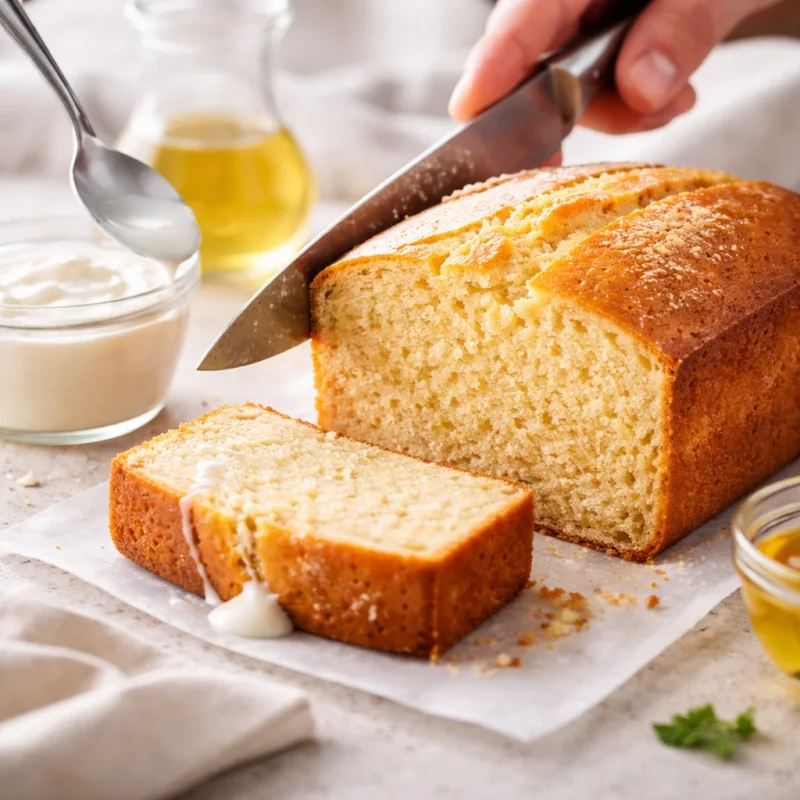
How to keep cake moist when you reduce the sugar
If you want a less sweet cake, the biggest mistake is to remove sugar without adjusting the rest of the system. Sugar is not only a sweetener. In cake batter it helps hold water, tenderize the crumb, influence aeration and browning, and delay staling.
That means a lower-sugar cake can become drier, firmer, paler, or smaller even when every other ingredient stays the same. The solution is not to pour in extra liquid at random. The goal is to rebalance the formula and control baking and storage more carefully.
What sugar actually does in cake
Sugar is hygroscopic: it attracts and holds water. It also affects starch gelatinization and protein setting during baking. In creamed cakes and foamed egg cakes, sugar also contributes to the structure that traps air.
When sugar is reduced, you may see:
- a drier or more crumbly crumb,
- a firmer or rubberier texture,
- less volume,
- a paler crust,
- faster drying the next day.
Sugar can be reduced, but it should not be treated as an ingredient that only changes sweetness.
Two different goals: no extra sugar, or less sugar in the formula
If your goal is simply not to add syrup, glaze, or extra sugar after baking, first improve the baking process and storage. A well-balanced cake often stays moist without any post-bake soaking.
If you want less sugar in the batter itself, you are reformulating the cake. Start with a modest change and test the result. Some cake styles tolerate a moderate reduction better than others; sponge and creamed cakes can be especially sensitive because sugar also supports foam or aeration.
1. Add water only where the structure can hold it
More liquid does not automatically mean a moister cake. Too much water can produce a gummy line, collapse, or a wet crumb if the batter does not have enough starch, protein, fat, or other solids to hold it.
Useful ingredients can include yogurt, sour cream, fruit purée, milk, or other liquid ingredients already compatible with the formula. But each also changes acidity, solids, fat, or naturally occurring sugars. Treat them as formulation changes, not emergency fixes.
2. Oil can keep the crumb softer, but it is not always better than butter
Oil stays fluid after cooling, so oil-based cakes often feel softer and more supple at room temperature. Butter brings flavor and, in a creaming method, helps create air cells.
If a recipe depends on creaming butter with sugar, replacing all the butter with oil changes the mixing mechanism. The right question is not “oil or butter?” but which fat supports the crumb you are trying to build?
3. Keep the emulsion stable
Eggs, fat, and water need to stay evenly dispersed. A split batter distributes water and fat poorly and can bake unevenly.
Use ingredients at compatible temperatures, add eggs or liquids gradually where the method requires it, and stop mixing soon after the flour is incorporated. Overmixing hydrated flour can make the crumb tougher.
4. The last few minutes in the oven often decide whether the cake stays moist
Overbaking is one of the most common reasons a cake turns dry. This matters even more in reduced-sugar cakes because they can brown less. A pale crust does not automatically mean the centre needs more time.
Check the cake before the full recipe time. There should be no raw batter in the centre, but a tester does not always need to come out bone-dry; a few soft crumbs can be appropriate for many cakes.
5. Cooling and storage are part of the formula
Do not seal a steaming-hot cake in an airtight container. Condensation can make the surface wet or sticky.
Let the cake cool as the recipe requires, then protect it from air. Once cool, store it well wrapped or in an airtight container. Cutting many cakes while very hot is also a poor general rule because the crumb is still setting.
Diagnose a dry cake
| Symptom | Likely cause | What to change |
|---|---|---|
| Dry edges, centre is fine | Overbaking or pan too large | Shorten baking time; check pan size |
| Entire crumb is dry and crumbly | Too much flour, too much baking, or too large a sugar cut | Weigh flour; bake less; reduce sugar gradually |
| Gummy crumb | Too much liquid or too much mixing | Rebalance liquid; mix minimally after flour |
| Moist on day one, dry on day two | Poor storage or weak moisture retention | Store airtight once fully cooled |
| Pale but already dry | Less sugar means less browning | Do not extend baking just for colour |
The safest way to reduce sugar
Do not change sugar, fat, liquid, flour, and oven temperature all at once. You will not know which change caused the result.
A better test sequence is:
- decide how much less sweet you want the cake,
- change one variable at a time,
- weigh the ingredients,
- record pan size and baking time,
- compare the crumb on the day of baking and the next day.
Moistness is a system: water, sugar, fat, starch, proteins, air, heat, and storage all work together. Once you control that system, you can make a cake less sweet without relying on a sugary soak to rescue a dry crumb.
Diagnostics
Common problems and solutions
Dry edges, centre is fine
Cause: Overbaking or pan too large.
Solution: Shorten baking and check pan size.
Entire crumb is dry and crumbly
Cause: Too much flour, overbaking, or too large a sugar reduction.
Solution: Weigh flour, bake less, and reduce sugar gradually.
Gummy crumb
Cause: Too much liquid or too much mixing after flour.
Solution: Rebalance liquid and mix minimally.
Soft on day one, dry on day two
Cause: Poor storage or weak moisture retention.
Solution: Store airtight once fully cooled.
Technical terms
Terms worth understanding
- Hygroscopic
- Able to attract and retain water; sugar’s hygroscopicity helps baked goods stay softer.
- Emulsion
- An even dispersion of fat and water in batter that supports a stable crumb.
- Starch gelatinization
- The process in which starch absorbs water and helps set cake structure during heating.
Frequently asked questions
Answers to common questions
Does less sugar make cake drier?
Often, yes. Sugar binds water and tenderizes structure, so a large reduction without other changes can make cake drier or firmer.
Can I fix dryness by adding more milk or water?
Not automatically. Too much liquid can create a gummy crumb or collapse. Liquid must stay balanced with flour, eggs, fat and baking method.
Is oil always better than butter for moisture?
No. Oil often feels softer after cooling, while butter adds flavour and can support aeration in the creaming method. The right choice depends on the formula.
Why is a lower-sugar cake paler?
Less sugar means less browning. A pale cake is not necessarily underbaked.
How do I keep cake moist overnight?
Avoid overbaking, cool it properly, then store it well wrapped or airtight.
What does overmixed batter mean?
Once flour is hydrated, excessive mixing can develop more gluten and make the crumb tougher or denser. Mix only until the flour is incorporated unless the method specifically requires more mixing.