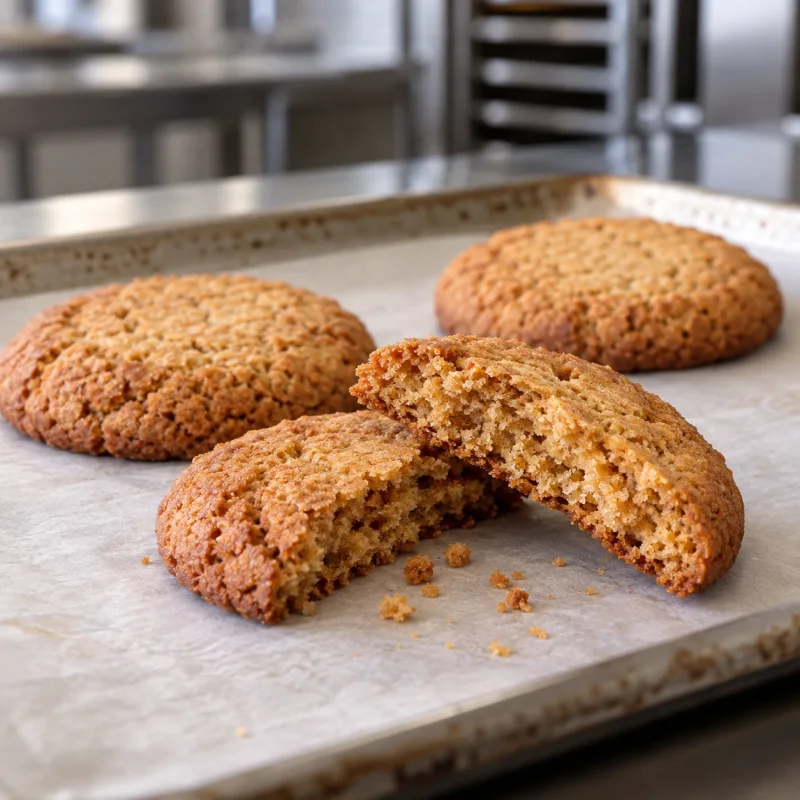
Crispness should reach from the edge to the center
If the edge already snaps but the center still bends, the problem is not simply the absence of egg or dairy butter. Uneven crispness usually comes from uneven dough thickness, too much bound water, or surface browning that outruns moisture loss in the center. In vegan baking, each substitution needs a clear job: binding, moisture control, structure, or controlled spread.
Crispness finishes developing as the cookies cool. While a cookie is hot, sugar is still soft, fat is fluid, and steam is moving out of the center. A cookie that is slightly flexible straight from the oven may turn crisp after 20 minutes on a rack. A wet, glossy center, however, will not magically dry as it cools.
For low-moisture baked goods, water activity matters. The more available water left in the cookie—or later absorbed from humid air—the faster a crisp structure softens.
Use egg replacer to bind the dough, not to trap extra water
Ground flax or chia forms a useful mucilage gel, but that gel also holds water strongly. This is helpful for soft or chewy cookies. In a cookie meant to be crisp throughout, too much gel can keep the center soft. Fruit purées add even more water and generally push the texture toward soft and cake-like. Aquafaba is mostly liquid, so its water must also be counted in the formula.
Do not automatically replace an egg with the same mass of a liquid substitute. Use only enough flax or chia gel to keep the dough together. If the dough still needs liquid, add plant milk in 5 g increments and stop as soon as it binds when pressed.
Proper dough should not look wet or glossy. It should hold its shape without leaving a sticky film on your fingers.
Plant-based fat controls when and how far the dough spreads
Soft vegan spreads often contain more water and soften quickly at room temperature. In formulas designed around solid fat, a vegan block butter around 75–80% fat is usually more repeatable. Fat percentage is not the whole story, though: the balance of saturated and unsaturated fats and the melting range can influence spread as much as total fat.
Liquid oil is not a direct replacement for solid fat in a recipe that depends on creaming fat with sugar. Coconut fat can work, but it changes from solid to liquid over a fairly narrow temperature range, so small differences in dough temperature can produce a large difference in cookie diameter.
Mix the fat and sugar only until homogeneous and slightly lighter. If the mixture becomes soft and shiny, chill it before adding the dry ingredients.
Sugar affects spread, browning, and the final snap
Sugar does more than sweeten. It dissolves in available water, changes when the dough sets, and helps form a thin brittle structure. More sugar or fat often increases spread, but flour, water, and dough temperature still set the limits.
For a crisper result, a larger share of the sweetener can be white granulated sugar. Brown sugar and invert syrups are more hygroscopic, so they hold on to moisture more readily and often produce a softer or chewier center. Do not slash the sugar blindly: too little can create a thick, dry, crumbly cookie instead of a clean crisp snap.
Color is not a reliable moisture gauge. Brown sugar, alkaline leaveners, or a dark pan can brown the surface before the center is dry enough.
Consistent mass and thickness matter more than one exact baking time
Do not bake very different portion sizes on the same sheet. For a first test of a thin round cookie, weigh 20–25 g portions. If the dough does not spread much on its own, flatten each piece to roughly 7–8 mm. Leave at least 5 cm / 2 in between cookies.
If the dough is soft, chill it for 30–60 minutes or until a shaped piece holds its edge under light pressure. Bake one test cookie before committing the full batch. If it stays too tall and soft, flatten the next one a little more. If it spreads into a thin greasy puddle, chill the dough further and make sure the sheet is fully cool before reaching for extra flour.
The baking sheet and oven should dry the center without scorching the bottom
For a basic thin vegan cookie weighing 20–25 g and about 7–8 mm thick, start around 165–175 °C / 329–347 °F in a conventional oven or 155–165 °C / 311–329 °F with convection, usually for 11–15 minutes. These are starting ranges, not universal rules; formula, true oven temperature, sheet material, and target texture all matter.
Use a light-colored, flat metal baking sheet and cool it completely before the next batch. Dark or very thin sheets can brown the bottoms before the centers lose enough moisture. Bake one sheet at a time on the middle rack. If the oven has a pronounced hot spot, rotate the pan 180° after roughly two-thirds of the baking time.
A properly baked crisp cookie has a dry matte top, a set edge, and a center that does not dent under a light touch. The underside should be golden rather than dark brown. If the edge darkens too quickly while the center stays soft, lower the oven by 5–10 °C / 9–18 °F and bake 2–4 minutes longer.
Cooling determines the final break
Leave the cookies on the sheet for 2–3 minutes, then move them to a wire rack so steam can escape from underneath. Judge crispness only after 20–30 minutes of cooling.
Store completely cooled cookies in a dry airtight container. If they soften, place them on a baking sheet, heat for 4–6 minutes at 140 °C / 284 °F, and cool completely on the rack again before storing.
Diagnostics
Common problems and solutions
The edge is dark and hard while the center stays soft and bendable.
Cause: The cookie is too thick, the oven is too hot, or the baking sheet is browning the bottom too aggressively.
Solution: Flatten portions to the same thickness, lower the oven by 5–10 °C / 9–18 °F, and bake 2–4 minutes longer.
The cookies spread into thin, greasy, irregular puddles.
Cause: The vegan fat was too soft, the dough was not chilled enough, or it was placed on a hot sheet.
Solution: Use a firmer block fat, chill the dough until firm, and load every batch onto a fully cooled baking sheet.
The cookies stay thick, dry, crumbly, and barely spread.
Cause: There is too much flour, too little sugar, or not enough liquid to bind the dough.
Solution: Weigh the flour, do not add extra flour while shaping, and add missing liquid in 5 g increments only until the dough holds together.
Cookies brown faster on one side of the sheet.
Cause: The oven has a hot spot or the sheet is not centered.
Solution: Bake one sheet on the middle rack and rotate it 180° after about two-thirds of the baking time.
Crisp cookies soften after storage.
Cause: They were sealed while still warm or absorbed moisture from the air.
Solution: Cool completely on a rack before storing in a dry airtight container.
Technical terms
Terms worth understanding
- Water activity
- A measure of available water in food; more available water makes crisp structures soften more quickly.
- Mucilage gel
- A viscous gel formed by soaking ground flax or chia; it binds dough but also holds water.
- Plastic fat
- A fat that is firm enough to hold shape at working temperature but soft enough to mix evenly into dough.
- Hygroscopicity
- The ability of an ingredient to attract and hold moisture from the dough or surrounding air.
- Maillard reaction
- Browning reactions between sugars and amino acids that create color and aroma but do not prove the cookie center is dry.
Frequently asked questions
Answers to common questions
Can I use coconut oil for crisp vegan cookies?
Yes, but chill the dough evenly before baking. Coconut fat changes from solid to liquid over a relatively narrow temperature range, so bake one test cookie first and check the spread.
Is baking soda or baking powder better for crisp cookies?
Baking soda often encourages spread and browning. Baking powder can produce a thicker cookie in formulas designed for it. Use the leavener the recipe was developed around.
Can I make softened vegan cookies crisp again?
Bake them for 4–6 minutes at 140 °C / 284 °F, then cool completely on a wire rack before storing again.