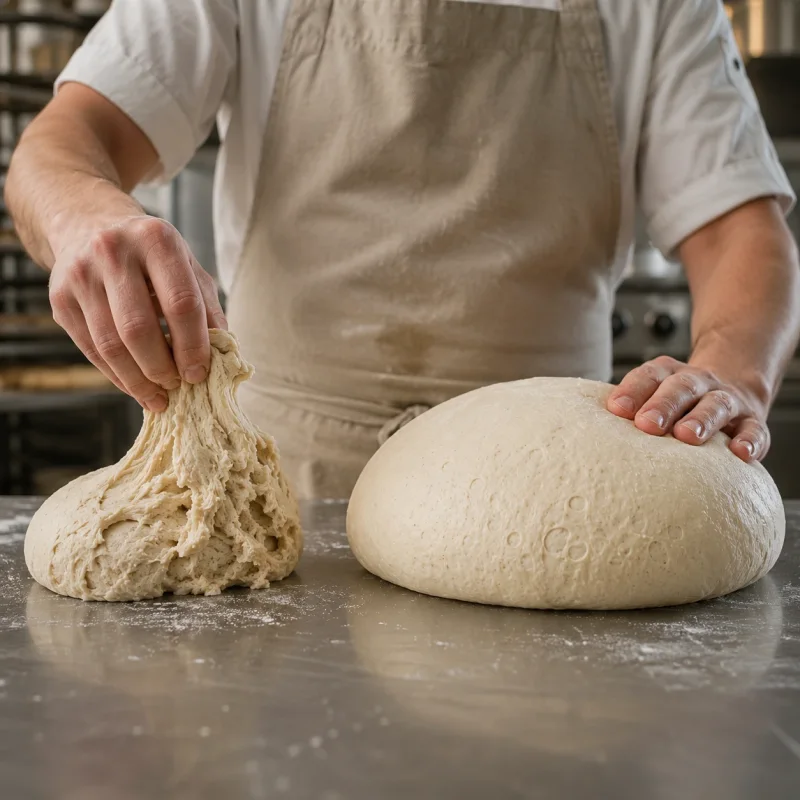
Dough not rising: separate slow fermentation from an actual failure first
If your dough is not rising, do not immediately add more flour, sugar, or another dose of yeast. First work out what the dough is actually doing. Most cases fall into one of three groups: the yeast is producing too little gas, fermentation is simply slow because of temperature or dough composition, or the dough is producing gas but its structure cannot retain it.
For many wheat bread doughs, roughly 24–26°C (75–79°F) after mixing is a useful professional starting range for dough temperature. It is not a universal requirement for every dough, but it is much more informative than the vague instruction to “use warm water.” Water temperature is only one factor; flour temperature, room temperature, and heat generated during mixing all affect the final dough temperature.
Quick diagnosis
| What you see | More likely cause | First action |
|---|---|---|
| The dough is cold and dense but changes slowly over time | low temperature and slow fermentation | move it to a stable, moderately warmer environment and watch its progress |
| At a reasonable temperature there are almost no bubbles or volume change | weak, old, or damaged yeast | check the yeast type, storage, and manufacturer instructions |
| Bubbles are present but the dough spreads and gains little height | the structure is not retaining gas | check mixing, gluten development, and hydration |
| Sweet or enriched dough rises much more slowly than lean dough | the formula is slowing fermentation | follow the dough's signals rather than a fixed clock time |
| The dough is already very inflated, soft, and losing tension | the problem may be overfermentation rather than too little rise | do not simply wait longer; diagnose overproofing and structural breakdown |
1. The dough is too cold, not necessarily “dead”
Yeast responds strongly to temperature. Cold flour, cold liquid, and a cool room can slow fermentation enough that the dough appears unchanged when the recipe's stated time has passed. That does not automatically mean the yeast is inactive.
Do not judge by the clock alone. Compare temperature, volume change, bubble formation, and how the dough feels. If the dough is cold but gradually softening and showing the first signs of gas, a more stable temperature will usually help more than adding extra yeast.
For reliable process control, treat fermentation as a combination of time, temperature, and visible dough development rather than a fixed number of minutes.
2. The yeast is old, damaged, or used incorrectly
If the dough remains almost completely unchanged at a reasonable temperature, check the yeast. Shelf life, storage, and yeast type all matter. Instant dry yeast, active dry yeast, and fresh yeast are not identical products, so the manufacturer's directions take priority over a universal home-baking rule.
Very hot liquid can damage yeast, but one “magic” temperature should not be applied to every product and method. A better practice is to control the final temperature of the complete dough and follow the instructions for the yeast you are actually using.
If you are unsure about the conversion between fresh and dry yeast, do not solve that uncertainty by randomly adding more yeast to a dough that is already mixed. The conversion should be checked separately and matched to the specific yeast type.
3. Sugar, salt, and fat can change the rate of fermentation
Lean bread dough and a sweet, butter-rich dough are not the same fermentation system. Yeast in wheat dough does not need a spoonful of added sugar just to start working; enzymes in the flour make fermentable sugars available during the process.
In very sweet doughs, a high sugar concentration can create osmotic stress and slow standard baker's yeast. A high local concentration of salt can also inhibit yeast activity. Brief ingredient contact during normal mixing is not the same as leaving wet yeast in prolonged contact with highly concentrated salt.
So when enriched dough rises slowly, do not assume that it simply needs more yeast. Check the formula, dough temperature, and yeast type first.
4. The dough produces gas but cannot retain it
Sometimes the yeast is working and the dough still stays low and dense. In that case, the problem is no longer just fermentation; it is the dough's load-bearing structure.
An underdeveloped gluten network, insufficient hydration, or repeatedly adding extra flour can reduce the dough's ability to retain carbon dioxide. The dough may contain small bubbles and smell fermented, yet spread, tear, or lack tension during shaping.
Fix the cause at its source: assess mixing and dough development, elasticity, extensibility, and the water-to-flour balance. Extra yeast cannot repair a structure that fails to hold gas.
5. The poke test is not a universal test for every stage
A common mistake is to use the poke test as an absolute rule for every stage of fermentation. It is most useful on shaped dough during the final proof, and even then the response varies with hydration, flour, shape, and surface tension.
During bulk fermentation, it is better to judge a combination of volume, bubbles, dough tension, and elapsed time at a known temperature. The dough does not have to exactly double in every recipe.
Can you rescue dough that is not rising?
If the dough is simply too cold, you can often rescue it by giving it a more stable environment and more time. If it shows at least some activity, change only one variable at a time and watch the response.
If there are almost no signs of fermentation for a prolonged period at a reasonable temperature and there is good reason to suspect that the yeast was inactive or damaged, starting a fresh batch with reliable yeast is usually more predictable than trying to knead extra yeast, liquid, and flour into a dough system that has already been built.
If the dough rose quickly at first and then became soft or collapsed, the problem is no longer “dough not rising.” At that point, investigate overfermentation and loss of dough strength instead.
PEKI recommends
If the same problem keeps returning, record four things: yeast type, dough temperature after mixing, approximate volume development, and time. That quickly shows whether you need to correct the yeast, temperature, or structure. If you change the yeast amount, flour, water, and temperature all at once, the next result will not tell you what actually fixed the problem.
Diagnostics
Common problems and solutions
The dough is cold and rising very slowly
Cause: The dough or environment is too cold.
Solution: Move it to a more stable, moderately warmer environment and watch progress rather than the clock alone.
At a reasonable temperature there are almost no bubbles or volume change
Cause: The yeast is weak, old, damaged, or used incorrectly.
Solution: Check the yeast type and directions; with completely inactive dough, a fresh batch is often more predictable.
Bubbles are present but the dough stays low or spreads
Cause: The gluten network or hydration is not allowing adequate gas retention.
Solution: Check mixing and structure development; more yeast will not fix this.
Sweet, enriched dough rises much more slowly
Cause: Sugar, fat, and dough composition are slowing fermentation.
Solution: Follow the dough signals and a formula designed for enriched dough.
Frequently asked questions
Answers to common questions
Why is my dough not rising if the yeast is fresh?
Yeast is only one factor. The dough may be too cold, very sweet, or unable to retain gas. Check temperature and signs of activity first.
Can dough rise normally without added sugar?
Yes. Yeast can use sugars that become available as starch in the flour is broken down. Added sugar is not required for wheat bread dough to rise.
Can I just add more yeast to dough that is not rising?
That should not be the first move. If temperature or structure is the problem, extra yeast does not fix the cause. With completely inactive yeast, starting a fresh batch is often more predictable.
Does dough always have to double in size?
No. The target volume depends on the recipe and process stage. Judge progress together with temperature, bubbles, and dough tension.