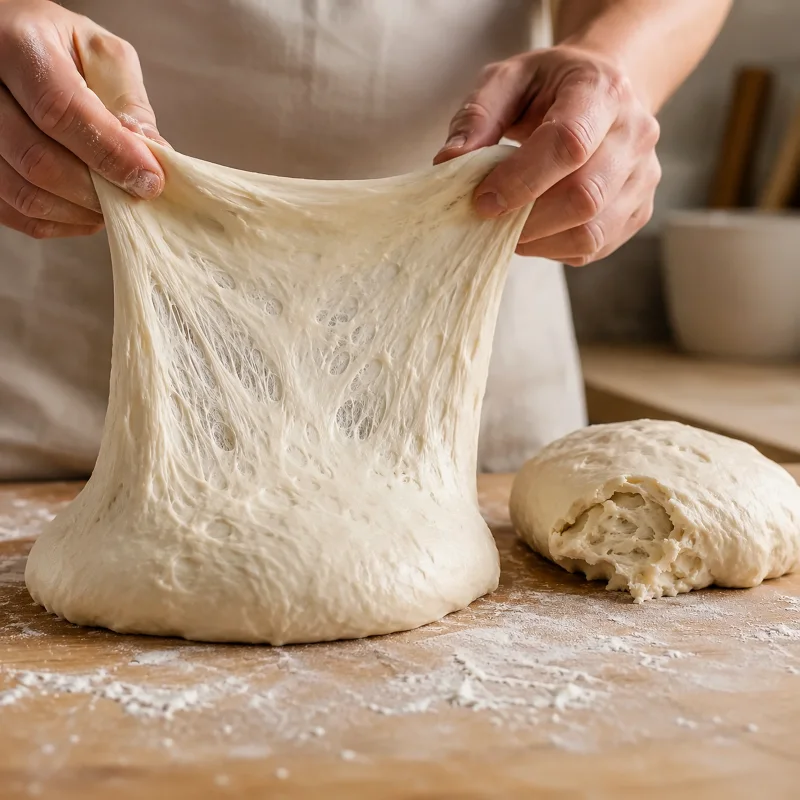
Does yeast need added sugar?
No. Baker's yeast in a normal wheat bread dough does not need a spoonful of added sugar for the dough to rise. Yeast needs fermentable sugars, but those sugars do not have to come from table sugar. During hydration and fermentation, enzymes in flour break down part of the starch and release smaller sugars, especially maltose, that yeast can use.
That is why a lean dough made from flour, water, yeast and salt can ferment normally with no added sucrose. If such a dough rises slowly, check dough temperature, yeast activity, time, salt level and gas retention before changing the formula.
If the dough shows almost no activity, use the diagnostic guide Why dough doesn't rise and stays dense.
Where does yeast get sugar when none is added?
Wheat flour contains starch and natural enzymes. Once flour is mixed with water, amylolytic enzymes begin breaking accessible and damaged starch into smaller carbohydrates. Maltose becomes an important fermentable substrate during bread fermentation.
Yeast converts available sugars mainly into carbon dioxide and ethanol. Carbon dioxide alone does not create an open crumb: the dough must have enough developed and still-stable structure to retain that gas.
This distinction matters: fermentation produces gas; dough structure determines how much of that gas stays in the dough.
What does added sugar actually change?
A small amount of sugar can provide readily available substrate early in fermentation and may change the initial rate. Sugar also changes flavor, water availability and crust browning.
But “more sugar = faster rise” is wrong. At higher concentrations, dissolved sugar increases osmotic pressure and reduces water available to yeast cells. Standard baker's yeast can therefore ferment more slowly in very sweet doughs. Rich sweet doughs use a different balance of time, temperature, yeast and sometimes osmotolerant yeast.
| System | What to expect |
|---|---|
| Lean bread dough without added sugar | fermentation can rely on sugars released from flour; added sugar is not required |
| Sweet or heavily enriched yeast dough | sugar changes water availability, gluten behavior and yeast activity; high levels can slow fermentation |
If dough without sugar rises slowly, check these four things first
1. Dough temperature
Temperature strongly affects fermentation rate, but there is no single ideal number for every flour, yeast level and process. Measure the final dough temperature and compare it with the recipe or method. Cooler dough generally needs more time; very warm dough may progress faster than its structure can remain stable.
2. Yeast activity and dosage
Fresh, active dry and instant yeast are not the same product. When changing form, use the correct conversion and the manufacturer's directions. Do not “repair” a slow dough by guessing at extra yeast. For conversion, see Fresh vs dry yeast: conversion ratios and how to use each.
3. Gas production versus gas retention
Bubbles and a fermenting aroma with little increase in volume often mean yeast is working but the structure is weak. Underdeveloped gluten, unsuitable hydration or rough handling can reduce gas retention.
Hydration is not one universal percentage. The appropriate water level depends on flour, bread style and method. First decide whether the problem is fermentation or the dough's ability to hold gas.
4. Salt, fat and the whole formula
Salt moderates fermentation and affects the gluten network. Fat, eggs and larger amounts of sugar change water availability and dough behavior. A process designed for lean bread should not be copied directly to brioche or another rich dough.
Do not use doubling or the poke test as universal laws
Dough is not ready simply because it has reached one exact volume increase. The target during bulk fermentation depends on flour, hydration, yeast quantity, temperature, shaping and what happens next.
The same applies to the poke test. It can be useful for some shaped doughs, but hydration, flour, temperature and surface tension all affect the response. With wet doughs, a combination of signals is usually more useful: volume progress, bubbles, behavior during folds and the ability to regain some tension after handling.
Do not rely on “always double” or “the dent must spring back halfway” as universal rules. Read several signals together.
Can bread without added sugar brown well?
Yes. Added sucrose is not the only source of compounds involved in browning. Available reducing sugars, proteins, surface temperature, baking time and drying all matter.
Added sugar can intensify browning, so a sweet dough may darken faster at the same oven setting. Lean bread without added sugar can still develop a deeply colored, aromatic crust when fermentation and baking are well controlled.
Quick diagnosis
| What you see | More likely explanation | Check first |
|---|---|---|
| almost no bubbles or growth | weak yeast, cold dough or a strongly inhibitory formula | yeast activity, temperature, salt and formula |
| bubbles but little volume | poor gas retention | gluten development, water level, handling |
| sweet dough rises very slowly | osmotic stress and reduced water availability | sugar level, yeast type, time |
| dough rises fast then weakens | fermentation progressed beyond structural strength | temperature, time, fermentation stage |
| pale bread | not necessarily too little sugar | fermentation and baking profile |
Frequently asked questions
Answers to common questions
Does yeast need sugar?
It needs fermentable sugars, but normal wheat bread dough does not necessarily need added table sugar. Flour enzymes release sugars that yeast can use.
Does a teaspoon of sugar make dough rise faster?
It may affect the early rate in some formulas, but it is not a universal fix. Higher sugar concentrations can slow yeast through osmotic stress.
Why doesn't dough without sugar rise?
Check temperature, yeast activity and dosage, salt, formula and gas retention before assuming the dough needs sugar.
Does dough always have to double?
No. The target depends on the recipe and fermentation stage; use volume together with bubbles and dough strength.