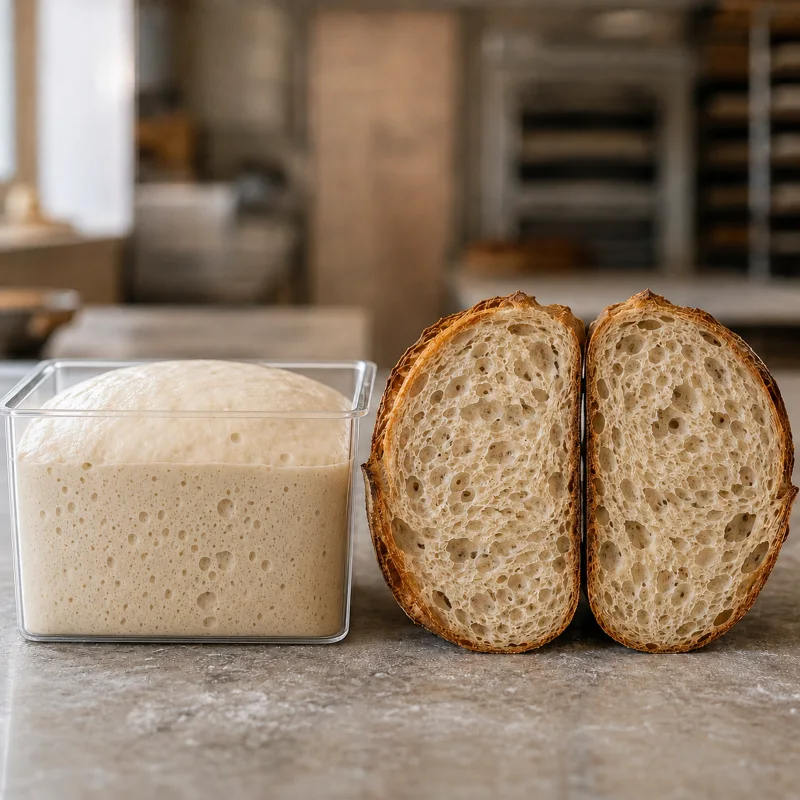
Good bread is a sequence of connected decisions
No single stage of bread making can reliably fix every mistake made earlier. Flour and water first determine the structure the dough can build. Fermentation fills that structure with gas and develops flavor. Shaping redistributes gas and creates surface tension. Baking then sets the soft foam-like structure, while cooling finishes stabilizing the crumb.
For a failed loaf, “When did the dough first start behaving differently from expected?” is usually a better question than “How many minutes should it rise?” Dough that spreads immediately after mixing will not gain missing strength simply from a longer fermentation. Dough that has fermented too far will not recover lost tension because the oven is hotter.
For a recipe-led route, see homemade bread with a soft, airy crumb and crisp crust.
1. Dough structure: first the dough must support itself
In wheat dough, water hydrates flour proteins while mixing, rest and folds help develop the gluten network. Its key job is not simply to make dough elastic, but to hold the gas produced later during fermentation.
Hydration is useful, but the number alone does not tell you whether the dough is right. Different flours absorb different amounts of water, and whole grain, salt, fat and sugar change how a dough behaves. A more useful sign is whether the dough becomes more cohesive, smoother and better able to hold shape after rest and folds.
2. Fermentation: target the dough state, not the clock
Fermentation speed changes with dough temperature, the amount and activity of yeast or starter, flour, hydration, salt, sugar and fat. Recipe time is therefore a framework, not a universal finish line.
Read several signals together: volume increase, bubbles, internal aeration, elasticity and whether the dough still has enough strength to stay coherent when moved. For repeatability, record dough temperature, the state at the end of bulk fermentation and how the dough felt during folds.
3. Shaping: preserve gas while building surface tension
Well-fermented dough is not automatically a well-shaped loaf. Shaping redistributes large gas pockets and builds a taut outer skin that helps the loaf expand upward instead of only outward.
Too little tension leads to spreading; overly aggressive shaping can expel too much gas. Properly shaped dough feels taut without tearing, keeps a smooth surface and retains some of the aeration created during fermentation.
4. Final proof: balance gas with remaining strength
Before baking, dough needs enough gas for an open crumb while retaining enough elastic reserve for oven spring. Underproofed dough is often tight and dense; overproofed dough becomes more fragile and may lose height during handling or scoring.
The poke test is only one clue. Interpret it alongside volume, surface tension, dough temperature and how the loaf behaves when moved.
5. Baking: set the structure at the right time
During the first part of baking, gases and water vapor expand before proteins and starches progressively set the crumb. Steam helps many loaves keep the surface extensible early on; later, moisture needs to escape so the crust can dry and firm.
There is no single correct temperature and time for every loaf. Size, formula and ingredients change heating and browning. A dark crust alone does not prove that the center is fully set.
6. Cooling is part of the process
After bread leaves the oven, moisture continues to redistribute and crumb structure keeps stabilizing. Slicing very hot bread can compress the crumb and make it seem gummy even when it was adequately baked. Cool on a rack so air can circulate underneath.
Diagnose the stage where the problem first appeared
If the dough is weak before fermentation, start with flour, water and structure development. If it expands strongly but loses support during bulk fermentation, examine fermentation progress. If it holds shape after shaping but spreads before baking, final proof is more likely the issue. If a stable loaf enters the oven and the result still has poor crust, oven spring or crumb stability, focus on heat, steam and bake progression.
Find the problem where it first appears, not only where you finally notice it.
Diagnostics
Common problems and solutions
The dough still spreads quickly after mixing and several rests.
Cause: The flour may be carrying too much water or the structure is still underdeveloped.
Solution: Hold back some water on the next bake and watch whether rest and folds build support; if they do not, reduce hydration.
The dough expands strongly during fermentation, then becomes slack.
Cause: Fermentation has progressed further than the structure can support.
Solution: End bulk earlier or slow the process and compare both volume and dough strength, not time alone.
The shaped loaf looks good but spreads before baking.
Cause: Final proof has gone too far or initial surface tension was too low.
Solution: Check whether the loaf holds height immediately after shaping; if it loses height only later, shorten final proof.
The loaf bursts at the side and has a denser lower crumb.
Cause: The dough may be underproofed or scoring did not provide a controlled expansion path.
Solution: Read multiple maturity signals and score appropriately; do not extend fermentation only by the clock.
The crust is dark but the crumb remains gummy when sliced.
Cause: The surface heated faster than the center or the loaf was sliced while too hot.
Solution: Check loaf size, actual oven temperature and bake time, then cool the loaf sufficiently before slicing.
Technical terms
Terms worth understanding
- Hydration
- The ratio of water weight to flour weight, with flour defined as 100%. The number describes the formula, not dough quality by itself.
- Gluten network
- The connected protein structure in wheat dough that enables stretching and gas retention.
- Bulk fermentation
- The stage between mixing and shaping when dough develops gas, flavor and internal aeration.
- Final proof
- Fermentation of shaped dough before baking, building gas while preserving enough structural strength.
- Oven spring
- The initial increase in loaf volume in the oven before crumb structure fully sets.
- Surface tension
- The taut outer skin of shaped dough that helps retain form and direct expansion.
Frequently asked questions
Answers to common questions
What matters most in the bread-baking process?
The stages need to work together: build structure, ferment appropriately, preserve gas during shaping, and set the crumb in the oven.
Must dough always double during bulk fermentation?
No. The target depends on formula, temperature, flour and the next steps. Read volume together with bubbles, aeration and remaining strength.
Is the poke test enough to judge final proof?
No. It is a supporting signal that should be combined with temperature, volume, surface tension and how the loaf behaves when moved.
Why can well-fermented bread still spread in the oven?
Possible causes include weak surface tension, excessive final proof or structure setting too slowly at the start of the bake.
When is the oven really the problem?
When the loaf holds shape and appears appropriately fermented before baking but repeatedly has poor oven spring, crust or crumb stability. Then check actual temperature, steam, rack position and bake time.