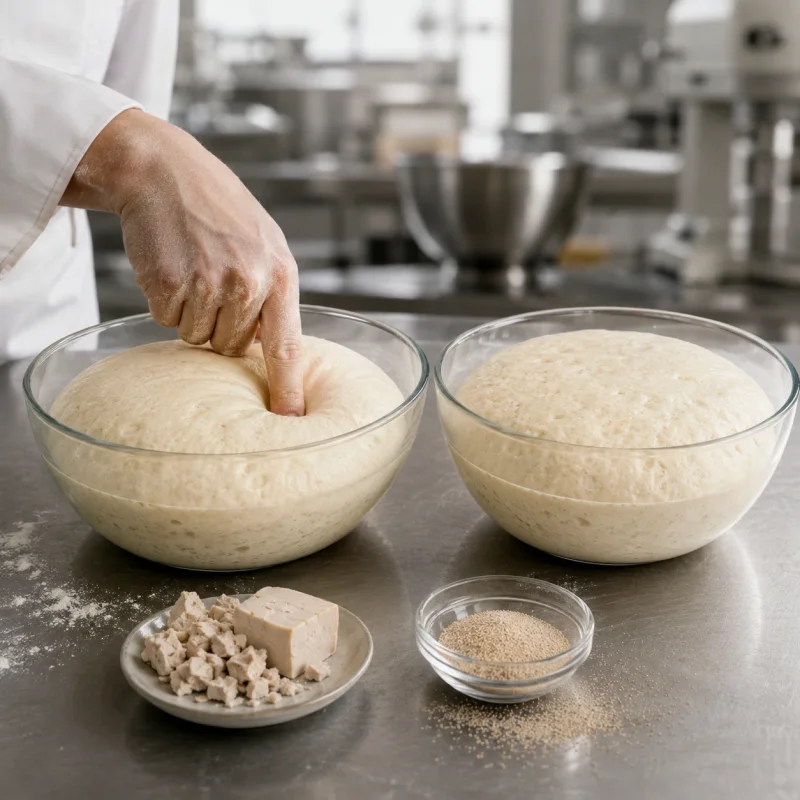
Fresh-to-dry yeast conversion is not one universal 3:1 rule
First identify which dry yeast you actually have
If a recipe calls for fresh yeast and you only have dry yeast, one detail matters most: instant yeast and active dry yeast are not the same product in every market. That is why “use one-third as much dry yeast” is not precise enough for every package.
Useful starting points by weight are:
- fresh yeast → instant yeast: multiply the fresh yeast by about 0.33;
- fresh yeast → active dry yeast: multiply the fresh yeast by about 0.40 as a professional general guideline;
- if the manufacturer gives a different conversion, follow the product instructions first.
So 21 g fresh yeast is about 7 g instant yeast, while a general professional starting point for active dry yeast is about 8–9 g. English-language markets add another complication: packet or sachet sizes vary, and terms such as fresh, cake, compressed, instant, fast-action and active dry yeast are not used identically everywhere. For reliable conversion, use grams and the yeast type, not the packet count.
The biggest mistake is swapping fresh and dry yeast gram for gram. If a formula calls for 30 g fresh yeast, 30 g dry yeast will not make the dough three times better; it will make fermentation much harder to control.
Quick yeast conversion table
How much dry yeast replaces fresh yeast?
| Fresh yeast | Instant yeast, approx. | Active dry yeast, approx. |
|---|---|---|
| 10 g | 3.3 g | 4 g |
| 15 g | 5 g | 6 g |
| 20 g | 6.6 g | 8 g |
| 21 g | 7 g | 8.4 g |
| 30 g | 10 g | 12 g |
| 42 g | 14 g | 16.8 g |
The same logic works in reverse. 7 g instant yeast is roughly equivalent to 21 g fresh yeast; 7 g active dry yeast corresponds to roughly 17–18 g fresh yeast using the 0.40 guideline. These are practical starting points, not perfect biological equivalence across every brand.
For long fermentation, do not determine the total yeast dose from this table alone. Time, dough temperature and yeast quantity work together. Yeast produces gas, but final volume also depends on the dough's ability to retain it.
Instant yeast vs active dry yeast: the distinction matters
The old rule that active dry yeast must always be dissolved first is no longer universal
Instant yeast is designed to mix directly with flour and is convenient for bread, pizza, focaccia and long-fermented doughs. It is also easy to weigh accurately at very small doses.
Active dry yeast was traditionally rehydrated before mixing. Modern products vary, and some formulations can be added directly to the dry ingredients. The safer rule is therefore: follow the instructions for the specific product you are using.
If you want to check older or previously opened dry yeast, testing it in a small amount of liquid can be useful. Foam alone is not a measure of dough quality; it mainly shows that the yeast has activity. If the dough stays dense despite active yeast, also check temperature, hydration and gluten development.
Fresh yeast is not automatically better or faster
At the correct dose, both perform the same core job
Fresh yeast is moist, soft and highly perishable. Dry yeast contains much less water, so it is more concentrated by weight and more stable in storage. That does not mean fresh yeast always tastes better or dry yeast always rises faster.
Fermentation speed is influenced mainly by:
- the actual amount of active yeast,
- dough temperature,
- dough composition,
- salt and sugar levels,
- time,
- yeast age and storage conditions.
When dose and process are matched correctly, both fresh and dry yeast can produce excellent dough. The choice is mostly about precision, storage and process control, not a quality hierarchy.
For long-fermented pizza and bread, instant yeast is often practical because very small quantities can be weighed accurately. For shorter home fermentations, fresh yeast is equally valid when it is fresh and correctly dosed.
Do not chase one universal water temperature
The dough temperature after mixing matters more
Advice such as “always dissolve yeast in lukewarm water” is too simplistic. In a warm kitchen, that water may already be too warm; in winter it may be appropriate. Mixing and kneading also add heat to the dough.
For typical yeasted wheat doughs, around 24–26 °C / 75–78 °F at the end of mixing is a useful professional starting range. It is not a magic number, but a range in which fermentation is often easier to control.
Adjust water temperature to account for:
- flour temperature,
- room temperature,
- mixing method and duration,
- preferment temperature, if used.
In summer the correct water may be surprisingly cool. In winter it may need to be warmer. The goal is not “warm water for yeast” but the desired final dough temperature.
For long fermentation, reduce the yeast dose
More yeast does not mean more flavour
If dough ferments for 12, 24 or more hours, a yeast dose intended for a one-hour rise is the wrong starting point. More time allows much less yeast while still achieving good volume.
With 500 g flour, the appropriate dose for a short room-temperature fermentation can be very different from an overnight cold fermentation. That is why “how much yeast for 500 g flour?” has no single correct answer without time and temperature.
For long fermentation, judge the dough itself. It should be visibly aerated while still holding shape and surface tension. If it becomes very loose, sticky and spreads, the main problem is no longer the yeast type but fermentation that has gone too far.
Basic bread dough does not need added sugar to rise
Yeast in bread does not depend on a spoonful of sugar
A basic dough made from flour, water, salt and yeast can ferment normally without added sugar. Enzymes in flour make fermentable sugars available during the process, so a spoonful of sugar is not a required “starter” for yeast.
Sweet and enriched doughs are different. High sugar levels bind water and can slow fermentation; very rich formulas may use osmotolerant yeast. For ordinary bread or pizza, however, sugar does not fix old yeast, incorrect dosing or dough that is too cold.
Why does dough behave differently after switching yeast?
Separate an actual error from a normal change in speed
The dough rises too quickly and loses strength. First check whether you used the correct factor for the dry yeast type, then check dough temperature. Excess yeast and excessive temperature compound each other.
The dough barely rises. Check the yeast date and storage, then the dough temperature. If the yeast is active, the problem may also be a very stiff dough, poor gluten development or a very cold environment.
The dough has a strong yeasty smell. This is not proof that dry yeast is inferior. It more often means the yeast dose is too high for the fermentation time and temperature.
The dough rises strongly and then collapses. Fermentation has probably outrun the dough structure. Next time reduce the dose, temperature or fermentation time. Do not try to fix over-fermented dough by adding more flour.
Pizza dough tears. Yeast type is often only a secondary factor. Check gluten development, relaxation after dividing and the degree of fermentation.
PEKI recommend: change only one variable when switching yeast
If you want to know what actually caused the difference, keep the recipe, hydration, temperature and time the same and change only the yeast form using the correct conversion. Then you are comparing yeast, not five process changes at once.
The most useful rule is simple: identify the dry yeast type first, convert it by weight, and then judge the dough by its development rather than by the clock alone.
Diagnostics
Common problems and solutions
Dough rises much too quickly after switching from fresh to dry yeast and loses strength.
Cause: The dry yeast dose is too high, or excessive dough temperature is compounding the over-dose.
Solution: Check the dry yeast type and conversion; next time reduce the dose or dough temperature.
Dough barely rises after switching yeast.
Cause: Yeast may be old or poorly stored, dough too cold, dose too low, or gluten structure too weak to retain gas.
Solution: Check date, storage instructions, dough temperature and gluten development; test older yeast if needed.
A strong yeasty smell remains after baking.
Cause: Too much yeast for the fermentation time and temperature, or fermentation was forced too quickly.
Solution: Reduce the dose and ferment longer at a more stable lower temperature.
Active dry yeast was mixed directly into flour and the dough still rises normally.
Cause: The modern formulation may not require mandatory pre-hydration.
Solution: If the manufacturer permits direct use and the result is good, there is no need to change the process.
Technical terms
Terms worth understanding
- Fresh yeast
- Moist compressed baker’s yeast with a high water content and short shelf life; also called cake or compressed yeast in some markets.
- Instant yeast
- Finely dried baker’s yeast intended mainly for direct mixing with flour; about ×0.33 of fresh yeast is a useful conversion starting point.
- Active dry yeast
- Dry yeast with a different granulation and production process; product directions vary, while about ×0.40 of fresh yeast is a general professional starting point.
- DDT / desired dough temperature
- The target dough temperature at the end of mixing, used to stabilise fermentation speed across changing ingredient and room conditions.
Frequently asked questions
Answers to common questions
How much dry yeast should I use instead of fresh yeast?
For instant yeast, fresh ×0.33 is a useful starting point. For active dry, a general professional guideline is about ×0.40. Manufacturer instructions take priority.
7 g dry yeast equals how much fresh yeast?
If it is 7 g instant yeast, about 21 g fresh yeast. If it is active dry, the 0.40 guideline gives roughly 17–18 g fresh yeast.
Do I always have to dissolve active dry yeast in water?
Not necessarily. Many modern products can be mixed directly with dry ingredients. Follow the instructions for the specific product.
Which yeast is better for pizza?
Instant yeast is convenient for long fermentation because very small quantities are easy to weigh. Fresh yeast can perform just as well when dose, time and temperature are matched.
Does the water for yeast always need to be lukewarm?
No. The desired final dough temperature matters more; adjust water temperature to the actual mixing conditions.
Does bread dough rise worse without sugar?
No. Basic bread and pizza dough can ferment normally without added sugar. Sugar does not fix old yeast, a wrong dose or dough that is too cold.