Egg whites won’t stiffen: causes and how to whip them correctly
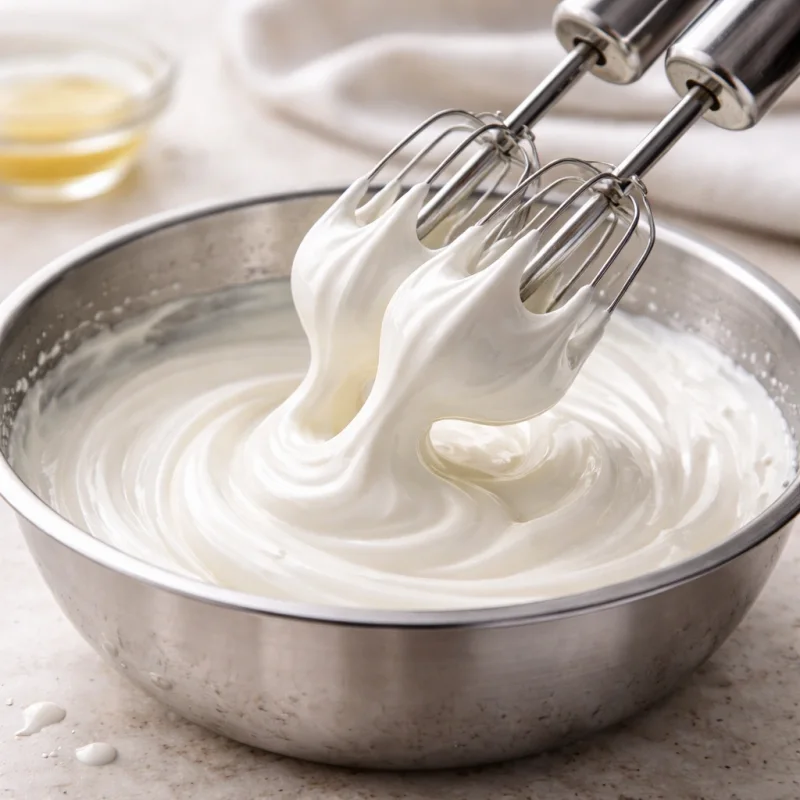
If egg whites will not foam or stiffen, first check for yolk or grease on the whites, bowl and beaters. Whip only to the stage the recipe needs: stiff peaks should stand while the foam remains smooth and glossy. A dull, dry, grainy or clumpy foam is overbeaten.
whites stay liquid
Grease or yolk may be interfering with foaming. If contamination is clear, start with fresh whites and completely clean equipment. Separate eggs one at a time.
soft peaks → glossy stiff peaks
Start with control and watch the transition from fine foam to soft and stiff peaks. The stiffest possible foam is not always the best foam; stop at the structure needed for the next step.
Foam is dull, dry and grainy.
The whites are overbeaten. For a mild case, add a little fresh unbeaten white and mix very briefly on low; if liquid has separated, restart. Check every few seconds near the target stage.
sugar
For French meringue, add sugar gradually after a foam has formed. Acid can make foam more tolerant but cannot repair greasy equipment. Salt is not a reliable universal foam stabilizer.
Good foam collapses during folding.
The base is too thick, foam too stiff or folding too aggressive. Lighten the base with a small portion first, then fold in the rest gently. Do not whip to a dry grainy stage.
Diagnostics
Common problems and solutions
Whites remain liquid.
Cause: Grease or yolk may be interfering with foaming.
Solution: If contamination is clear, start with fresh whites and completely clean equipment.
Foam is large-bubbled and weeps.
Cause: Bubbles are too coarse or the foam stood too long.
Solution: Use immediately if still suitable; next time start more moderately.
Foam is dull, dry and grainy.
Cause: The whites are overbeaten.
Solution: For a mild case, add a little fresh unbeaten white and mix very briefly on low; if liquid has separated, restart.
Meringue is firm but sugar feels gritty.
Cause: Sugar has not dissolved enough or was added too quickly.
Solution: Continue according to the formula until smooth and add sugar more gradually next time.
Good foam collapses during folding.
Cause: The base is too thick, foam too stiff or folding too aggressive.
Solution: Lighten the base with a small portion first, then fold in the rest gently.
Technical terms
Terms worth understanding
- Soft peaks
- The foam holds a peak but its tip bends over.
- Stiff peaks
- The peak stands while the foam remains smooth, glossy and flexible.
- Overbeaten egg white
- Dull, grainy or clumpy foam that may begin to release liquid.
- Ovotransferrin
- An egg-white protein that can interact with copper ions and affect foam stability.
- Folding
- Gently combining foam with a thicker mixture to retain as many air bubbles as possible.
Frequently asked questions
Answers to common questions
Why won't egg whites stiffen?
First check for yolk or grease on the whites and equipment, then review whipping speed and duration.
Must egg whites be room temperature?
No. Cold eggs are easier to separate; for greater volume, separated whites can stand about 20–30 minutes before whipping.
When should I add sugar?
For French meringue, add it gradually after an even foam has formed. Swiss and Italian methods follow different processes.
Does salt help egg whites whip?
Salt is not a reliable universal stabilizer. Use it for flavor if the recipe calls for it.
How do I know the whites are overbeaten?
They lose gloss, become dry, grainy or clumpy and may begin to release liquid.
Can overbeaten whites be rescued?
If only slightly dry, a little fresh unbeaten white and very brief low-speed mixing may help; restart if strongly separated.
Is a copper bowl necessary?
No. Copper ions can increase stability, but clean stainless steel or glass and correct technique are sufficient.
Why does whipped egg white collapse in batter?
A very thick base, overly stiff foam or prolonged aggressive folding are common causes.