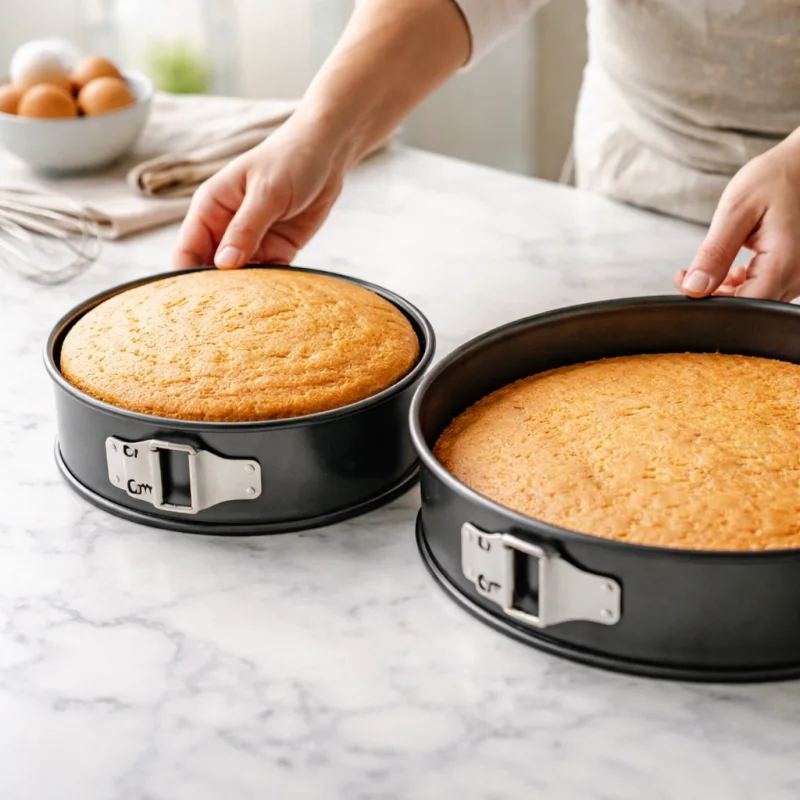
Why the same batter makes a shorter cake in a larger pan
Pour the batter intended for an 18 cm pan into a 24 cm pan without changing the recipe and it spreads over much more area. A 24 cm round has about 1.78 times the base area of an 18 cm round, so the batter is shallower before it even enters the oven.
For a similar layer height in ordinary round cakes, use the area ratio: scale factor = new diameter² ÷ old diameter². Moving from 18 to 24 cm gives about 1.78, so scale all ingredients by the same factor. See how to scale a cake recipe for a different pan size and the worked 18 cm to 24 cm example.
Batter depth matters more than diameter alone
The goal is to keep the raw batter at roughly the same depth as in the original recipe. If you do not increase the batter, the wider layer is thinner, usually reaches doneness earlier, and can dry out if baked for the same time as the deeper original.
This is not a universal conversion for chiffon, angel food, cheesecake or specialty pans. In those cakes, pan design and cooling method can be part of the structure.
Do not lower the oven temperature automatically
A larger diameter alone is not a reason to drop the oven by 5–10 °C. If you scaled the recipe by area and preserved similar batter depth, start with the temperature specified by the tested recipe. Then judge timing and any adjustment from the actual depth, pan material and oven behaviour.
If you keep the original batter amount, start checking the thinner cake earlier. If the edges brown before the centre sets, first check batter depth, pan colour/material and actual oven temperature rather than applying a fixed rule.
Extra leavening does not replace missing batter
A cake that is short because the pan is wider is primarily a geometry problem. More baking powder cannot restore the missing amount of batter and can damage flavour or structure. If shape changes too, use the guide to convert a round pan to a square pan.
More filling cannot restore cake-layer structure
A thicker filling can make the assembled cake taller, but it does not restore the support or cake-to-filling ratio of a properly sized layer. This matters even more for a tiered cake, where every tier needs its own stable structure.
PEKI recommend solving pan geometry and batter depth first. Only then fine-tune bake time and oven settings from the way the specific cake actually bakes.
Diagnostics
Common problems and solutions
Problem
Problem
Problem
Technical terms
Terms worth understanding
- Pan-area factor
- Ratio of target to original pan base area; for round pans it is the ratio of squared diameters.
- Batter depth
- Height of raw batter in the pan before baking.
- Usable pan capacity
- Amount of batter a pan can safely hold while leaving room to rise.
- Crumb setting
- The cake structure becoming firm enough to support itself during baking.
- Recipe scaling
- Proportional adjustment of all ingredients for a different pan size.
Frequently asked questions
Answers to common questions
Why is the same cake shorter in a larger pan?
Because the same batter spreads over more base area and is shallower before baking.
How much more batter do I need from 18 cm to 24 cm?
For similar depth, use (24 ÷ 18)² ≈ 1.78 and scale every ingredient by the same factor.
Should I always lower the temperature in a larger pan?
No. Diameter alone is not a reason; start with the tested recipe temperature when batter depth is comparable.
Does a cake in a larger pan always take longer?
No. The same amount becomes thinner and may bake sooner; scaled batter depends on actual depth, pan and oven.
Can extra filling make up for a short cake layer?
It can increase assembled height, but it does not restore the support and cake-to-filling ratio of a properly sized layer.